Abstract Algebra (8): Galois Theory — The Bridge Between Fields and Groups
The Fundamental Theorem of Galois Theory establishes a perfect correspondence between intermediate fields and subgroups — and settles the ancient question of solvability by radicals.
In 1832, a twenty-year-old mathematician named Evariste Galois, on the eve of a duel he would not survive, wrote down the final versions of his mathematical ideas in a letter to a friend. Those ideas — connecting the symmetries of polynomial roots to the structure of groups — would take more than a decade to be understood and published, but they would reshape algebra forever. Galois theory, as we now call it, establishes a precise dictionary between intermediate fields of a field extension and subgroups of a group of symmetries. It explains, in one elegant framework, why the quadratic formula exists, why there is no analogous formula for degree five, and what “solvability” really means.
What I find astonishing about Galois’s idea is the direction of the abstraction. He did not study polynomials by computing their roots more cleverly. He studied them by ignoring the roots entirely and instead analyzing the permutations of those roots that preserve all algebraic relations among them. The set of such permutations forms a group, and the structure of that group tells you everything you wanted to know about the original polynomial. It is a complete change of subject — from numbers to groups — that nevertheless answers the original question. This article walks through that change of subject in detail.

The Galois Group: Automorphisms Fixing the Base Field#

Given a field extension $L/K$ , an automorphism of $L$ over $K$ is a field isomorphism $\sigma : L \to L$ such that $\sigma(a) = a$ for every $a \in K$ . The collection of all such automorphisms forms a group under composition, called the Galois group of $L/K$ :
$$\mathrm{Gal}(L/K) = \mathrm{Aut}_K(L) = \{\sigma : L \to L \mid \sigma \text{ is a field automorphism},\ \sigma|_K = \mathrm{id}\}.$$The key insight is that automorphisms of $L$ that fix $K$ permute the roots of any polynomial in $K[x]$ . If $f(x) \in K[x]$ and $f(\alpha) = 0$ for some $\alpha \in L$ , then applying $\sigma \in \mathrm{Gal}(L/K)$ to both sides:
$$0 = \sigma(0) = \sigma(f(\alpha)) = f(\sigma(\alpha)),$$since $\sigma$ fixes the coefficients of $f$ . So $\sigma(\alpha)$ is also a root of $f$ . The Galois group acts on the roots of $f$ by permutation, and that action is faithful when $L$ is a splitting field — once you know what $\sigma$ does to the roots, you know $\sigma$ everywhere.

Example ($\mathbb{Q}(\sqrt{2})/\mathbb{Q}$ ). Any $\sigma \in \mathrm{Gal}(\mathbb{Q}(\sqrt{2})/\mathbb{Q})$ must send $\sqrt{2}$ to a root of $x^2 - 2$ , namely $\pm\sqrt{2}$ . So there are exactly two automorphisms: the identity and $\sigma(\sqrt{2}) = -\sqrt{2}$ . The Galois group is $\mathbb{Z}/2\mathbb{Z}$ .
Note: $\sigma$ is determined by its action on $\sqrt{2}$ , since every element of $\mathbb{Q}(\sqrt{2})$ has the form $a + b\sqrt{2}$ with $a, b \in \mathbb{Q}$ , and $\sigma(a + b\sqrt{2}) = a + b\sigma(\sqrt{2})$ . The arithmetic identity that survives sign-flip is exactly $(a+b\sqrt{2})(a-b\sqrt{2}) = a^2 - 2b^2$ — the norm — which is automatically $\mathbb{Q}$ -valued and Galois-invariant.
Example ($\mathbb{Q}(\sqrt{2}, \sqrt{3})/\mathbb{Q}$ ). Let $L = \mathbb{Q}(\sqrt{2}, \sqrt{3})$ . An automorphism $\sigma$ fixing $\mathbb{Q}$ sends $\sqrt{2} \mapsto \pm\sqrt{2}$ and $\sqrt{3} \mapsto \pm\sqrt{3}$ independently, giving four automorphisms: identity, $\sqrt{2} \mapsto -\sqrt{2}$ , $\sqrt{3} \mapsto -\sqrt{3}$ , and the product. The Galois group is $\mathbb{Z}/2 \times \mathbb{Z}/2$ , the Klein four-group $V_4$ . And $|\mathrm{Gal}(L/\mathbb{Q})| = 4 = [L:\mathbb{Q}]$ , matching the degree.
Example ($\mathbb{Q}(\sqrt[3]{2})/\mathbb{Q}$ ). The minimal polynomial $x^3 - 2$ has only one real root, $\sqrt[3]{2}$ , while the other two are complex. Any $\sigma : \mathbb{Q}(\sqrt[3]{2}) \to \mathbb{Q}(\sqrt[3]{2})$ must send $\sqrt[3]{2}$ to a root of $x^3 - 2$ inside $\mathbb{Q}(\sqrt[3]{2}) \subset \mathbb{R}$ . Only one such root exists. So $\sigma = \mathrm{id}$ and $\mathrm{Gal}(\mathbb{Q}(\sqrt[3]{2})/\mathbb{Q})$ is trivial. Yet $[\mathbb{Q}(\sqrt[3]{2}):\mathbb{Q}] = 3 \neq 1$ .
This is the punchline of separability and normality from the previous article: the equality $|\mathrm{Gal}(L/K)| = [L:K]$ holds exactly for Galois extensions. Here $\mathbb{Q}(\sqrt[3]{2})/\mathbb{Q}$ fails normality (the extension is not a splitting field), and the group collapses.
Theorem. A finite extension $L/K$ is Galois iff $|\mathrm{Gal}(L/K)| = [L:K]$ .
This is one of those equivalences whose two halves are both useful: in one direction it lets us check the Galois condition by counting automorphisms, in the other it lets us verify that we have found all automorphisms by checking the count against the degree.
It also lines up with the abstract definition of “Galois” via separability + normality. A separable extension has at most $[L:K]$ embeddings into the algebraic closure (by counting roots of minimal polynomials, all distinct); a normal extension has those embeddings actually land back in $L$ (rather than escaping to the algebraic closure); so a Galois extension has exactly $[L:K]$ automorphisms — none missing, none extra. The “embedding count = degree” identity is exactly the equality $|\mathrm{Gal}(L/K)| = [L:K]$ in disguise.
Why this matters. The Galois group is a small, finite, computable object that nevertheless captures the entire content of a field extension. Group theory has a 200-year head start of structural results — Sylow theorems, simple groups classification, representation theory — and Galois theory lets us pull all of it into the study of polynomial roots. That trade is worth essentially everything we paid in Part 7 to set up the machinery.
There is a useful conceptual reframing here. The Galois group is the automorphism group of the polynomial $f$ , in a sense made precise by the action on the roots. We could equivalently define $\mathrm{Gal}(f)$ as the subgroup of $S_n$ (where $n = \deg f$ ) consisting of those permutations of the roots that respect every algebraic relation among them. The “respect every algebraic relation” clause is what makes the definition non-trivial — without it, every permutation would be an automorphism, and the Galois group would always be $S_n$ . The fact that some permutations do not extend to field automorphisms is exactly the information you exploit when computing the group.
A small worked check. For $f(x) = x^4 + 1$ (the eighth cyclotomic polynomial), the four roots are $\zeta_8, \zeta_8^3, \zeta_8^5, \zeta_8^7$ , the primitive eighth roots of unity. There is an algebraic relation $\zeta_8^3 = \zeta_8 \cdot \zeta_8^2 = \zeta_8 \cdot i$ , and another $\zeta_8 + \zeta_8^7 = \sqrt{2}$ . Permutations of the four roots that respect all such identities form a group of order 4 — namely $(\mathbb{Z}/8)^\times$ — even though there are $4! = 24$ permutations on the underlying set. Most permutations break some relation; the surviving four are exactly the Galois group.
Fixed Fields and the Galois Correspondence#
In one direction, given an extension $L/K$ , we get a group $\mathrm{Gal}(L/K)$ . In the other direction, given a subgroup $H \leq \mathrm{Gal}(L/K)$ , we get a field:

This is the fixed field of $H$ . It is a subfield of $L$ containing $K$ (since elements of $K$ are fixed by everything in $\mathrm{Gal}(L/K)$ ).
We thus have two maps:
- $\Phi$ : subgroups of $\mathrm{Gal}(L/K)$ → intermediate fields, $H \mapsto L^H$ .
- $\Psi$ : intermediate fields → subgroups, $M \mapsto \mathrm{Gal}(L/M)$ .
Theorem (Galois Correspondence). If $L/K$ is a finite Galois extension, then $\Phi$ and $\Psi$ are mutually inverse, order-reversing bijections between the set of subgroups of $\mathrm{Gal}(L/K)$ and the set of intermediate fields $K \subseteq M \subseteq L$ .

The order-reversing aspect is the part that surprises people on a first encounter, but it is forced: the larger the subgroup, the more constraints we impose, the smaller the fixed field. Symbolically, $H_1 \leq H_2 \implies L^{H_1} \supseteq L^{H_2}$ .
Two formulas pin down the dictionary:
- $[L : L^H] = |H|$ (the degree equals the size of the fixing group).
- $[L^H : K] = [\mathrm{Gal}(L/K) : H]$ (the degree from the bottom equals the index in the full group).
Multiplying gives $|\mathrm{Gal}(L/K)| = [L:K]$ , which is the Galois condition.
The proof of the correspondence rests on two lemmas:
Artin’s Lemma. If $G$ is a finite group of automorphisms of $L$ , then $[L : L^G] = |G|$ . So every finite group acting faithfully on $L$ realizes $L$ as a Galois extension of its fixed field.
Galois’s Theorem. If $L/K$ is finite Galois, then $L^{\mathrm{Gal}(L/K)} = K$ . So no element of $L$ outside $K$ is fixed by every automorphism — automorphisms see everything.
Combine the two: starting with $L/K$ Galois, the subgroup $\mathrm{Gal}(L/K)$ has fixed field $K$ , and applying Artin to subgroups $H$ gives the equality $[L : L^H] = |H|$ that drives the bijection.
Why this matters. This is the bridge from field-theoretic questions to group-theoretic answers. Want to know how many subfields lie strictly between $K$ and $L$ ? Count proper non-trivial subgroups of $\mathrm{Gal}(L/K)$ . Want to know which subfields are themselves Galois over $K$ ? Look at normal subgroups. Every structural question about the extension has a group-theoretic shadow that is, in practice, much easier to compute.
A practical lemma worth carrying around: if $H_1, H_2 \leq G$ are subgroups with fixed fields $M_1, M_2$ , then:
- $L^{H_1 \cap H_2} = M_1 \cdot M_2$ (the compositum, the smallest field containing both).
- $L^{\langle H_1, H_2 \rangle} = M_1 \cap M_2$ .
So the lattice operations on subgroups (intersection, generated subgroup) translate to lattice operations on subfields (compositum, intersection), with the order reversed. Once you internalize this, drawing the subfield lattice of any concrete extension becomes a purely group-theoretic exercise.
There is also a strong uniqueness statement hiding in the correspondence. If $L/K$ is Galois and $\sigma \in \mathrm{Gal}(L/K)$ acts trivially on every intermediate field, then $\sigma = \mathrm{id}$ . Equivalently, the only element fixing all subfields is the identity. This is a way of saying that the lattice of subfields, together with the Galois group action, contains all the information of the extension.
The Fundamental Theorem of Galois Theory#
Putting the pieces together, we get the central result:
Fundamental Theorem of Galois Theory. Let $L/K$ be a finite Galois extension with Galois group $G = \mathrm{Gal}(L/K)$ . Then:
(Bijection) The maps $H \mapsto L^H$ and $M \mapsto \mathrm{Gal}(L/M)$ are mutually inverse, order-reversing bijections between subgroups of $G$ and intermediate fields $K \subseteq M \subseteq L$ .
(Degrees match) For every subgroup $H \leq G$ , $[L : L^H] = |H|$ and $[L^H : K] = [G : H]$ .
(Normality) An intermediate extension $M/K$ is Galois (equivalently, normal) iff $\mathrm{Gal}(L/M)$ is a normal subgroup of $G$ . In that case, $\mathrm{Gal}(M/K) \cong G/\mathrm{Gal}(L/M)$ .
The third part is the most striking. The word “normal” appears on both sides — for fields it means “splitting field of some polynomial,” for groups it means “closed under conjugation” — and the theorem says these are the same condition viewed from opposite ends of the dictionary. That coincidence of terminology is no coincidence at all; “normal” was originally defined to make the correspondence work out.

Sketch of part (3). If $H \trianglelefteq G$ , define a homomorphism $G \to \mathrm{Aut}_K(L^H)$ by restricting each $\sigma \in G$ to $L^H$ . (Restriction makes sense because $L^H$ is mapped to itself by $\sigma$ : if $\alpha \in L^H$ and $\tau \in H$ , then $\tau\sigma(\alpha) = \sigma\sigma^{-1}\tau\sigma(\alpha) = \sigma(\alpha)$ since $\sigma^{-1}\tau\sigma \in H$ by normality.) The kernel is exactly $H$ , so $G/H$ embeds into $\mathrm{Aut}_K(L^H)$ . Counting: $|G/H| = [L^H : K]$ , so by the Galois condition $G/H \cong \mathrm{Gal}(L^H/K)$ and $L^H/K$ is Galois.
Conversely, if $M/K$ is Galois, then every $\sigma \in G$ maps $M$ to itself (because $M$ is a splitting field, hence stable under all $K$ -automorphisms of $L$ ), so the restriction map $G \to \mathrm{Aut}_K(M)$ is well-defined, and its kernel is $\mathrm{Gal}(L/M)$ , which is therefore normal.
The “stable under $\sigma$ ” step in the converse is worth a closer look. Suppose $M = K(\alpha_1, \ldots, \alpha_r)$ is the splitting field of $f \in K[x]$ inside $L$ . For any $\sigma \in G$ , $\sigma$ sends each root $\alpha_i$ of $f$ to another root $\alpha_j$ of $f$ (because $\sigma$ fixes the coefficients of $f$ ). The other roots are also in $M$ (that is what splitting field means), so $\sigma(\alpha_i) \in M$ . Therefore $\sigma(M) \subseteq M$ . By dimension counting (or by injectivity of $\sigma$ ), $\sigma(M) = M$ . So restriction is well-defined.
Why this matters. The Fundamental Theorem is the engine that powers every concrete computation in Galois theory. If you want to find the subfields of $L$ , draw the subgroup lattice of $G$ — those are the same lattice. If you want to know which subfield is Galois over $K$ , mark the normal subgroups. The whole question moves from a subject (fields) where you have to reason about elements to a subject (groups) where you can reason combinatorially.
Three additional structural payoffs of the FTGT that are worth being explicit about:
Counting intermediate fields. The number of subfields of $L$ containing $K$ equals the number of subgroups of $G$ . For $G \cong S_3$ this is $1 + 3 + 1 + 1 = 6$ subgroups, hence 6 intermediate fields. For $G \cong (\mathbb{Z}/p)^n$ this is the number of subspaces of $(\mathbb{F}_p)^n$ , given by Gaussian binomial coefficients.
Detecting Galois closure. The smallest Galois extension of $K$ containing a given $M \subseteq L$ is the fixed field of the largest normal subgroup of $G$ contained in $\mathrm{Gal}(L/M)$ . So Galois closures correspond to normal cores. This shows up constantly when you start with a non-Galois extension and want to do Galois theory anyway.
Coupling with quotient groups. Whenever $H \trianglelefteq G$ , there is an induced action of $G/H$ on $L^H$ , and that action is exactly $\mathrm{Gal}(L^H/K)$ . This often lets you reduce computations in a big Galois group to two smaller ones — one for $H$ , one for $G/H$ .
Computing Galois Groups: Concrete Examples#
The theory is elegant, but examples drive the intuition. Let us actually compute some Galois groups.
Example 1: $\mathbb{Q}(\sqrt{2}, \sqrt{3})/\mathbb{Q}$ #
We already saw $G \cong V_4 = \mathbb{Z}/2 \times \mathbb{Z}/2$ . The subgroups are:
- $\{e\}$ , fixed field $L = \mathbb{Q}(\sqrt{2}, \sqrt{3})$ , degree 4 over $\mathbb{Q}$ .
- $\langle \sigma_2 \rangle$ (where $\sigma_2 : \sqrt{2} \mapsto -\sqrt{2}$ , $\sqrt{3} \mapsto \sqrt{3}$ ), fixed field $\mathbb{Q}(\sqrt{3})$ , degree 2.
- $\langle \sigma_3 \rangle$ (where $\sigma_3 : \sqrt{2} \mapsto \sqrt{2}$ , $\sqrt{3} \mapsto -\sqrt{3}$ ), fixed field $\mathbb{Q}(\sqrt{2})$ , degree 2.
- $\langle \sigma_2 \sigma_3 \rangle$ (sends $\sqrt{2} \mapsto -\sqrt{2}$ , $\sqrt{3} \mapsto -\sqrt{3}$ , hence $\sqrt{6} \mapsto \sqrt{6}$ ), fixed field $\mathbb{Q}(\sqrt{6})$ , degree 2.
- $G$ , fixed field $\mathbb{Q}$ , degree 1.
Five subgroups, five intermediate fields, all matching by degree. Since $V_4$ is abelian, every subgroup is normal, so every intermediate field is Galois over $\mathbb{Q}$ — easy to verify directly since each is a splitting field of a quadratic.
This is the prototypical “biquadratic” extension. It also illustrates how the apparently mysterious element $\sqrt{6} = \sqrt{2}\sqrt{3}$ ends up fixed by the diagonal automorphism: since both square roots flip sign together, their product is invariant. This is the same trick that produces the Pell-equation lattice $\mathbb{Z}[\sqrt{6}]$ as the ring of integers of $\mathbb{Q}(\sqrt{6})$ , sitting cleanly inside $\mathbb{Z}[\sqrt{2}, \sqrt{3}]$ .
Example 2: Splitting Field of $x^3 - 2$ over $\mathbb{Q}$ #
Let $L = \mathbb{Q}(\sqrt[3]{2}, \omega)$ where $\omega = e^{2\pi i/3}$ . From Part 7, $[L:\mathbb{Q}] = 6$ .
The three roots of $x^3 - 2$ are $\sqrt[3]{2}$ , $\sqrt[3]{2}\omega$ , $\sqrt[3]{2}\omega^2$ . The Galois group permutes these three roots, embedding into $S_3$ . Since the order is 6, $G \cong S_3$ . We can write generators:
- $\sigma$ (order 3): $\sqrt[3]{2} \mapsto \sqrt[3]{2}\omega$ , $\omega \mapsto \omega$ .
- $\tau$ (order 2): $\sqrt[3]{2} \mapsto \sqrt[3]{2}$ , $\omega \mapsto \omega^2$ (complex conjugation).
Subgroup lattice of $S_3$ :
- $\{e\}$ — fixed field $L$ .
- $\langle \tau \rangle$ , $\langle \sigma\tau \rangle$ , $\langle \sigma^2\tau \rangle$ — three order-2 subgroups, fixed fields $\mathbb{Q}(\sqrt[3]{2})$ , $\mathbb{Q}(\sqrt[3]{2}\omega^2)$ , $\mathbb{Q}(\sqrt[3]{2}\omega)$ (each is one of the three real or complex cube roots).
- $\langle \sigma \rangle = A_3$ — fixed field $\mathbb{Q}(\omega)$ , degree 2.
- $S_3$ — fixed field $\mathbb{Q}$ .
The three order-2 subgroups are not normal in $S_3$ (they are conjugate to each other), and correspondingly the three fields $\mathbb{Q}(\sqrt[3]{2}\omega^k)$ are not Galois over $\mathbb{Q}$ — none of them is the splitting field of anything, and none is closed under all the automorphisms. The subgroup $A_3$ is normal (index 2 in $S_3$ ), and correspondingly $\mathbb{Q}(\omega)/\mathbb{Q}$ is Galois (it is the splitting field of $x^2 + x + 1$ , with Galois group $\mathbb{Z}/2$ ).
This is the canonical example of how non-normality on the field side appears as non-normality on the group side.
A short numerical check on the FTGT here. Take the subgroup $\langle \tau \rangle$ of order 2 with fixed field $\mathbb{Q}(\sqrt[3]{2})$ , of degree 3 over $\mathbb{Q}$ . The FTGT predicts $|G| / |H| = 6/2 = 3$ , matching. Now take $A_3$ , order 3, fixed field $\mathbb{Q}(\omega)$ , of degree 2: ratio $6/3 = 2$ , matching. The numerics are pedestrian; what is striking is that every subgroup of $S_3$ has a unique field that knows about it, and vice versa.
Example 3: Splitting Field of $x^4 - 2$ over $\mathbb{Q}$ #
Let $L = \mathbb{Q}(\sqrt[4]{2}, i)$ . From Part 7, $[L:\mathbb{Q}] = 8$ . The Galois group acts on the four roots $\pm\sqrt[4]{2}, \pm i\sqrt[4]{2}$ . Generators:
- $r$ (order 4): $\sqrt[4]{2} \mapsto i\sqrt[4]{2}$ , $i \mapsto i$ . (Cycles the four roots.)
- $s$ (order 2): $\sqrt[4]{2} \mapsto \sqrt[4]{2}$ , $i \mapsto -i$ . (Complex conjugation.)
These satisfy $r^4 = s^2 = 1$ , $srs = r^{-1}$ . So $G \cong D_4$ , the dihedral group of order 8.

$D_4$ has 10 subgroups: $\{e\}$ , three subgroups of order 2 ($\langle r^2 \rangle$ , $\langle s \rangle$ , $\langle rs \rangle$ , $\langle r^2 s \rangle$ , $\langle r^3 s \rangle$ — five total), three subgroups of order 4 ($\langle r \rangle$ , $\langle r^2, s \rangle$ , $\langle r^2, rs \rangle$ ), and $D_4$ . So there are 10 intermediate fields.
The center of $D_4$ is $\langle r^2 \rangle$ , normal. The three index-2 subgroups (of order 4) are all normal, giving three Galois sub-extensions of $\mathbb{Q}$ . Working out the fixed fields explicitly is a satisfying exercise; among them you find $\mathbb{Q}(i)$ , $\mathbb{Q}(\sqrt{2})$ , $\mathbb{Q}(i, \sqrt{2})$ , and a few less obvious ones like $\mathbb{Q}(\sqrt{2}\cdot i)$ .
Two non-normal subgroups of order 2 are conjugate, namely $\langle s \rangle$ and $\langle r^2 s \rangle$ (and likewise $\langle rs \rangle, \langle r^3 s \rangle$ ). Their fixed fields $\mathbb{Q}(\sqrt[4]{2})$ and $\mathbb{Q}(i\sqrt[4]{2})$ are not Galois over $\mathbb{Q}$ , but they are isomorphic to each other (one is the conjugate of the other). The reflection of group-theoretic conjugacy as field-isomorphism-but-not-equality is something I find satisfying every time I see it: the FTGT does not just match subgroups to subfields, it matches conjugacy classes to isomorphism classes of “the same” field embedded differently.
Example 4: Cyclotomic Fields#
The $n$ -th cyclotomic field is $\mathbb{Q}(\zeta_n)$ , where $\zeta_n = e^{2\pi i/n}$ . The minimal polynomial of $\zeta_n$ over $\mathbb{Q}$ is the $n$ -th cyclotomic polynomial $\Phi_n(x)$ , of degree $\varphi(n)$ .
Theorem. $\mathrm{Gal}(\mathbb{Q}(\zeta_n)/\mathbb{Q}) \cong (\mathbb{Z}/n\mathbb{Z})^\times$ .
The isomorphism sends $\sigma \in \mathrm{Gal}$ to the unique $a \in (\mathbb{Z}/n\mathbb{Z})^\times$ such that $\sigma(\zeta_n) = \zeta_n^a$ . The proof comes down to (i) showing $\Phi_n$ is irreducible over $\mathbb{Q}$ — a classical theorem of Gauss — and (ii) noting that the $\varphi(n)$ primitive $n$ -th roots of unity are exactly $\zeta_n^a$ for $\gcd(a, n) = 1$ , so each Galois automorphism corresponds to a choice of such $a$ .

Since $(\mathbb{Z}/n\mathbb{Z})^\times$ is abelian, all cyclotomic extensions of $\mathbb{Q}$ are abelian. The Kronecker-Weber theorem (1853, completed 1886) says the converse holds: every finite abelian extension of $\mathbb{Q}$ is contained in some cyclotomic field. So abelian extensions of $\mathbb{Q}$ are exactly the subfields of cyclotomic fields. This is the prototype of class field theory.
$$\zeta_8 + \zeta_8^{-1} = \sqrt{2}$$is no longer mysterious: it is the trace from $\mathbb{Q}(\zeta_8)$ down to its index-2 subfield $\mathbb{Q}(\sqrt{2})$ , fixed by complex conjugation.
Example 5: Finite Fields#
The Galois group $\mathrm{Gal}(\mathbb{F}_{p^n}/\mathbb{F}_p)$ is cyclic of order $n$ , generated by the Frobenius automorphism $\mathrm{Frob}_p : x \mapsto x^p$ . So every finite extension of a finite field is Galois with cyclic Galois group, and the entire subgroup lattice is the divisor lattice of $n$ . This is the cleanest possible Galois theory: $\mathbb{F}_{p^d}$ sits inside $\mathbb{F}_{p^n}$ iff $d \mid n$ , and the Galois group of $\mathbb{F}_{p^n}/\mathbb{F}_{p^d}$ is cyclic of order $n/d$ , generated by $\mathrm{Frob}_p^d$ .
Why this matters. Galois group computations are not just sport. They are the algorithmic step in a great deal of algebraic number theory: identifying when a polynomial’s roots admit closed-form expressions, computing class numbers, building reciprocity laws, doing modern cryptography. The number-field package in any computer algebra system is essentially a Galois-group calculator wrapped in a database of factorizations.
Some practical computational notes:
For a degree-$n$ irreducible $f \in \mathbb{Q}[x]$ , the Galois group is a transitive subgroup of $S_n$ . There are 5 transitive subgroups of $S_4$ , 5 of $S_5$ , 16 of $S_6$ , 7 of $S_7$ , 50 of $S_8$ , and so on. Identifying which one a given $f$ produces is a finite (but sometimes annoying) check. PARI/GP and SageMath both ship with
polgalois/f.galois_group()for this.The factorization pattern of $f \bmod p$ for various primes $p$ tells you about the cycle structure of Frobenius in $\mathrm{Gal}(f)$ . Chebotarev’s density theorem says that as $p$ varies, every cycle structure appearing in $\mathrm{Gal}(f)$ shows up with the right density. So you can guess the Galois group by factoring $f$ mod many primes and matching cycle types — a delightfully effective heuristic.
The discriminant of $f$ is a square in $\mathbb{Q}$ iff $\mathrm{Gal}(f) \subseteq A_n$ . So $\mathrm{disc}(f)$ being or not being a square cuts the candidate Galois groups roughly in half.
Solvability by Radicals and Solvable Groups#
We now translate the question “can this polynomial be solved by radicals?” into group theory.
in which each step is obtained by adjoining a radical (i.e., $K_{i+1} = K_i(\sqrt[n_i]{a_i})$ for some $n_i \geq 1$ and $a_i \in K_i$ ), and the splitting field of $f$ is contained in $K_r$ .
In words: you can write the roots of $f$ using $+, -, \times, \div$ and $n$ -th roots, starting from $K$ .
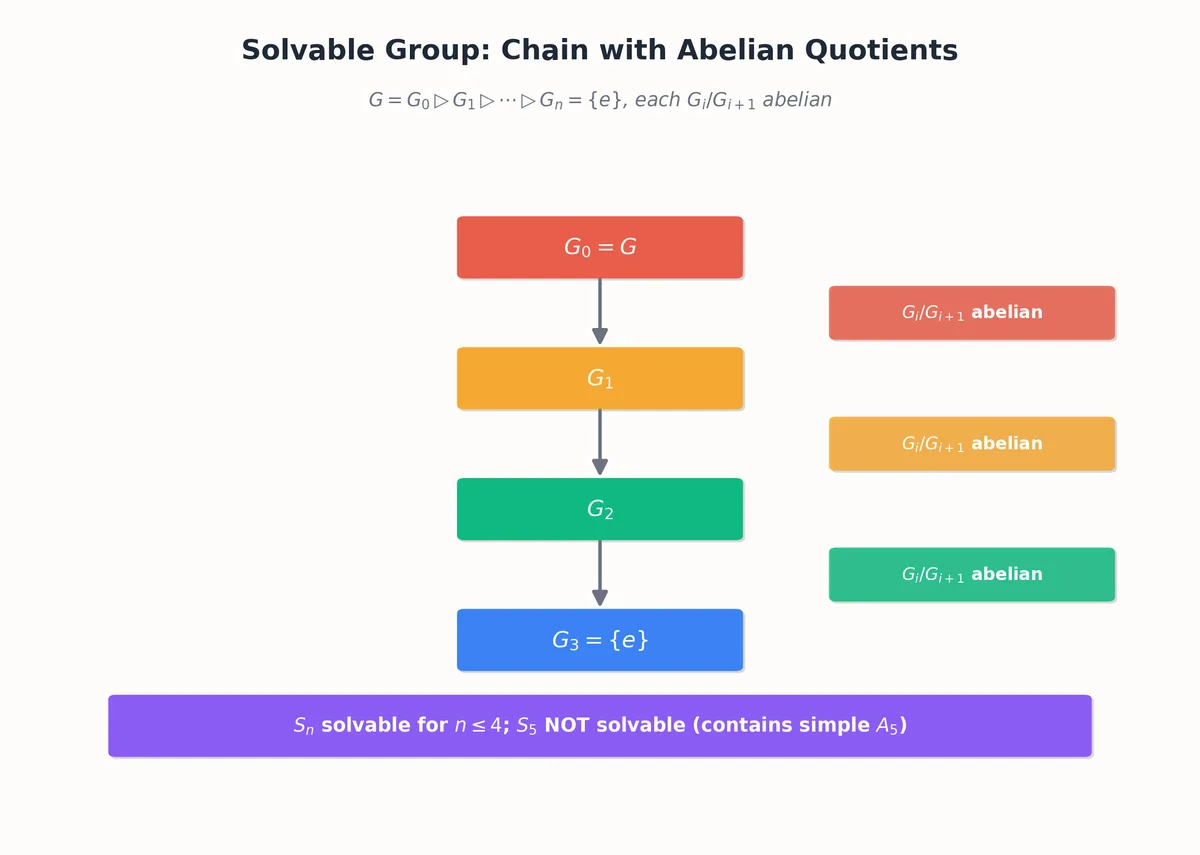
$$\{e\} = G_0 \trianglelefteq G_1 \trianglelefteq \cdots \trianglelefteq G_n = G$$such that each quotient $G_{i+1}/G_i$ is abelian.
Examples.
- All abelian groups (chain of length 1).
- All groups of order $< 60$ .
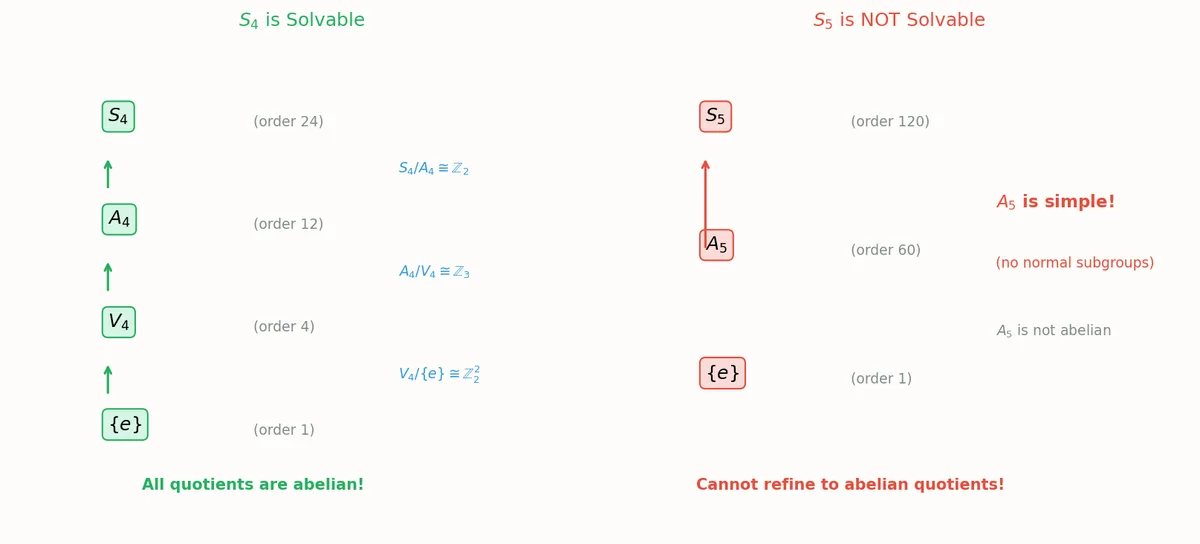
- $S_n$ for $n \leq 4$ ($S_3$ has $\{e\} \trianglelefteq A_3 \trianglelefteq S_3$ with abelian quotients $\mathbb{Z}/3, \mathbb{Z}/2$ ; $S_4$ has $\{e\} \trianglelefteq V_4 \trianglelefteq A_4 \trianglelefteq S_4$ ).
- Dihedral groups $D_n$ .
- Every $p$ -group is solvable.
Non-examples. $S_n$ for $n \geq 5$ — because $A_5$ is simple and non-abelian, so it has no nontrivial normal subgroups, and any solvable chain through $S_5$ would have to break at $A_5$ .
A few useful structural facts about solvable groups:
- Subgroups and quotients of solvable groups are solvable.
- An extension of a solvable group by a solvable group is solvable. (So solvability is “closed under group extensions.”)
- Burnside (1904): every group of order $p^a q^b$ is solvable. The proof uses character theory and was the first major application of representation theory to abstract group theory.
- Feit-Thompson (1963): every group of odd order is solvable. The proof runs over 250 pages and was the spark that started the classification of finite simple groups.
The two cited theorems show how much group theory has to say about which groups are solvable. For our purposes, the relevant fact is that solvability is a local property of finite groups that you can check by chasing normal subgroups — exactly the kind of question that responds to the Sylow theorems.
Theorem (Galois). $f(x) \in K[x]$ is solvable by radicals over $K$ iff its Galois group $\mathrm{Gal}(L/K)$ (where $L$ is the splitting field of $f$ ) is a solvable group.
The forward direction is the hard part. The idea: a tower of radical extensions has Galois group built up from cyclic pieces (each $\sqrt[n]{a}$ generates a cyclic-Galois extension once you have enough roots of unity), and “built up from abelian pieces” is exactly the definition of solvable. So if $f$ is solvable by radicals, $\mathrm{Gal}(L/K)$ embeds in a solvable group, hence is solvable. The converse is also true and slightly more constructive: a solvable Galois group can be unwound into radical extensions.
Why this matters. The statement turns the question “is there a closed-form solution?” into a finite combinatorial check on a finite group. Once you know the Galois group, you know whether radicals suffice — and if they suffice, you know the chain of radicals to use.
A useful slogan: “radical extensions are exactly the cyclic-step Galois extensions, after enough roots of unity have been adjoined.” The “enough roots of unity” caveat is real — over $\mathbb{Q}$ , the extension generated by one $n$ -th root is not Galois until you also throw in $\zeta_n$ — but it is a clean, separable adjustment, and the resulting picture is that “radical” means “tower of cyclic.” Hence solvability of the Galois group is exactly what makes the radical tower possible.
The proof of solvability $\Leftrightarrow$ radicals also gives a recipe. If $G$ is solvable with derived series $G = G_0 \supseteq G_1 \supseteq \cdots \supseteq G_n = 1$ , the corresponding tower of fixed fields gives you the chain of radicals: each $G_i / G_{i+1}$ is abelian, hence (after adjoining roots of unity) cyclic, and a cyclic extension is generated by a single radical (Hilbert 90). So solvability is not just a yes/no answer; it is a recipe for the formula.
The Insolvability of the General Quintic#
For the general polynomial of degree $n$ — the one with indeterminate coefficients, $f(x) = x^n + a_{n-1}x^{n-1} + \cdots + a_0$ over $K = \mathbb{Q}(a_0, \ldots, a_{n-1})$ — the Galois group is $S_n$ . (This is essentially because no algebraic relations hold among the roots beyond what is forced by the symmetric functions.)

Corollary. The general polynomial of degree $n$ is solvable by radicals iff $S_n$ is solvable iff $n \leq 4$ .
For $n = 2$ : $S_2 = \mathbb{Z}/2$ is abelian. Quadratic formula. For $n = 3$ : $S_3$ has solvable chain $\{e\} \trianglelefteq A_3 \trianglelefteq S_3$ . Cardano’s formula. For $n = 4$ : $S_4$ has solvable chain $\{e\} \trianglelefteq V_4 \trianglelefteq A_4 \trianglelefteq S_4$ . Ferrari’s method. For $n \geq 5$ : $A_n$ is simple non-abelian (Galois proved this for $n = 5$ ; the general fact is due to Jordan), so $S_n$ is not solvable. No formula in radicals exists.
There is a beautiful conceptual reason the cutoff is $n = 4$ : the symmetric group $S_n$ acts on a 4-element set canonically when $n = 4$ (namely, on the four cosets of $V_4$ in $S_4$ ), giving a homomorphism $S_4 \to S_4/V_4 \cong S_3$ . This “outer” reduction does not exist for $n \geq 5$ because the alternating group $A_n$ for $n \geq 5$ is simple, blocking any quotient. The classical degree-3-and-4 formulas exploit this reduction explicitly: to solve a quartic, you reduce it to a “resolvent cubic,” whose roots correspond to the three pairs of conjugate roots; you solve the cubic by Cardano, and lift back. The whole apparatus depends on the existence of the resolvent, which depends on the existence of a normal subgroup of index 3 in $A_4$ , which depends on $V_4$ being normal in $S_4$ — and this last fact is exactly what fails when $n \geq 5$ .
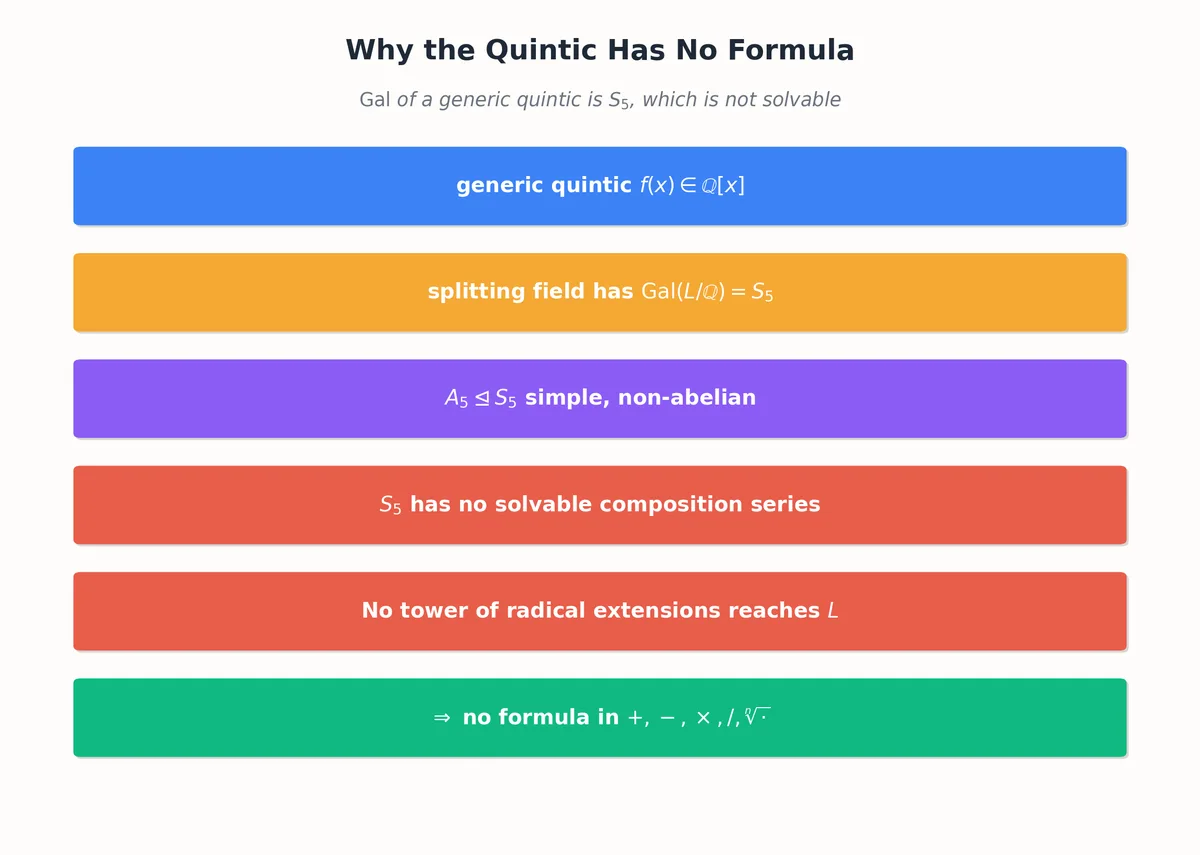
The simplicity of $A_5$ is the obstruction. It is remarkable that the impossibility of a 19th-century calculator’s dream — a quintic formula — comes down to the absence of a normal subgroup in a 60-element group. That is the kind of leverage Galois theory provides.
A specific quintic. $f(x) = x^5 - 4x + 2 \in \mathbb{Q}[x]$ has Galois group $S_5$ (irreducible by Eisenstein at $p=2$ , three real roots and two complex by analyzing $f'$ , hence the Galois group contains a transposition and a 5-cycle, which generate $S_5$ ). So this specific polynomial is not solvable by radicals — its roots cannot be expressed using $+, -, \times, \div, \sqrt[n]{\cdot}$ .
The argument that “transposition + 5-cycle generates $S_5$ ” is a small group-theoretic fact worth knowing: any 5-cycle and any transposition in $S_5$ generate the whole symmetric group, because the 5-cycle has order 5 (prime), so its powers fill out a subgroup that, combined with one transposition, lifts to $S_5$ via standard Cayley arguments. Concretely: given $(1\ 2\ 3\ 4\ 5)$ and any transposition, you can manufacture all transpositions $(i\ i+1)$ by conjugating, and adjacent transpositions generate $S_n$ for any $n$ .
The “three real, two complex” part is where calculus sneaks back in. $f'(x) = 5x^4 - 4$ has real roots $\pm(4/5)^{1/4}$ , so $f$ has exactly three real critical-point-bracketed roots, leaving two complex conjugate roots. Complex conjugation is a transposition of those two roots, fixing the three real ones. The Galois group of $f$ contains complex conjugation, which is a transposition.
However: many specific quintics are solvable by radicals. $x^5 - 1$ is solvable (Galois group $(\mathbb{Z}/5)^\times \cong \mathbb{Z}/4$ , abelian). $x^5 - 2$ is solvable (Galois group of order 20, isomorphic to $\mathbb{Z}/5 \rtimes \mathbb{Z}/4$ , which contains $\mathbb{Z}/5$ as a normal subgroup with cyclic quotient). The unsolvable quintics are the “generic” ones whose Galois group is the full $S_5$ .
A delightful subplot: the icosahedral extensions over $\mathbb{Q}$ — those with Galois group $A_5$ — are not solvable by radicals, but Hermite (1858) showed they can be solved using elliptic modular functions. So if you allow yourself slightly more exotic functions than $n$ -th roots, the quintic is back on the table. This is the spiritual ancestor of the modern theory of “solvability by special functions” and shows how the Galois-theoretic obstruction shifts when you change the toolkit.
Why this matters. This is one of the great theorems of mathematics. A question — “is there a formula for the roots of a polynomial?” — that occupied mathematicians for centuries, that was answered for degrees 2, 3, 4 by ingenious case analysis, is settled in full generality by an abstract structural argument about groups. The bridge from “find a formula” to “the alternating group is simple” is exactly the Galois correspondence.
It also illustrates the broader pattern of 19th-century algebra: hard concrete problems get reduced to abstract structural ones, and the abstraction lets you handle infinitely many cases at once. Galois did not solve the quintic; he proved that no one ever will, and explained why. That is a different kind of mathematical achievement, and it set the template for much of what came after.
What’s Next#
Galois theory completes our tour of fields. We have seen how the structure of polynomials, fields, and groups intertwine to give one of the deepest results in classical algebra. In the next article, we leave fields and groups behind to introduce a new perspective: modules, the natural generalization of vector spaces to arbitrary rings. Modules unify abelian groups, vector spaces, and ideals into a single framework — and they are the first step toward the homological methods that dominate modern algebra.

Before moving on, three takeaways worth keeping in your back pocket:
- The Galois group sees everything algebraic. Two elements of a Galois extension are conjugate over $K$ iff some Galois-group element swaps them. Every algebraic property that survives field automorphisms can be read off the group action.
- Normal subgroups encode normal sub-extensions. The terminology was chosen exactly so that the FTGT statement is uniform on both sides. When you see “normal” in either context, the other context’s “normal” is what makes it work.
- Solvability is about chains of cyclic steps. The general philosophy — break a problem into iterated cyclic (or abelian) pieces — recurs throughout algebra: composition series for groups, refinements for representations, derived functors in homological algebra. Galois theory is the original example, and it is the one whose connection to a concrete classical question is most striking.
Deeper Dive: Computations in Galois Theory#
Galois theory feels abstract until you compute the Galois group of a specific polynomial and trace the correspondence by hand. Five computations:
Computation A: Galois group of $x^4 - 2$ over $\mathbb{Q}$ . The four roots are $\sqrt[4]{2}, i\sqrt[4]{2}, -\sqrt[4]{2}, -i\sqrt[4]{2}$ . The splitting field is $L = \mathbb{Q}(\sqrt[4]{2}, i)$ . Degree: $[\mathbb{Q}(\sqrt[4]{2}) : \mathbb{Q}] = 4$ (irreducible by Eisenstein at $p = 2$ ), and $[L : \mathbb{Q}(\sqrt[4]{2})] = 2$ (since $\mathbb{Q}(\sqrt[4]{2}) \subset \mathbb{R}$ but $i \notin \mathbb{R}$ ). So $[L : \mathbb{Q}] = 8$ .
The Galois group $G$ has order $8$ , acts faithfully on the four roots, hence embeds in $S_4$ . Generators: $\sigma : \sqrt[4]{2} \mapsto i\sqrt[4]{2}, i \mapsto i$ (order $4$ , a “rotation” of the four roots) and $\tau : \sqrt[4]{2} \mapsto \sqrt[4]{2}, i \mapsto -i$ (order $2$ , complex conjugation). Compute $\tau \sigma \tau^{-1}$ : applied to $\sqrt[4]{2}$ , $\tau$ fixes it, then $\sigma$ sends to $i\sqrt[4]{2}$ , then $\tau$ sends $i\sqrt[4]{2}$ to $-i\sqrt[4]{2}$ . So $\tau\sigma\tau^{-1}(\sqrt[4]{2}) = -i\sqrt[4]{2} = \sigma^{-1}(\sqrt[4]{2})$ . Hence $\tau\sigma\tau = \sigma^{-1}$ (using $\tau^{-1} = \tau$ ). The relations $\sigma^4 = \tau^2 = e, \tau\sigma\tau = \sigma^{-1}$ are exactly the dihedral relations, so $G \cong D_4$ .
A common mistake here: thinking the Galois group acts by “choosing a root.” It doesn’t — it permutes the roots simultaneously according to the relations. The complex root $i\sqrt[4]{2}$ and its conjugate $-i\sqrt[4]{2}$ are linked: any automorphism either preserves complex conjugation or swaps it. There is no automorphism that, say, fixes $\sqrt[4]{2}$ , sends $i\sqrt[4]{2}$ to $-\sqrt[4]{2}$ , and does something independent with $-\sqrt[4]{2}$ . The four roots are coupled.
Computation B: Galois group of a cyclotomic extension. $\mathrm{Gal}(\mathbb{Q}(\zeta_n)/\mathbb{Q}) \cong (\mathbb{Z}/n\mathbb{Z})^*$ , acting via $\zeta_n \mapsto \zeta_n^a$ for $a$ coprime to $n$ . For $n = 7$ : $(\mathbb{Z}/7)^* \cong \mathbb{Z}/6$ , cyclic of order $6$ . So the Galois group is cyclic, hence abelian. By the Galois correspondence, $\mathbb{Q}(\zeta_7)/\mathbb{Q}$ has exactly one subfield of each degree dividing $6$ : degrees $1, 2, 3, 6$ , corresponding to subgroups of $\mathbb{Z}/6$ of indices $1, 2, 3, 6$ (i.e., subgroups of orders $6, 3, 2, 1$ ). The degree-$2$ subfield is $\mathbb{Q}(\sqrt{-7})$ (a deep fact, but the existence comes free from the correspondence).
Computation C: solvability of $S_4$ . The composition series is $S_4 \supset A_4 \supset V_4 \supset \{e, (1\ 2)(3\ 4)\} \supset \{e\}$ , with successive quotients $\mathbb{Z}/2, \mathbb{Z}/3, \mathbb{Z}/2, \mathbb{Z}/2$ . All abelian, so $S_4$ is solvable. By the fundamental theorem of Galois theory’s solvability criterion, every quartic over $\mathbb{Q}$ is solvable by radicals — there are explicit formulas (Ferrari, 1540) using nested square and cube roots. Cubic: same story, $S_3$ solvable, Cardano’s formula.
Computation D: insolvability of $S_5$ . $S_5$ has only one non-trivial normal subgroup, $A_5$ , which is simple non-abelian (the smallest non-abelian simple group). Composition series: $S_5 \supset A_5 \supset \{e\}$ , with quotients $\mathbb{Z}/2$ and $A_5$ . The second is non-abelian, so $S_5$ is not solvable. Therefore the general quintic is not solvable by radicals: there is no analogue of the cubic or quartic formula. Specific polynomials with Galois group $S_5$ — e.g., $x^5 - x - 1$ — have roots that cannot be expressed using rational arithmetic and root extractions alone.
Computation E: a non-Galois extension. $\mathbb{Q}(\sqrt[3]{2})/\mathbb{Q}$ has degree $3$ . Its Galois group has order $\leq 3$ . But $\mathbb{Q}(\sqrt[3]{2}) \subset \mathbb{R}$ , so any automorphism fixes $\mathbb{R}$ pointwise on real embeddings, and the only real cube root of $2$ is $\sqrt[3]{2}$ itself — so the only automorphism is the identity. $|\mathrm{Aut}(\mathbb{Q}(\sqrt[3]{2})/\mathbb{Q})| = 1$ , not $3$ . The extension is not Galois (because it is not normal: $x^3 - 2$ does not split in $\mathbb{Q}(\sqrt[3]{2})$ ).
To make it Galois, take the splitting field $\mathbb{Q}(\sqrt[3]{2}, \omega)$ , degree $6$ , Galois group $S_3$ (compute: $S_3$ acts on the three roots, and the action is faithful and transitive). Subgroups of $S_3$ : $\{e\}, \langle(1\ 2)\rangle, \langle(1\ 3)\rangle, \langle(2\ 3)\rangle, A_3, S_3$ . By Galois correspondence, six intermediate fields. The three subgroups of order $2$ correspond to the three real embeddings of $\mathbb{Q}(\sqrt[3]{2})$ — three different but isomorphic fields, each of degree $3$ over $\mathbb{Q}$ .
Common Pitfalls for Beginners#
The most subtle pitfall: thinking of Galois group elements as “choosing a root.” They don’t. They permute the roots simultaneously, respecting all algebraic relations. Here’s where the difference matters: for $x^4 - 2$ over $\mathbb{Q}$ , two roots are real ($\pm\sqrt[4]{2}$ ) and two are complex ($\pm i\sqrt[4]{2}$ ). Any Galois automorphism either fixes complex conjugation (mapping real roots to real roots) or swaps it (mapping real to complex). It cannot, for instance, map $\sqrt[4]{2}$ to a real root and simultaneously map $i\sqrt[4]{2}$ to a real root — that would force $i$ to map to a real number, impossible. The constraints couple the roots.
A second pitfall: confusing “abelian extension” with “abelian group.” A Galois extension $L/F$ is abelian if $\mathrm{Gal}(L/F)$ is abelian. Cyclotomic extensions are abelian (Galois group is $(\mathbb{Z}/n)^*$ , abelian). A field whose Galois group over $\mathbb{Q}$ is non-abelian (like $\mathbb{Q}(\sqrt[3]{2}, \omega)$ , group $S_3$ ) is non-abelian — even though the field itself is, of course, an abelian additive group. The adjective lives on the extension, not the field.
A third pitfall: assuming that all Galois extensions of $\mathbb{Q}$ have abelian Galois group. They don’t. $\mathbb{Q}(\sqrt[3]{2}, \omega)/\mathbb{Q}$ is Galois with group $S_3$ , non-abelian. The Kronecker–Weber theorem says every abelian extension of $\mathbb{Q}$ sits inside a cyclotomic field, but non-abelian extensions are wide open territory and the subject of the Langlands program.
Where This Shows Up#
The inverse Galois problem. Given a finite group $G$ , is there a Galois extension $L/\mathbb{Q}$ with $\mathrm{Gal}(L/\mathbb{Q}) \cong G$ ? This is open in general and has been a central question for over a century. Solvable groups are known (Shafarevich), and many specific groups including all symmetric and alternating groups are known. The general case remains stubbornly hard.
Class field theory. The abelian extensions of a number field $K$ are classified by the idele class group of $K$ . Class field theory is, roughly, the “Galois theory of abelian extensions” done globally. The non-abelian generalization is the Langlands program.
Cryptographic field choices. Elliptic curve cryptography requires choosing curves over finite fields whose group of points has prime order, and verifying this involves Galois-theoretic computations of Frobenius eigenvalues. The whole infrastructure of TLS / SSL handshakes depends on the algebraic geometry over finite fields, which depends on Galois theory.
What I Want You to Carry Forward#
Three questions for Part 9, on modules:
- What is the analogue of vector spaces for rings other than fields? Modules. Every theorem about vector spaces becomes a question for modules: are there bases? Are submodules direct summands? When is a module finitely generated?
- How does the Galois group structure connect to module structure? For an extension $L/K$ with Galois group $G$ , the field $L$ is a $K[G]$ -module. The structure of this module is the input to Hilbert 90 and to many cohomological constructions.
- When does a module have a “nice” decomposition? Over a PID, finitely generated modules decompose as a direct sum of cyclic modules (the structure theorem). This generalizes both the structure of finite abelian groups (over $\mathbb{Z}$ ) and the Jordan canonical form (over $k[x]$ ).
Three reflections to take away from Galois theory:
The Galois correspondence is the prototype of all Galois-style dualities — between subgroups and intermediate objects, between subobjects and quotients. Topology has covering spaces (Galois group = deck transformation group, intermediate spaces = intermediate covers). Algebraic geometry has étale covers. Number theory has class field theory. The pattern is one of the deepest in mathematics.
Solvability is about chains of cyclic steps. The general philosophy — break a problem into iterated cyclic (or abelian) pieces — recurs throughout algebra: composition series for groups, refinements for representations, derived functors in homological algebra. Galois theory is the original example, and it is the one whose connection to a concrete classical question — solving polynomials by radicals — is most striking.
Galois theory is the bridge between groups and fields. Once you have it, you can move freely between group-theoretic and field-theoretic problems. A deep group-theoretic fact (like the simplicity of $A_5$ ) translates to a deep field-theoretic fact (the unsolvability of the general quintic). This kind of dictionary between very different-looking subjects is the most rewarding feature of abstract algebra, and it is exactly the payoff for the abstraction we have been investing in for eight articles.
If you can compute the Galois group of one or two specific polynomials and identify the corresponding intermediate fields, you have the technique. The next time you see a polynomial of degree $\leq 5$ , your reflex should be: factor over $\mathbb{Q}$ , find the splitting field, identify the Galois group as a subgroup of $S_n$ , and read off the intermediate fields. Three articles ago this would have been impossible. Now it is bread and butter.
Supplementary Examples#
A second Galois computation: the polynomial $x^3 - 2$ over $\mathbb{Q}$ . The three roots are $\sqrt[3]{2}, \omega\sqrt[3]{2}, \omega^2\sqrt[3]{2}$ . The splitting field is $K = \mathbb{Q}(\sqrt[3]{2}, \omega)$ of degree $6$ . The Galois group has order $6$ and acts faithfully on the three roots, so it embeds in $S_3$ . Since the order matches, $\mathrm{Gal}(K/\mathbb{Q}) \cong S_3$ , the smallest non-abelian group. The three subgroups of order $2$ in $S_3$ correspond to the three real embeddings of $\mathbb{Q}(\sqrt[3]{2})$ into $K$ — three different intermediate fields, each isomorphic but not equal as subsets of $K$ . The unique subgroup of order $3$ , $A_3$ , corresponds to $\mathbb{Q}(\omega)$ , and the index-$2$ subgroup matches a degree-$2$ extension over $\mathbb{Q}$ .
A third example: the discriminant and the Galois group of a cubic. For an irreducible cubic $f(x) = x^3 + ax + b$ over $\mathbb{Q}$ (any cubic can be brought to this depressed form by translation), the discriminant is $\Delta = -4a^3 - 27b^2$ . The Galois group is $A_3$ (cyclic of order $3$ ) if $\Delta$ is a square in $\mathbb{Q}$ , and $S_3$ otherwise. Concrete: $f(x) = x^3 - 3x + 1$ has $\Delta = 108 - 27 = 81 = 9^2$ , a square. So Galois group is $A_3$ , the splitting field has degree $3$ (not $6$ ), and the cubic is “totally real” in the sense that all three roots are real and lie in a single cyclic cubic extension. By contrast, $f(x) = x^3 - 2$ has $\Delta = -108$ , not a square, and Galois group $S_3$ .
The Galois group of $x^p - x - 1$ over $\mathbb{Q}$ is $S_p$ . This is a striking result: for $p$ prime, this specific polynomial has the maximal possible Galois group. Sketch: the polynomial is irreducible (Artin–Schreier modulo $p$ ), it has a real root (by intermediate value theorem with $f(-2) < 0 < f(2)$ ), and the Galois group acts transitively on the $p$ roots, contains a transposition (because complex conjugation gives one when there are exactly two complex roots), and a transitive subgroup of $S_p$ containing a transposition must be all of $S_p$ when $p$ is prime. So we get explicit polynomials with Galois group $S_5, S_7, S_{11}, \ldots$ — and via the Galois correspondence, explicit unsolvable extensions.
Solvability and the cubic resolvent. For a quartic polynomial $f(x)$ , the Galois group is a subgroup of $S_4$ . The four possibilities — $S_4, A_4, D_4, V_4, \mathbb{Z}/4$ — can be distinguished by the cubic resolvent (a polynomial whose roots are certain symmetric functions of the roots of $f$ ). When the cubic resolvent factors into a product of three linear factors over $\mathbb{Q}$ , the Galois group of $f$ is contained in $V_4$ . This is the level of detail at which classical Galois theory operates, and modern computer algebra systems have full implementations.#
Abstract Algebra 12 parts
- 01 Abstract Algebra (1): Groups — Your First Encounter with Algebraic Structure
- 02 Abstract Algebra (2): Group Actions — How Groups Move Things Around
- 03 Abstract Algebra (3): Quotient Groups and Homomorphisms: The Art of Collapsing Structure
- 04 Abstract Algebra (4): Sylow Theorems — Dissecting Finite Groups
- 05 Abstract Algebra (5): Rings and Ideals — When Multiplication Enters the Picture
- 06 Abstract Algebra (6): Polynomial Rings — Factorization and Unique Decomposition
- 07 Abstract Algebra (7): Field Extensions — Building Bigger Number Systems
- 08 Abstract Algebra (8): Galois Theory — The Bridge Between Fields and Groups you are here
- 09 Abstract Algebra (9): Modules — Generalizing Vector Spaces
- 10 Abstract Algebra (10): Representation Theory — Groups Acting on Vector Spaces
- 11 Abstract Algebra (11): Category Theory — The Language of Mathematical Structure
- 12 Abstract Algebra (12): Algebra in the Wild — Cryptography, Coding Theory, and Beyond