Differential Geometry (7): Vector Fields, Flows, and the Lie Bracket
Vector fields generate flows — one-parameter families of diffeomorphisms. The Lie bracket measures the failure of flows to commute, leading to Frobenius integrability.
A tangent vector lives at one point. It tells you “this direction, this speed, right here, right now.” It is fundamentally local — pluck it off the manifold and it remembers nothing about its neighbors. A vector field, by contrast, is what you get when you let one tangent vector at every point conspire smoothly. It is a velocity prescription on the entire manifold: stand anywhere, and the field tells you where to go. Follow the prescription, and you trace out an integral curve. Follow it from every starting point at once, and you get a flow — a one-parameter family of diffeomorphisms that drags the whole manifold along itself like a slow river.
I want to stress that this picture is not just kinematic decoration. Vector fields are how differential geometry encodes infinitesimal symmetry. Every conserved quantity in Hamiltonian mechanics arises from a vector field whose flow preserves the Hamiltonian. Every one-parameter subgroup of a Lie group is the flow of a left-invariant vector field. Every gauge transformation in Yang-Mills theory is, infinitesimally, a vector field on the configuration space of connections. And the Lie bracket $[X, Y]$ — the gadget that measures how badly the flows of $X$ and $Y$ fail to commute — is exactly the algebraic structure that turns the tangent space at the identity of a Lie group into its Lie algebra. Understanding vector fields well is, by a substantial margin, the prerequisite to understanding everything that follows in this series.
The plan for this article: define vector fields three different ways (geometric, algebraic, sectional), turn them into integral curves via ODE theory, package the curves into flows, define the bracket and the Lie derivative, work through enough numerical examples to make the formulas reflexive, then close with the Frobenius theorem on integrability — the deep result that ties everything together. Throughout, I will resist the temptation to prove things from scratch (Lee’s textbook does that very well) and instead focus on what the formulas mean and how to compute with them.
Vector Fields: Smooth Sections of the Tangent Bundle#

A vector field $X$ on a smooth manifold $M$ is a smooth assignment $p \mapsto X_p \in T_p M$ . In bundle language, it is a smooth section of the tangent bundle $TM \to M$ : pick a tangent vector at every point, and require that the choice vary smoothly as you move. The space of all vector fields on $M$ is denoted $\mathfrak{X}(M)$ . It is simultaneously a real vector space (you can add fields and scale by constants), a module over $C^\infty(M)$ (you can multiply by smooth functions pointwise), and — as we will see in section 4 — a Lie algebra under the bracket.
$$X = X^i(x) \frac{\partial}{\partial x^i},$$where the components $X^i$ are smooth functions of the coordinates. The intuition is simple: at each point, the vector $X_p$ has $n$ components in the coordinate basis $\{\partial_i\}$ , and those components vary smoothly with $p$ . Smoothness of $X$ as a section is equivalent to smoothness of all the component functions $X^i$ in any chart; you only need to check this on an atlas.

A theorem of Hadamard says that every such derivation arises from a unique vector field. So we have two equivalent definitions: geometric (a section of $TM$ ) and algebraic (a derivation of $C^\infty(M)$ ). Use whichever is more convenient — and one of the basic skills of differential geometry is knowing instantly which is more convenient for any given problem.
$$X(f) = -y \cdot 2x + x \cdot 2y = 0.$$The function $f = x^2 + y^2$ is invariant under $X$ . Geometrically, this is obvious: $X$ generates rotations, and rotations preserve distance from the origin. Algebraically, the derivation killed the radial function. Both perspectives give the same answer, which is comforting.
Apply $X$ to $g(x, y) = x$ : we get $X(g) = -y$ . To $h(x, y) = xy$ : we get $X(h) = -y \cdot y + x \cdot x = x^2 - y^2$ . Notice that $h$ is not invariant (the field is rotational but $xy$ rotates into something different). This kind of computation is what occupies the first hour of any practical work with vector fields, and being able to read $X = -y\partial_x + x\partial_y$ as “rotation” without computing should be your first goal.
Why this matters. The derivation perspective is what makes vector fields composable. If $X, Y \in \mathfrak{X}(M)$ , you cannot meaningfully “add” them as sections of $TM$ in any nontrivial way beyond pointwise addition. But as derivations, you can compose them: $(XY)(f) = X(Y(f))$ . This composition is not itself a derivation (it fails Leibniz — try it on $f = g = x$ and watch the second derivatives appear), but a clever combination of $XY$ and $YX$ is a derivation, and that combination is the Lie bracket. So the algebraic viewpoint is what unlocks the bracket — and through the bracket, the entire theory of Lie groups and infinitesimal symmetry.
Integral Curves: Following the Field#
$$\gamma(0) = p, \qquad \dot\gamma(t) = X_{\gamma(t)} \text{ for all } t \in I.$$ $$\frac{d x^i}{dt} = X^i(x^1(t), \dots, x^n(t)), \qquad x^i(0) = p^i.$$This is a first-order autonomous system in $n$ variables.

The Picard-Lindelof theorem guarantees that for any smooth $X$ and any starting point $p$ , an integral curve exists and is unique on some open interval around $0$ . The interval might be small (the integral curve could escape to infinity in finite time — think of $\dot x = x^2$ on $\mathbb{R}$ , which blows up at $t = 1/x_0$ ), but locally everything is fine. On compact manifolds, the interval is always all of $\mathbb{R}$ — there is nowhere to escape to — and the field is called complete.
$$\dot x = -y, \qquad \dot y = x.$$ $$\gamma(t) = (p^1 \cos t - p^2 \sin t,\; p^1 \sin t + p^2 \cos t).$$This is exactly rotation by angle $t$ around the origin. The integral curves are circles, parametrized by angle. The fixed point — where $X$ vanishes — is the origin.
Worked example 2 — exponential growth. Take $X = x\,\partial_x$ on $\mathbb{R}$ . The ODE is $\dot x = x$ , so $x(t) = p e^t$ . Integral curves are exponentially expanding rays. Starting at $p > 0$ , you blow up to $+\infty$ as $t \to +\infty$ and shrink to $0$ as $t \to -\infty$ . The origin is a fixed point, but now an unstable one. Notice that $X$ is complete on $\mathbb{R}$ : the integral curve $x(t) = p e^t$ is defined for all $t$ .
Worked example 3 — finite-time blowup. Take $X = x^2 \partial_x$ on $\mathbb{R}$ . The ODE $\dot x = x^2$ has solution $x(t) = p / (1 - pt)$ , which blows up at $t = 1/p$ if $p > 0$ . So $X$ is not complete on $\mathbb{R}$ . This is the local-vs-global distinction in action: existence is always local, but global existence requires a growth bound on $X$ (intuitively: the integral curve must not run off to infinity in finite time).
Why this matters. Integral curves are the trajectories of physical systems. Newton’s law $\ddot{q} = -\nabla V(q)$ becomes a first-order system on the phase space $(q, p)$ via $\dot q = p, \dot p = -\nabla V$ . The integral curves of this Hamiltonian vector field are precisely the trajectories of the mechanical system. ODE existence and uniqueness translate into the deterministic evolution of physics. When physicists say “given initial conditions, the future is determined,” they are invoking Picard-Lindelof on the manifold of states.
Flows: One-Parameter Families of Diffeomorphisms#
$$\varphi_t: M \to M, \qquad \varphi_t(p) = \gamma_p(t),$$where $\gamma_p$ is the integral curve starting at $p$ . The map $\varphi_t$ pushes every point along its integral curve for time $t$ . The collection $\{\varphi_t\}_{t \in \mathbb{R}}$ is the flow of $X$ .

The flow satisfies three properties that I want to highlight, because they are the entire reason flows are useful:
- Identity: $\varphi_0 = \mathrm{id}_M$ .
- Group law: $\varphi_{s+t} = \varphi_s \circ \varphi_t$ .
- Smoothness: the map $(t, p) \mapsto \varphi_t(p)$ is smooth, and each $\varphi_t$ is a diffeomorphism with inverse $\varphi_{-t}$ .
The group law is the punchline. It says the flow is a homomorphism from the additive group $(\mathbb{R}, +)$ into the diffeomorphism group $\mathrm{Diff}(M)$ . In other words, every complete vector field $X$ generates a one-parameter subgroup of diffeomorphisms. The vector field is the infinitesimal generator; the flow is the exponentiation. We sometimes write $\varphi_t = \exp(tX)$ to emphasize this — and on Lie groups, this notation is literally a matrix exponential.
$$\varphi_t(x, y) = (x\cos t - y\sin t,\; x\sin t + y\cos t),$$which is exactly the rotation matrix $R_t$ acting on $\mathbb{R}^2$ . The group law $\varphi_s \circ \varphi_t = \varphi_{s+t}$ becomes $R_s R_t = R_{s+t}$ , the angle-addition formula. We have just rediscovered $\mathrm{SO}(2) \cong S^1$ as the flow of a vector field on $\mathbb{R}^2$ , and the angle-addition identity for sine and cosine has been recast as a group homomorphism property of the flow.
Continuing the dilation example. For $X = x\,\partial_x$ on $\mathbb{R}$ , the flow is $\varphi_t(x) = e^t x$ . The group law is $e^s e^t = e^{s+t}$ , and we have rediscovered $(\mathbb{R}_{>0}, \times) \cong (\mathbb{R}, +)$ as a flow. The exponential map on this Lie group is literally the exponential function from calculus.

Pushforward of a vector field. If $\varphi_t$ is the flow of $X$ and $Y$ is another vector field, we can ask: how does $Y$ change as we drag it along $X$ ’s flow? The answer is the pushforward $(\varphi_t)_* Y$ , defined by $((\varphi_t)_* Y)_q = (d\varphi_t)_p Y_p$ where $q = \varphi_t(p)$ . This will be central in section 4 when we define the Lie bracket as a derivative of pushforwards.
Aside: incomplete fields and local flows. When $X$ is not complete — e.g. $X = x^2 \partial_x$ on $\mathbb{R}$ — the flow is only defined on an open subset of $\mathbb{R} \times M$ called the flow domain. For each $p$ , there is a maximal interval $(a_p, b_p)$ on which $\varphi_t(p)$ is defined; the integral curve “escapes” if $b_p < \infty$ . Most theorems involving flows still work locally, by restricting to small enough $t$ . In practice, complete vector fields are common (compactly supported $X$ on any manifold; bounded $X$ on $\mathbb{R}^n$ ; left-invariant fields on Lie groups), so the distinction is more often a technical aside than a serious obstacle.
Why this matters. Every continuous symmetry in physics — translation, rotation, time evolution, gauge transformation — is the flow of a vector field. Noether’s theorem in its modern form says: a symmetry of the Lagrangian (a flow that preserves the action) gives rise to a conserved quantity (a function constant along the flow). The dictionary between vector fields and one-parameter symmetry groups is the geometric core of mechanics. Without it, you cannot do classical field theory in any serious way.
The Lie Bracket: Failure of Flows to Commute#
Given two vector fields $X, Y$ , what happens if we flow along $X$ for a small time $\epsilon$ , then along $Y$ , then back along $-X$ , then back along $-Y$ ? Naively, we should return to where we started. We don’t. The discrepancy is a vector at $p$ , and to second order in $\epsilon$ it is exactly $\epsilon^2 [X, Y]_p$ . The bracket is a quantitative measure of how non-commuting the flows are.

![Lie bracket [X,Y] measuring the failure of flows to commute](https://blog-pic-ck.oss-cn-beijing.aliyuncs.com/posts/en/differential-geometry/07-vector-fields-flows/dg_v2_07_4_lie_bracket.png?x-oss-process=image/resize,w_1200/format,webp/quality,q_88)
This is a derivation of $C^\infty(M)$ — the failures of Leibniz from $XY$ and $YX$ exactly cancel — so it corresponds to a vector field by Hadamard’s theorem. Notice that $XY$ alone is a second-order differential operator; the antisymmetrization knocks the second-order part out and leaves a first-order operator.
$$[X, Y]^k = X^i \frac{\partial Y^k}{\partial x^i} - Y^i \frac{\partial X^k}{\partial x^i}.$$The second-order terms cancel because mixed partials commute; only first-order corrections survive. This is the formula you compute with.
$$[X, Y]_p = \lim_{t \to 0} \frac{Y_p - ((\varphi_t^X)_* Y)_p}{t} = \left.\frac{d}{dt}\right|_{t=0} (\varphi_{-t}^X)_* Y_p.$$The bracket is the rate at which $Y$ changes when dragged backward by the flow of $X$ . Antisymmetric in $X$ and $Y$ because the roles of “drag” and “compare” are swapped.
$$[X, Y](f) = \partial_x(x \partial_y f) - x \partial_y(\partial_x f) = \partial_y f + x \partial_x \partial_y f - x \partial_y \partial_x f = \partial_y f.$$So $[X, Y] = \partial_y$ . Geometrically: $X$ translates in the $x$ -direction, $Y$ translates in $y$ but with strength proportional to $x$ . The two flows fail to commute precisely because $Y$ “depends on” $x$ . This pair $(X, Y)$ is the canonical example of a non-integrable contact distribution (we revisit in section 8).
$$L_x = -z\partial_y + y\partial_z, \quad L_y = -x\partial_z + z\partial_x, \quad L_z = -y\partial_x + x\partial_y.$$ $$[L_x, L_y]^z = L_x^i \partial_i L_y^z - L_y^i \partial_i L_x^z = (-z)(0) + y(\partial_z(-x)) - (-x)(\partial_x(y)) - 0 \cdot (\dots) - z(\partial_z(0)) + (\dots)$$ $$[L_x, L_y] = L_z, \quad [L_y, L_z] = L_x, \quad [L_z, L_x] = L_y.$$This is the Lie algebra of rotations, written in vector-field form on $\mathbb{R}^3$ .
Properties. The bracket on $\mathfrak{X}(M)$ satisfies:
- Bilinearity: linear in each argument over $\mathbb{R}$ .
- Antisymmetry: $[X, Y] = -[Y, X]$ .
- Jacobi identity: $[X, [Y, Z]] + [Y, [Z, X]] + [Z, [X, Y]] = 0$ .
These are exactly the axioms of a Lie algebra. So $\mathfrak{X}(M)$ is an infinite-dimensional Lie algebra, and finite-dimensional Lie algebras (like $\mathfrak{so}(3)$ or $\mathfrak{su}(2)$ ) appear as subalgebras coming from group actions.
$$[fX, gY] = fg[X, Y] + f X(g) Y - g Y(f) X.$$Extra terms appear because the bracket differentiates the coefficient functions. This $C^\infty$ -non-bilinearity will reappear in the next article when we contrast Lie derivatives (no extra structure needed) with covariant derivatives (which require a connection).
Why this matters. The Jacobi identity is not arbitrary — it falls out of the associativity of composition $XYZ$ . The bracket is the algebraic shadow of associativity, just translated to first-order terms. When physicists write $[\hat L_x, \hat L_y] = i\hbar \hat L_z$ for angular momentum operators, they are computing a Lie bracket in the Lie algebra $\mathfrak{so}(3)$ realized as vector fields on $\mathbb{R}^3$ . Quantum mechanics inherits its non-commutativity directly from the geometry. The factor of $i\hbar$ is just a unit choice; the algebra is geometric.
The Lie Derivative: Differentiating Anything Along a Flow#
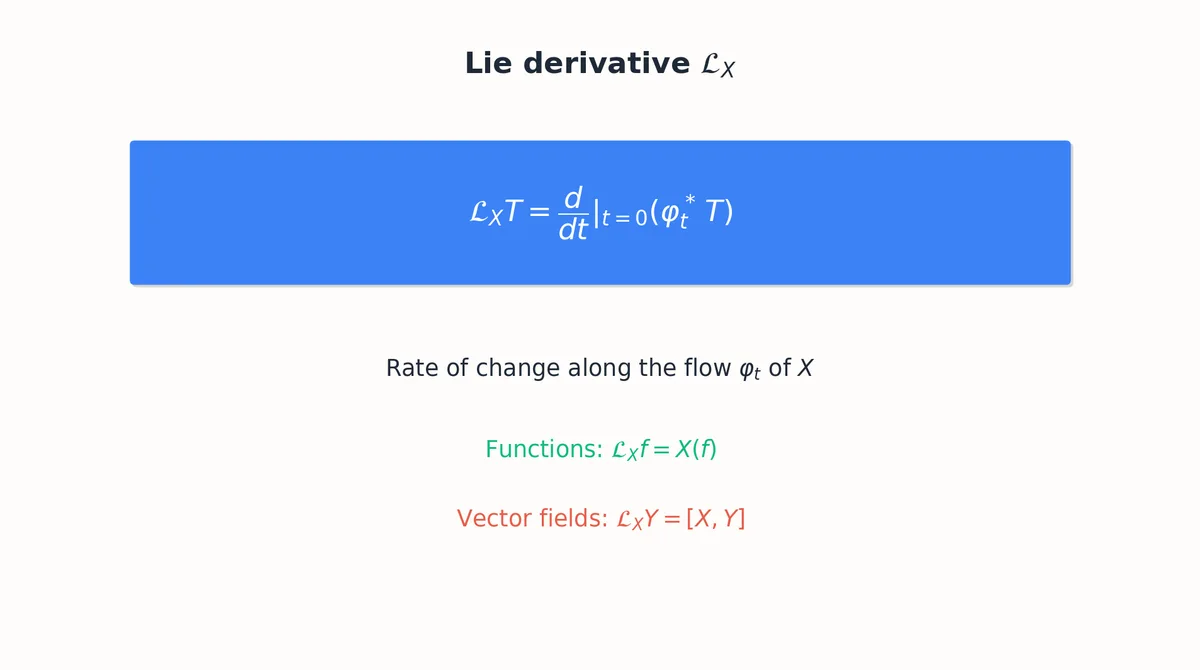
$$\mathcal{L}_X T = \lim_{t \to 0} \frac{\varphi_t^* T - T}{t} = \left.\frac{d}{dt}\right|_{t=0} \varphi_t^* T,$$where $\varphi_t^*$ is the pullback by $\varphi_t$ . Geometrically: drag $T$ along the flow for time $t$ , compare to its original value, divide by $t$ , take the limit.
Special cases.
- For a function $f$ : $\mathcal{L}_X f = X(f)$ , the directional derivative.
- For a vector field $Y$ : $\mathcal{L}_X Y = [X, Y]$ , the Lie bracket.
- For a 1-form $\omega$ : by the Leibniz rule, $(\mathcal{L}_X \omega)(Y) = X(\omega(Y)) - \omega([X, Y])$ .
- For a $k$ -form, Cartan’s magic formula: $\mathcal{L}_X = d \iota_X + \iota_X d$ , where $\iota_X$ is interior product.
The Lie derivative satisfies Leibniz over tensor products and commutes with contractions. It is the canonical way to differentiate any object on a manifold along a vector field, without needing extra structure (no metric, no connection — just the smooth structure). This minimality is its defining virtue.
$$\iota_X \omega = \omega(X) = x \cdot x - y \cdot (-y) = x^2 + y^2.$$ $$d \iota_X \omega = d(x^2 + y^2) = 2x\,dx + 2y\,dy.$$ $$d\omega = 2\,dx \wedge dy, \qquad \iota_X d\omega = 2 X^i \partial_i \,\lrcorner\, dx\wedge dy = 2(-y\,dy - x\,dx) = -2x\,dx - 2y\,dy.$$ $$\mathcal{L}_X \omega = (2x\,dx + 2y\,dy) + (-2x\,dx - 2y\,dy) = 0.$$The angular form is invariant under rotation — as it should be, since rotations preserve angle. The computation took six lines, but every step was mechanical.
$$(\mathcal{L}_X g)_{ij} = X^k \partial_k g_{ij} + g_{kj}\partial_i X^k + g_{ik}\partial_j X^k$$(here $g_{ij} = \delta_{ij}$ so the first term vanishes): $(\mathcal{L}_X g)_{xx} = \partial_x X^x + \partial_x X^x = 0 + 0 = 0$ . (Since $X^x = -y$ .) $(\mathcal{L}_X g)_{xy} = \partial_x X^y + \partial_y X^x = 1 + (-1) = 0$ . $(\mathcal{L}_X g)_{yy} = \partial_y X^y + \partial_y X^y = 0$ . Confirmed: $\mathcal{L}_X g = 0$ . The vector field $X$ is a Killing vector field for the Euclidean metric.
Worked example 3. Compute $\mathcal{L}_X (x^2 + y^2) dx\wedge dy$ for the same rotation $X$ . The function $x^2 + y^2$ is invariant under $X$ (computed in section 1), so $\mathcal{L}_X(x^2 + y^2) = 0$ . The form $dx \wedge dy$ is the volume form on $\mathbb{R}^2$ , and $\mathcal{L}_X(dx\wedge dy) = (\nabla \cdot X) dx \wedge dy = 0$ since $X$ is divergence-free. By the Leibniz rule, $\mathcal{L}_X((x^2+y^2)dx\wedge dy) = 0$ . Three different “preservation” facts about rotation, all encoded in single Lie-derivative computations.

Why this matters. Symmetries of geometric structures are exactly the vector fields with $\mathcal{L}_X(\text{structure}) = 0$ . Killing fields preserve the metric ($\mathcal{L}_X g = 0$ ); these are the infinitesimal isometries. Symplectic vector fields preserve the symplectic form ($\mathcal{L}_X \omega = 0$ ); these generate Hamiltonian flows. Conformal vector fields satisfy $\mathcal{L}_X g = \lambda g$ ; these generate angle-preserving (but not length-preserving) transformations. The Lie derivative is the universal language of “this flow is a symmetry of that object” — and it is the same operator regardless of what kind of tensor that object is.
Worked Examples: Rotation, Source, Sink#
To consolidate, here are three classical fields on $\mathbb{R}^2$ that you should learn to recognize on sight. Each illustrates a different qualitative behavior, and each sits inside a larger family with physical significance.

Rotation field: $X_R = -y\,\partial_x + x\,\partial_y$ . Integral curves are circles of constant radius, flow is rotation by angle $t$ . Divergence $\nabla \cdot X_R = -\partial_x y + \partial_y x = 0$ , curl (in 2D, $\partial_x X^y - \partial_y X^x$ ) equals $1 - (-1) = 2$ . Generates $\mathrm{SO}(2)$ . Preserves area (because divergence-free).
Radial source: $X_S = x\,\partial_x + y\,\partial_y$ . Integral curves are rays from the origin, flow is dilation $\varphi_t(p) = e^t p$ . Divergence $2$ , curl $0$ . Generates the multiplicative group of positive reals (in each direction). Multiplies area by $e^{2t}$ in time $t$ — so volume grows exponentially under the flow.
Sink (negative source): $X_K = -x\,\partial_x - y\,\partial_y$ . Integral curves are rays into the origin, flow is contraction $\varphi_t(p) = e^{-t} p$ . Divergence $-2$ , curl $0$ . Same one-parameter group as the source, run in reverse. Volume contracts by $e^{-2t}$ .
Computing brackets:
- $[X_R, X_S]$ : Let $X_R = -y\partial_x + x\partial_y$ , $X_S = x\partial_x + y\partial_y$ . $[X_R, X_S]^x = X_R^i \partial_i X_S^x - X_S^i \partial_i X_R^x = (-y)(1) + x(0) - x(0) - y(-1) = -y + y = 0$ . $[X_R, X_S]^y = (-y)(0) + x(1) - x(1) - y(0) = 0$ . So $[X_R, X_S] = 0$ . The flows commute. Indeed, rotation and dilation commute as transformations of $\mathbb{R}^2$ — rotating then dilating gives the same point as dilating then rotating.
- $[X_S, X_K] = -2 X_S$ ? Wait, $X_K = -X_S$ , so $[X_S, X_K] = [X_S, -X_S] = 0$ trivially. Sink and source generate the same one-parameter subgroup.
- More interesting: take $X = -y\partial_x + x\partial_y$ (rotation) and $Y = \partial_x$ (translation in $x$ ). Then $[X, Y]^x = (-y)(0) - 1\cdot 0 - 1\cdot(-1) = $ … let me be careful: $[X, Y] = XY - YX$ . $X(Y^x) = X(1) = 0$ . $Y(X^x) = \partial_x(-y) = 0$ . $X(Y^y) = X(0) = 0$ . $Y(X^y) = \partial_x(x) = 1$ . So $[X, Y]^x = 0 - 0 = 0$ , $[X, Y]^y = 0 - 1 = -1$ . Thus $[X, Y] = -\partial_y$ . Rotation and $x$ -translation do not commute, and the discrepancy is a $-y$ -translation. Consistent with $\mathfrak{so}(2) \ltimes \mathbb{R}^2$ , the Lie algebra of the Euclidean group.
This is a healthy sanity check: when geometric intuition says flows commute, the bracket should vanish. When it says they do not commute, the bracket should produce a sensible field — typically lying in the same Lie algebra you started with.
Phase Portraits: Geometry of ODEs#
A phase portrait is the picture of all integral curves of a vector field, drawn in the manifold (or its phase space). Phase portraits are the qualitative theory of ODEs in geometric form. Where 19th-century mathematicians struggled to write down explicit solutions, Poincare realized that for most vector fields you cannot — but you can still describe the qualitative behavior of trajectories, and that is often what physics actually wants to know.

The structure of a phase portrait is dictated by:
- Fixed points (zeros of $X$ ) — where flow stagnates. Linearize $X$ at a fixed point $p$ to get a matrix $A = (\partial X^i / \partial x^j)|_p$ ; the eigenvalues of $A$ classify the fixed point as source (both eigenvalues positive real), sink (both negative real), saddle (one of each sign), center (purely imaginary), spiral source/sink (complex with positive/negative real part).
- Periodic orbits — closed integral curves. Generic systems may have isolated limit cycles that attract nearby trajectories. The Poincare-Bendixson theorem says that on an annulus in $\mathbb{R}^2$ with no fixed points, every trajectory tends to a limit cycle.
- Separatrices — integral curves connecting fixed points (heteroclinic) or returning to the same fixed point (homoclinic); they separate qualitatively distinct regions and govern the topology of the portrait.
on the cylinder $S^1 \times \mathbb{R}$ . Fixed points at $(\theta, \omega) = (n\pi, 0)$ . At $\theta = 0$ (downward equilibrium), the linearization has eigenvalues with negative real part (because of friction $\gamma > 0$ ) — a stable spiral sink. At $\theta = \pi$ (inverted pendulum), the linearization has one positive and one negative real eigenvalue — a saddle. The phase portrait shows trajectories spiraling into the sinks, being deflected by the saddles, and the separatrices form the boundary between trajectories that “swing back and forth” and trajectories that “go over the top.”
Example: Lotka-Volterra predator-prey. $\dot x = ax - bxy$ , $\dot y = -cy + dxy$ . Fixed points at $(0, 0)$ (saddle) and $(c/d, a/b)$ (center). The portrait shows closed orbits around the interior fixed point, oscillating populations of predators and prey 90 degrees out of phase. This is a Hamiltonian system (with an unusual Hamiltonian); the closed orbits reflect a conserved quantity.
Example: Van der Pol oscillator. $\ddot x - \mu(1 - x^2)\dot x + x = 0$ becomes $\dot x = y$ , $\dot y = \mu(1 - x^2)y - x$ . For $\mu > 0$ there is one fixed point at the origin (an unstable spiral) and a unique stable limit cycle that all nonzero trajectories converge to. This is the prototypical relaxation oscillator — it appears in heart rhythms, electronic circuits, and any system with a slow buildup followed by a fast release. The geometric content (existence of limit cycle + global attraction) is invisible in the analytic formula but immediate in the phase portrait.
Why this matters. Engineers and physicists almost never care about exact solutions to ODEs — they care about qualitative behavior: stability, oscillation, escape, bifurcation. The geometric language of vector fields and flows turns ODE theory from analytic drudgery into a study of pictures. The whole field of dynamical systems lives in this picture, and modern stability theory (Lyapunov, Floquet, KAM) is essentially the deep version of the elementary observations above. Even the modern theory of bifurcations — how phase portraits change as a parameter is varied — is essentially the study of how vector fields fail to be structurally stable, and that failure is a geometric statement about the field.
Frobenius Integrability: When Distributions Integrate#
A distribution $\mathcal{D}$ on $M$ is a smooth assignment $p \mapsto \mathcal{D}_p \subseteq T_p M$ of a $k$ -dimensional subspace at each point. (Think of a distribution as a “field of $k$ -planes,” generalizing a “field of lines” which is a 1-dimensional distribution given by a non-vanishing vector field up to scale.) An integral submanifold is a $k$ -dimensional submanifold $N \subseteq M$ with $T_q N = \mathcal{D}_q$ for all $q \in N$ .
A distribution is involutive if it is closed under brackets: $X, Y \in \mathcal{D}$ implies $[X, Y] \in \mathcal{D}$ . The Frobenius theorem states:
A distribution is integrable (admits integral submanifolds through every point) if and only if it is involutive.
The “only if” direction is geometric: if you can move along $\mathcal{D}$ in two directions $X, Y$ and stay on a submanifold $N$ , then the bracket flow must also keep you on $N$ , so $[X, Y]$ must lie in $\mathcal{D}$ . The “if” direction is the deep content — given involutivity, you can construct foliation charts in which the integral submanifolds are coordinate slices.
$$X = \partial_x, \qquad Y = \partial_y + x\,\partial_z.$$ $$[X, Y] = \partial_x \cdot 0 + \partial_x(x)\partial_z - 0 = \partial_z.$$But $\partial_z$ is not in $\mathcal{D}$ : $\mathcal{D}_p = \mathrm{span}(X_p, Y_p) = \mathrm{span}(\partial_x, \partial_y + x\partial_z)$ , which equals the kernel of the 1-form $\alpha = dz - x\,dy$ — and $\alpha(\partial_z) = 1 \neq 0$ . So $\mathcal{D}$ is not involutive, and Frobenius says no integral surfaces exist.
This is the standard contact structure on $\mathbb{R}^3$ . Try to walk while staying in the plane field: move in $x$ , then in $y$ , then back in $x$ , then back in $y$ — you do not return to where you started, you end up shifted in the $z$ -direction. This is “holonomy” in the most elementary form, and physically it is the geometric content of the second law of thermodynamics: heat $\delta Q = TdS$ defines a non-integrable distribution on the thermodynamic state space, which is why heat is not a state function.
Application to Lie groups. For a Lie group $G$ , the Lie algebra $\mathfrak{g}$ is identified with left-invariant vector fields. The Frobenius theorem then says: every Lie subalgebra $\mathfrak{h} \subseteq \mathfrak{g}$ corresponds to a unique connected Lie subgroup $H \subseteq G$ . Subalgebras integrate to subgroups. This is Lie’s third theorem in geometric form, and it is the reason group theory and infinitesimal calculus are the same subject.
A foliation example. On $\mathbb{R}^3$ , consider $\mathcal{D} = \ker(dz)$ . This is the distribution of horizontal planes; integral surfaces are the planes $z = \mathrm{const}$ . It is involutive (a basis $\partial_x, \partial_y$ has $[\partial_x, \partial_y] = 0 \in \mathcal{D}$ ), and the integral submanifolds foliate $\mathbb{R}^3$ . Frobenius confirms what is geometrically obvious.
Codimension-1 case. When $\mathcal{D}$ has codimension 1, it is the kernel of a 1-form $\alpha$ (locally, up to nonzero scalar multiplication). The involutivity criterion becomes $\alpha \wedge d\alpha = 0$ . For our contact distribution above, $\alpha = dz - x\,dy$ has $d\alpha = -dx \wedge dy$ and $\alpha \wedge d\alpha = (dz - x\,dy)\wedge(-dx\wedge dy) = -dz \wedge dx \wedge dy \neq 0$ , confirming non-integrability via the form calculus. This is a preview of how the language of forms (next article) makes Frobenius computations almost automatic.
Why this matters. Frobenius is the precise statement of when first-order PDE systems are solvable. Many problems in physics and engineering reduce to “find a function whose differential equals a given 1-form” or “find a submanifold tangent to a given plane field” — and Frobenius tells you exactly when these problems have solutions. Without it, you would not know when a thermodynamic potential exists, when a connection is flat, or when a control system is reachable.
Deeper Examples and Common Pitfalls#
The earlier sections introduced vector fields, integral curves, flows, the Lie bracket, the Lie derivative, and the Frobenius integrability theorem. This section computes specific brackets and flows in detail, points out where beginners go wrong, and connects the Lie-bracket machinery to applications outside pure math.
A worked numerical example: Lie bracket on the plane#
$$X(Yf) = (x\partial_x + y\partial_y)(-y f_x + x f_y) = x(-yf_{xx} + f_y + xf_{xy}) + y(-f_x - yf_{xy} + xf_{yy})$$ $$= -xyf_{xx} + xf_y + x^2 f_{xy} - yf_x - y^2 f_{xy} + xy f_{yy}.$$ $$Y(Xf) = (-y\partial_x + x\partial_y)(xf_x + yf_y) = -y(f_x + xf_{xx} + yf_{xy}) + x(xf_{xy} + f_y + yf_{yy})$$ $$= -yf_x - xy f_{xx} - y^2 f_{xy} + x^2 f_{xy} + xf_y + xy f_{yy}.$$Subtract: $[X, Y]f = X(Yf) - Y(Xf) = (xf_y - yf_x) - (xf_y - yf_x) = 0$ . So $[X, Y] = 0$ — radial dilation and rotation commute. This makes geometric sense: rotating then dilating gives the same point as dilating then rotating, since both are linear and centered at the origin.
Now try $X = \partial_x$ and $Y = x\partial_y$ . Compute: $X(Yf) = \partial_x(xf_y) = f_y + xf_{xy}$ . $Y(Xf) = x\partial_y(f_x) = xf_{xy}$ . $[X, Y]f = f_y$ . So $[X, Y] = \partial_y$ . Translating in $x$ then translating in the variable-$y$ -direction is not the same as the reverse: the first sequence accumulates a vertical drift. This is exactly the way a parallel-parking car maneuver works (next paragraph).

A worked numerical example: brackets in robotics — parallel parking#
Model a car at position $(x, y)$ with heading $\theta$ . Two control vector fields:
- $X = \cos\theta\, \partial_x + \sin\theta\, \partial_y$ (drive forward).
- $Y = \partial_\theta$ (turn the wheel without moving).
Compute $[X, Y]f$ : $Y(Xf) = \partial_\theta(\cos\theta\, f_x + \sin\theta\, f_y) = -\sin\theta\, f_x + \cos\theta\, f_y + \cos\theta\, f_{x\theta} + \sin\theta\, f_{y\theta}$ . $X(Yf) = (\cos\theta\, \partial_x + \sin\theta\, \partial_y)(f_\theta) = \cos\theta\, f_{x\theta} + \sin\theta\, f_{y\theta}$ .
Subtract: $[X, Y]f = X(Yf) - Y(Xf) = -(-\sin\theta\, f_x + \cos\theta\, f_y) = \sin\theta\, f_x - \cos\theta\, f_y$ . So $[X, Y] = \sin\theta\, \partial_x - \cos\theta\, \partial_y = -(-\sin\theta\, \partial_x + \cos\theta\, \partial_y)$ , which is the sideways direction perpendicular to the heading.
This is the bracket structure that makes parallel parking possible. Even though no single control directly produces sideways motion, alternating the two controls (drive-turn-reverse-turn-drive) produces a net sideways displacement of order $\varepsilon^2$ for control durations $\varepsilon$ . The Chow-Rashevskii theorem is the precise statement: a control system whose control fields together with their iterated brackets span the entire tangent space at every point is controllable — any state can be reached from any other. Parking is possible because $\{X, Y, [X, Y]\}$ span $T\mathbb{R}^2 \times TS^1$ at every point.
A third worked example: integral curve of a non-trivial field#
Take $X = -y\partial_x + x\partial_y$ on $\mathbb{R}^2$ . The integral curve through $(x_0, y_0)$ satisfies $\dot x = -y, \dot y = x$ . This is the classical harmonic oscillator system. Solution: $x(t) = x_0 \cos t - y_0 \sin t$ , $y(t) = x_0 \sin t + y_0 \cos t$ . So $\Phi^X_t = $ rotation by angle $t$ . The flow is the one-parameter family of rotations, and the orbits are concentric circles. The exception is the origin, which is a fixed point ($X(0, 0) = 0$ ). Numerically, starting at $(1, 0)$ : at $t = \pi/4$ , position is $(\cos\pi/4, \sin\pi/4) = (\sqrt{2}/2, \sqrt{2}/2)$ . Speed at this point: $|X(\sqrt{2}/2, \sqrt{2}/2)| = |(-\sqrt{2}/2, \sqrt{2}/2)| = 1$ . Constant speed along the orbit, as expected for a circle of radius 1 traversed in time $2\pi$ — average speed $1$ .
Now perturb: $\tilde X = -y\partial_x + x\partial_y + 0.01(x\partial_x + y\partial_y)$ . The integral curves become outward-spiraling, with radial growth rate $0.01$ and angular speed $1$ . At $t = 100$ , the radius has grown by a factor of $e \approx 2.72$ . This kind of small-perturbation analysis is exactly what robotic control engineers do to certify stability: integrate the linearized system, check whether the spectrum is in the left half-plane, conclude.

A fourth worked example: Lie derivative of a 1-form#
Take $\alpha = x\, dy$ on $\mathbb{R}^2$ and $X = \partial_x$ . Compute $\mathcal{L}_X \alpha$ using Cartan’s magic formula $\mathcal{L}_X = d\circ \iota_X + \iota_X \circ d$ .
$d\alpha = dx \wedge dy$ . $\iota_X(d\alpha) = \iota_X(dx \wedge dy) = (dx(X)) dy - (dy(X)) dx = 1 \cdot dy - 0 = dy$ . $\iota_X(\alpha) = \alpha(X) = x \cdot dy(\partial_x) = 0$ . $d(\iota_X \alpha) = d(0) = 0$ . So $\mathcal{L}_X \alpha = 0 + dy = dy$ .
Verify directly: under the flow $\Phi^X_t(x, y) = (x + t, y)$ , the pullback is $(\Phi^X_t)^* \alpha = (x + t)\, dy$ . Differentiating at $t = 0$ : $\partial_t|_0 (x + t)\, dy = dy$ . Match.
Counterexample: when fields commute but flows do not look it#
Beginners sometimes misread $[X, Y] = 0$ as “the trajectories of $X$ and $Y$ are parallel.” That is much too strong. $[X, Y] = 0$ means the flows commute: $\Phi^X_s \circ \Phi^Y_t = \Phi^Y_t \circ \Phi^X_s$ . The trajectories themselves can be wildly different.
Example: on $\mathbb{R}^2$ , $X = \partial_x$ and $Y = \partial_y$ commute ($[X, Y] = 0$ ). The flow of $X$ moves you horizontally; the flow of $Y$ moves you vertically. They commute, but their trajectories are perpendicular, not parallel. Commuting flows form a coordinate grid; the orthogonality of trajectories is incidental in this example, not implied by the commutation.
A stronger counterexample: consider $X = \partial_\theta$ and $Y = f(\theta) \partial_\theta$ on $S^1$ . They commute ($[X, Y] = X(f) \partial_\theta - 0 = f' \partial_\theta$ , which is generically nonzero), so actually $[X, Y] \neq 0$ unless $f$ is constant. So for non-constant scalar multiples of a vector field, the bracket does not vanish — a place where naive intuition (multiplying by a function “shouldn’t change anything”) fails badly.
A second counterexample: commuting fields generate coordinate charts#
A theorem complementing the Frobenius integrability theorem says: if $X_1, \ldots, X_k$ are linearly independent commuting vector fields on $M$ , then there exists a local coordinate chart in which $X_i = \partial / \partial x_i$ . Conversely, the fields $\partial / \partial x_i$ in any chart are linearly independent and pairwise commuting. So commuting frames are coordinate frames.
Counterexample to “any frame is a coordinate frame”: on $S^2$ , the orthonormal frame $\{e_\phi, e_\theta / \sin\phi\}$ in spherical coordinates does not commute. Compute their bracket: $[e_\phi, e_\theta / \sin\phi] = -\cot\phi \cdot e_\theta / \sin\phi$ , nonzero. So this orthonormal frame is not a coordinate frame for any chart. In fact, an orthonormal frame on $S^2$ near the equator cannot be a coordinate frame, because any coordinate frame on $S^2$ has a nontrivial metric (off-diagonal terms in $E, F, G$ as you move around). The hairy-ball theorem is downstream of this: there is no global non-vanishing vector field on $S^2$ , so no global commuting frame, so no global coordinate chart on $S^2$ .
Common pitfall for beginners#
$$[X, Y]^k = X^i \partial_i Y^k - Y^i \partial_i X^k.$$Notice no second derivatives appear — they cancel.
A second pitfall: confusing the Lie bracket with the matrix commutator on $\mathfrak{gl}(n)$ . They agree on $\mathbb{R}^n$ for linear vector fields (where $X(p) = Ap$ for a matrix $A$ , etc.), but for nonlinear fields the bracket has the additional $\partial Y - \partial X$ pieces. The matrix-commutator picture is a useful special case, not a general definition.
Where this matters in physics, computing, and engineering#
In classical mechanics, the Poisson bracket on phase space is a Lie bracket: $\{f, g\}$ measures the failure of two observables’ Hamiltonian flows to commute. Conservation laws correspond to bracket-vanishing: $f$ is conserved iff $\{f, H\} = 0$ where $H$ is the Hamiltonian. The entire theory of conserved quantities and integrable systems is bracket-arithmetic.
In quantum mechanics, the commutator of operators is the quantum analog of the Lie bracket. Heisenberg’s uncertainty principle $[\hat x, \hat p] = i\hbar$ is a non-vanishing bracket forcing the impossibility of simultaneous diagonalization. Geometric quantization (Kostant-Souriau-Kirillov) is the systematic mapping from classical Poisson brackets to quantum commutators, mediated by symplectic geometry.
In control theory, the Lie algebra rank condition (essentially: do the iterated brackets of control fields span the tangent space?) determines small-time local controllability of nonlinear systems. Autonomous-vehicle trajectory planners use this to certify that a maneuver is feasible before committing to it. The cost of a parking maneuver scales as the depth of bracket nesting needed: depth-2 brackets give $\varepsilon^2$ displacement, depth-3 give $\varepsilon^3$ , and so on.
Revisiting “what’s next” with sharper questions#
Article 8 will introduce differential forms and the wedge product. To prepare:
(1) Vector fields are sections of $TM$ . There is a dual notion: covariant fields, sections of $T^*M$ . These are the 1-forms. Why introduce duals at all, and what does the dual basis look like in coordinates? (2) The exterior derivative $d$ generalizes gradient, curl, and divergence into a single operation on $k$ -forms. Why is the unification possible, and what is the geometric meaning of $d^2 = 0$ ? (3) The wedge product $\alpha \wedge \beta$ is anti-symmetric. Beginners ask “why anti-symmetric?” The answer is that anti-symmetry is what makes integrals of $k$ -forms over $k$ -dimensional submanifolds well-defined under change of orientation. Why does antisymmetry capture orientation?
You now have vector fields. Article 8 introduces their duals. Read it asking “what is the geometric thing that 1-forms eat?” The answer — they eat tangent vectors and produce numbers, with the right transformation behavior under change of coordinates — connects to the integration theory of article 9.
One last worked example: Frobenius integrability on $\mathbb{R}^3$ #
Take the distribution $\mathcal{D}$ on $\mathbb{R}^3$ spanned at each point by $X = \partial_x + y \partial_z$ and $Y = \partial_y$ . Compute $[X, Y]$ : $Y(Xf) = \partial_y(\partial_x f + y \partial_z f) = \partial_x \partial_y f + \partial_z f + y \partial_y \partial_z f$ . $X(Yf) = (\partial_x + y \partial_z)(\partial_y f) = \partial_x \partial_y f + y \partial_z \partial_y f$ . $[X, Y]f = X(Yf) - Y(Xf) = -\partial_z f$ . So $[X, Y] = -\partial_z$ .
Is $-\partial_z$ in $\mathcal{D}$ ? At a generic point, $\mathcal{D}$ is spanned by $\{\partial_x + y\partial_z, \partial_y\}$ , and $\partial_z$ is not a linear combination of these (it would require an extra direction). So $\mathcal{D}$ is not closed under brackets — by Frobenius, it is not integrable. There is no 2-dimensional submanifold of $\mathbb{R}^3$ whose tangent plane at every point coincides with $\mathcal{D}$ .
This is exactly the contact structure on $\mathbb{R}^3$ defined by the 1-form $\alpha = dz - y\, dx$ . Note $X(\alpha) = \alpha(X) = 0 - y \cdot 1 = 0$ at the right point — wait, $\alpha(X) = dz(X) - y\, dx(X) = y - y = 0$ . And $\alpha(Y) = 0$ . So $\mathcal{D}$ is the kernel of $\alpha$ . Compute $\alpha \wedge d\alpha = (dz - y\, dx) \wedge (-dy \wedge dx) = dz \wedge (-dy)\wedge dx + y\, dx \wedge dy \wedge dx = dx \wedge dy \wedge dz$ , the volume form, nonzero everywhere. This is exactly the contact condition: $\alpha \wedge d\alpha \neq 0$ . Contact structures are maximally non-integrable, the opposite extreme of foliations.
What’s Next#
We now have the kinematic toolkit: vector fields, flows, brackets, Lie derivatives, integrability. The next article moves from $TM$ to its dual $T^*M$ and studies differential forms — the objects you integrate. The exterior derivative $d$ unifies gradient, curl, and divergence, and Cartan’s magic formula $\mathcal{L}_X = d\iota_X + \iota_X d$ ties everything in this article to the form calculus we are about to develop.
Summary of the key ideas.
- A vector field assigns a tangent vector to every point smoothly. Equivalently, it is a derivation of $C^\infty(M)$ .
- Integral curves are trajectories of the field, governed by an ODE; Picard-Lindelof gives local existence and uniqueness.
- The flow $\varphi_t$ assembles all integral curves into a one-parameter group of diffeomorphisms — the exponentiation of an infinitesimal symmetry.
- The Lie bracket $[X, Y]$ measures the failure of two flows to commute and makes $\mathfrak{X}(M)$ a Lie algebra.
- The Lie derivative $\mathcal{L}_X$ extends the bracket to all tensor fields, providing the universal “rate of change along a flow.”
- The Frobenius theorem characterizes integrable distributions by involutivity — the bridge between infinitesimal data (brackets) and global structure (submanifolds, subgroups).
Differential Geometry 12 parts
- 01 Differential Geometry (1): Curves in Space — Curvature, Torsion, and the Frenet Frame
- 02 Differential Geometry (2): Surfaces and the First Fundamental Form: Intrinsic Measurements
- 03 Differential Geometry (3): The Shape Operator — Curvature of Surfaces
- 04 Differential Geometry (4): Intrinsic Geometry — Theorema Egregium and Geodesics
- 05 Differential Geometry (5): The Gauss-Bonnet Theorem — Where Geometry Meets Topology
- 06 Differential Geometry (6): Smooth Manifolds — Geometry Beyond Embedded Surfaces
- 07 Differential Geometry (7): Vector Fields, Flows, and the Lie Bracket you are here
- 08 Differential Geometry (8): Differential Forms — The Natural Language of Integration on Manifolds
- 09 Differential Geometry (9): Integration on Manifolds and Stokes' Theorem
- 10 Differential Geometry (10): Riemannian Geometry — Metrics, Connections, and Parallel Transport
- 11 Differential Geometry (11): Curvature in Riemannian Geometry — Riemann, Ricci, and Scalar
- 12 Differential Geometry (12): Fiber Bundles, Characteristic Classes, and Physics