Functional Analysis (5): Weak and Weak-* Topologies — When Norm Convergence Is Too Strong
Norm topology is too fine for many purposes — weak and weak-* topologies provide the compactness results that make optimization and PDE theory work.
Why Weaker Topologies Exist and Why They Matter#

Article 1 ended with a depressing fact: in any infinite-dimensional normed space, the closed unit ball is not compact. No bounded sequence is guaranteed to have a norm-convergent subsequence. If you are trying to find a minimizer of an energy functional — say, the lowest-energy configuration of a vibrating membrane — you take a minimizing sequence, and you need a limit. In finite dimensions, Bolzano-Weierstrass delivers that limit. In infinite dimensions, it does not. The direct method of the calculus of variations appears dead on arrival.
The rescue comes from weakening the topology. A “weaker” topology has fewer open sets and fewer continuous functions, which makes it strictly easier for a set to be compact: with fewer open covers to defeat, more sets pass the compactness test. The trade-off is real — convergence in a weaker topology is less informative. A weakly convergent sequence may not converge pointwise or in norm. It only commits to converging against all continuous linear functionals. But this weaker convergence is enough for variational arguments, provided the energy functional is lower semicontinuous in the weak topology.
The pattern of the direct method runs like this: (1) take a minimizing sequence, (2) extract a weakly convergent subsequence (possible by weak compactness), (3) show the functional is weakly lower semicontinuous, so the weak limit is a minimizer. This pattern underlies essentially every existence theorem in elliptic PDE, optimal control, and the calculus of variations. The weak topology is not a curiosity — it is the mechanism that makes infinite-dimensional optimization possible.
The intuition for why the trade-off works: the norm topology demands convergence in all directions simultaneously (the norm measures worst-case deviation). The weak topology asks only for convergence “one functional at a time.” Convergence one-functional-at-a-time is much easier to achieve from bounded sequences, and many energy functionals only need this weaker form of convergence to behave well. The mismatch between “what the topology provides” and “what the functional needs” is exactly the sweet spot that the direct method exploits.

Let me make this concrete. Consider minimizing $E(u) = \frac{1}{2}\int_0^1 |u'(t)|^2\,dt$ over $H^1_0(0,1)$ subject to $\int_0^1 u^2 = 1$ . A minimizing sequence $(u_n)$ is bounded in $H^1$ (the energy bound constrains the derivative norm). In the norm topology of $H^1$ , we cannot extract a convergent subsequence — the unit ball is not compact. But $H^1$ is reflexive, so Banach-Alaoglu gives a subsequence $u_{n_k} \rightharpoonup u^*$ weakly in $H^1$ . By Rellich-Kondrachov (compact embedding $H^1 \hookrightarrow L^2$ ), this subsequence converges strongly in $L^2$ , preserving the constraint $\|u^*\|_{L^2} = 1$ . The functional $E$ is convex and continuous, hence weakly lower semicontinuous, so $E(u^*) \leq \liminf E(u_{n_k}) = \inf E$ . The minimizer $u^*(t) = \sqrt{2}\sin(\pi t)$ is the ground-state eigenfunction of $-d^2/dt^2$ on $[0,1]$ with Dirichlet conditions, with eigenvalue $\lambda_1 = \pi^2$ . Four lines of abstract functional analysis replace what would otherwise be a page of explicit PDE argument involving separation of variables and Sturm-Liouville theory.
The pattern is completely general. Replace $\int|u'|^2$ with any convex coercive functional, replace $[0,1]$ with any bounded domain in $\mathbb{R}^n$ , replace the eigenvalue constraint with any weakly closed constraint set. The abstract machine produces minimizers as long as the three ingredients — coercivity, compactness (via reflexivity), and weak l.s.c. (via convexity) — are present. This is why the direct method is “direct”: it avoids solving the Euler-Lagrange equation and instead constructs minimizers by an abstract compactness argument. The Euler-Lagrange equation is then derived as a consequence — the minimizer satisfies the equation because it is a critical point of the functional.
Worked Numerical Example#
Consider minimizing $J(u) = \int_0^1 u(x)^2\,dx$ over $L^2[0,1]$ subject to the linear constraint $\int_0^1 u(x)\,dx = 1$ . The unique minimizer is $u^*(x) = 1$ , with $J(u^*) = 1$ . Construct the sequence $u_n(x) = 1 + \sin(2\pi n x)$ . The constraint holds exactly: $\int_0^1 (1 + \sin(2\pi n x))\,dx = 1 + 0 = 1$ . Compute the energy: $J(u_n) = \int_0^1 (1 + 2\sin(2\pi n x) + \sin^2(2\pi n x))\,dx = 1 + 0 + \frac{1}{2} = 1.5$ . The sequence is bounded in $L^2$ since $\|u_n\|_2 = \sqrt{1.5} \approx 1.2247$ . By Riemann-Lebesgue, $u_n \rightharpoonup 1$ weakly in $L^2$ . The weak limit recovers the constraint and delivers the true minimizer, while the energy values $J(u_n) = 1.5$ stay strictly above the infimum. The gap $0.5$ quantifies the oscillation energy that the weak topology discards. If we demanded norm convergence, we would need to suppress the sine term entirely, which costs computational effort and obscures the fact that the constraint alone determines the limit. The weak topology isolates the relevant average behavior and ignores the high-frequency noise that does not affect the linear constraint.
The Weak Topology: Definition, Examples, and Key Properties#
Let $X$ be a Banach space with dual $X^*$ . The weak topology $\sigma(X, X^*)$ is the coarsest topology making every $\varphi \in X^*$ continuous. A sub-base consists of sets $\{x : |\varphi(x - x_0)| < \varepsilon\}$ for $\varphi \in X^*$ , $x_0 \in X$ , $\varepsilon > 0$ . A net $(x_\alpha)$ converges weakly to $x$ , written $x_\alpha \rightharpoonup x$ , if and only if $\varphi(x_\alpha) \to \varphi(x)$ for every $\varphi \in X^*$ .

Since every $\varphi \in X^*$ is norm-continuous, the weak topology is coarser than the norm topology: every weakly open set is norm-open, but not conversely. Norm convergence implies weak convergence; the converse fails in infinite dimensions.
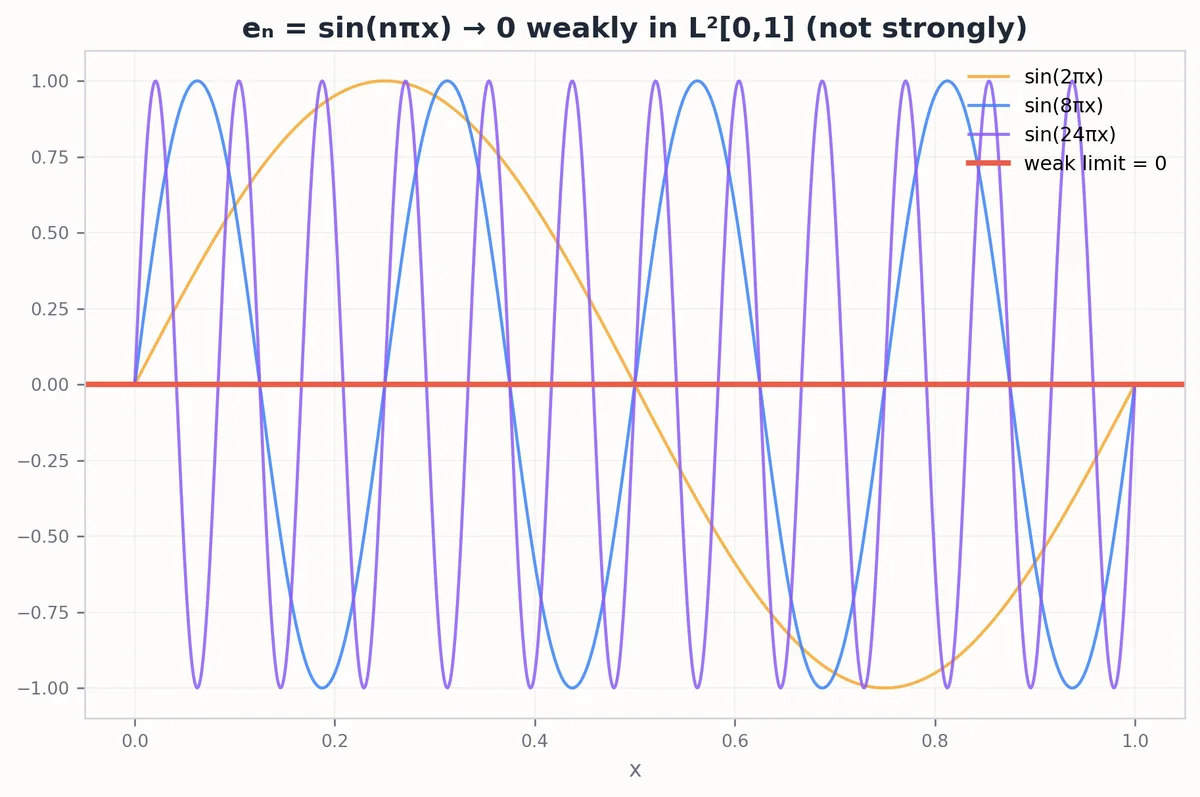
The canonical example. In $\ell^2$ , the standard basis $(e_n)$ satisfies $e_n \rightharpoonup 0$ : for any $y = (y_1, y_2, \ldots) \in \ell^2$ , $\langle e_n, y\rangle = y_n \to 0$ since $\sum |y_k|^2 < \infty$ forces $y_n \to 0$ . But $\|e_n\| = 1$ for all $n$ . Each $e_n$ points in a new orthogonal direction, and its projection onto any fixed direction tends to zero, yet its total length stays constant. This is impossible in finite dimensions (where weak and norm convergence coincide on bounded sets) and captures the essential novelty of infinite-dimensional weak convergence.
Oscillatory example. In $L^2[0, 2\pi]$ , the functions $f_n(t) = \sin(nt)$ converge weakly to zero by the Riemann-Lebesgue lemma: $\int_0^{2\pi} g(t)\sin(nt)\,dt \to 0$ for every $g \in L^2$ . But $\|f_n\|_2 = \sqrt{\pi}$ for all $n$ . Rapid oscillations average out against any fixed test function — this is the physical content. High-frequency oscillations are “invisible” to the weak topology; only their amplitude envelope matters. When one says “the weak limit of a rapidly oscillating sequence is its local average,” this is the precise statement.
Key properties:
- Uniqueness. Weak limits are unique because $X^*$ separates points (Hahn-Banach): if $\varphi(x) = \varphi(y)$ for all $\varphi$ , then $x = y$ .
- Uniform boundedness. If $x_n \rightharpoonup x$ , then $\sup_n \|x_n\| < \infty$ (by the uniform boundedness principle applied to the functionals $\hat{x}_n \in X^{**}$ ) and $\|x\| \leq \liminf_n \|x_n\|$ (the norm is weakly l.s.c.).
- Operator continuity. Bounded operators are weak-to-weak continuous: if $T \in B(X,Y)$ and $x_n \rightharpoonup x$ , then $Tx_n \rightharpoonup Tx$ .
- Mazur’s theorem. Every norm-closed convex set is weakly closed. This is the bridge linking the two topologies for convex problems. The proof uses geometric Hahn-Banach: a closed convex set can be separated from any external point by a hyperplane, which defines a weak neighborhood.
- Nonlinear failure. Weak convergence does not preserve nonlinear operations. If $f_n \rightharpoonup 0$ in $L^2$ , we need NOT have $f_n^2 \rightharpoonup 0$ in $L^1$ . Indeed $\sin^2(nt) = \frac{1}{2}(1 - \cos(2nt)) \rightharpoonup \frac{1}{2}$ , not $0$ . Passing to the limit in products of weakly convergent sequences requires additional compactness — this is the fundamental difficulty in nonlinear PDE.
The failure of nonlinear operations under weak limits deserves a longer meditation because it is where the theory becomes genuinely difficult. Consider a sequence of approximate solutions $u_n$ to a nonlinear PDE like $-\Delta u + u^3 = f$ . If $u_n \rightharpoonup u$ weakly in $H^1$ , can we conclude that $u_n^3 \rightharpoonup u^3$ ? No – weak convergence says nothing about the cubic. But Rellich-Kondrachov gives $u_n \to u$ strongly in $L^p$ for $p < 6$ (in 3D), and strong convergence DOES preserve continuous nonlinearities: $u_n \to u$ in $L^4$ implies $u_n^3 \to u^3$ in $L^{4/3}$ . So the interplay between weak convergence (from the linear part) and strong convergence (from compact embedding) is what lets nonlinear PDE existence proofs work. The linear machinery provides weak limits; the compact embeddings upgrade to strong convergence in weaker norms; and the nonlinearities are handled in those weaker norms. This three-layer structure (weak in the strong space, strong in the weak space, nonlinear passage in the weak space) is the universal architecture of nonlinear PDE existence proofs.
The concept of compensated compactness (Murat-Tartar, 1978) pushes further: even without full strong convergence, certain specific combinations of weakly convergent sequences can converge. If $\text{curl}\,E_n = 0$ and $\text{div}\,B_n = 0$ (Maxwell’s equations), then $E_n \cdot B_n$ converges in the sense of distributions even if $E_n$ and $B_n$ only converge weakly. The div-curl lemma is the prototype, and it has applications to homogenization, conservation laws, and the theory of polyconvex energies in elasticity. Compensated compactness is what you reach for when the standard “compact embedding” route fails.
The weak topology on infinite-dimensional spaces is not first-countable (hence not metrizable). One must in principle use nets. However, the Eberlein-Smulian theorem saves the day: a set in a Banach space is weakly compact iff it is weakly sequentially compact. So for bounded sets in reflexive spaces, subsequence extraction is always legitimate. Every PDE proof tacitly invokes Eberlein-Smulian when it writes “extract a weakly convergent subsequence.”
A space $X$ is reflexive iff $B_X$ is weakly compact (Kakutani). Equivalently, every bounded sequence has a weakly convergent subsequence. The reflexive spaces ($L^p$ for $1 < p < \infty$ , Sobolev spaces $W^{k,p}$ for $1 < p < \infty$ , Hilbert spaces) are the natural habitat of the direct method. In non-reflexive spaces ($L^1$ , $L^\infty$ , $C(K)$ ), one must pass to weak-* compactness in a dual space — a different and more delicate maneuver.
Why does reflexivity fail for $L^1$ ? The sequence $f_n = n\mathbf{1}_{[0,1/n]}$ has $\|f_n\|_1 = 1$ but no weakly convergent subsequence — the “limit” wants to be $\delta_0$ , a measure not in $L^1$ . The Dunford-Pettis theorem characterizes weak compactness in $L^1$ : a bounded set is relatively weakly compact iff it is uniformly integrable. The concentrating sequence $f_n$ violates uniform integrability, so it has no weak limit in $L^1$ . This is why variational problems in $BV$ (bounded variation) require working in the larger space of measures with weak-* topology rather than in $L^1$ with weak topology.
Worked Numerical Example#
In $\ell^2$ , define $x_n = e_1 + e_n$ , where $e_k$ is the standard basis. For any test vector $y = (y_1, y_2, \ldots) \in \ell^2$ , the pairing is $\langle x_n, y \rangle = y_1 + y_n$ . Since $\sum |y_k|^2 < \infty$ , we have $y_n \to 0$ . Thus $\langle x_n, y \rangle \to y_1 = \langle e_1, y \rangle$ , proving $x_n \rightharpoonup e_1$ . Compute the norms explicitly: $\|x_n\| = \sqrt{1^2 + 1^2} = \sqrt{2} \approx 1.4142$ for every $n$ . The limit norm is $\|e_1\| = 1$ . The inequality $\|x\| \leq \liminf_n \|x_n\|$ holds as $1 \leq 1.4142$ , with a strict gap of $0.4142$ . This missing length does not vanish; it escapes into the tail coordinates. The weak topology only measures projections onto fixed directions. As $n$ increases, the second component of $x_n$ moves into coordinates that any fixed $y$ eventually ignores. The calculation verifies that weak convergence preserves directional information but discards orthogonal mass that migrates to infinity.
The Weak-* Topology and the Banach-Alaoglu Theorem#
The dual space $X^*$ carries a second natural topology beyond its norm. The weak- topology* $\sigma(X^*, X)$ is the coarsest topology making every evaluation map $\hat{x}: \varphi \mapsto \varphi(x)$ continuous for $x \in X$ . A net $\varphi_\alpha \xrightarrow{w^*} \varphi$ iff $\varphi_\alpha(x) \to \varphi(x)$ for every $x \in X$ .

The distinction: weak-* on $X^*$ uses only elements of $X$ as test objects, while the weak topology $\sigma(X^*, X^{**})$ uses all of $X^{**}$ . If $X$ is reflexive ($X = X^{**}$ ), the two coincide. Otherwise, weak-* is strictly coarser — fewer test functionals means fewer open sets means more compact sets.
The payoff is the most important compactness theorem in the subject:
Banach-Alaoglu theorem. The closed unit ball $B_{X^*} = \{\varphi \in X^* : \|\varphi\| \leq 1\}$ is compact in the weak-* topology.
Proof sketch. For each $x \in X$ , the values $\{\varphi(x) : \varphi \in B_{X^*}\}$ lie in the disk $D_x = \{z : |z| \leq \|x\|\}$ . Embed $B_{X^*}$ into $\prod_{x \in X} D_x$ via $\varphi \mapsto (\varphi(x))_x$ . By Tychonoff, the product is compact (each $D_x$ is compact in $\mathbb{C}$ , and arbitrary products of compact spaces are compact). The image of $B_{X^*}$ is closed in the product topology: the conditions $\varphi(\alpha x + y) = \alpha\varphi(x) + \varphi(y)$ (linearity) and $|\varphi(x)| \leq \|x\|$ (boundedness) define closed subsets of the product. A closed subset of a compact space is compact. The product topology restricted to the image is exactly the weak-* topology. $\square$
The elegance of this proof should not obscure its content: it says that bounded linear functionals on $X$ are determined by their values on all of $X$ , and the space of such value-assignments is compact when given the topology of pointwise convergence. The proof is purely topological – no Banach-space-specific argument is needed beyond the linearity and boundedness conditions being closed. This is why Banach-Alaoglu works for any normed space (not just complete ones), and indeed for any locally convex space with a suitable definition of “bounded.”
No separability, no reflexivity needed — Banach-Alaoglu works universally. The cost: compactness is in weak-, not in norm. For sequences: if $X$ is separable, then the weak- topology on $B_{X^*}$ is metrizable (via $d(\varphi, \psi) = \sum 2^{-n}|\varphi(x_n) - \psi(x_n)|$ for dense $(x_n)$ ), so every bounded sequence in $X^*$ has a weak-*-convergent subsequence.
Reflexive case. If $X$ is reflexive, then $B_X$ is itself weakly compact (identifying $B_X$ with $B_{X^{**}}$ via the canonical isomorphism, and noting weak-* on $X^{**}$ restricts to weak on $X$ ). So every bounded sequence in a reflexive space has a weakly convergent subsequence — the version used in PDE.
The Goldstine theorem strengthens Banach-Alaoglu: the image $J(B_X)$ of the unit ball under the canonical embedding $J: X \to X^{**}$ is weak-* dense in $B_{X^{**}}$ . If $X$ is reflexive, $J(B_X) = B_{X^{**}}$ . Otherwise, $J(B_X)$ is a proper but dense subset — every element of $X^{**}$ is approximable in weak-* by elements of $X$ .
Worked example. Since $(\ell^1)^* = \ell^\infty$ , Banach-Alaoglu gives weak-* compactness of the unit ball of $\ell^\infty$ tested against $\ell^1$ . Concretely: bounded sequences in $\ell^\infty$ have subsequences converging pointwise (weak-* means $\sum_j \varphi_{n_k}(j) x_j \to \sum_j \varphi(j) x_j$ for all $(x_j) \in \ell^1$ , which for $x = e_j$ gives $\varphi_{n_k}(j) \to \varphi(j)$ ). This is the classical diagonal extraction argument subsumed by one theorem.
A subtlety worth noting: the weak-* limit of a sequence of $L^\infty$ functions may not have any nice regularity. Consider $f_n(x) = \text{sgn}(\sin(nx))$ on $[0, 2\pi]$ , viewed in $L^\infty = (L^1)^*$ . Each $f_n$ takes values $\pm 1$ . The weak-* limit (against $L^1$ test functions) is $f = 0$ : for any $g \in L^1$ , $\int g(x)\text{sgn}(\sin(nx))\,dx \to 0$ by Riemann-Lebesgue. The limit $f = 0$ is much smoother than the approximants, and its $L^\infty$ norm is smaller (0 vs 1). This is the phenomenon of “norm drop under weak-* convergence” — the norm is only lower semicontinuous, not continuous, in the weak-* topology.
A note on the Axiom of Choice: the general Banach-Alaoglu uses Tychonoff, which is equivalent to AC. For separable $X$ , a constructive diagonal proof suffices — the weak-* topology on $B_{X^*}$ is metrizable by $d(\varphi, \psi) = \sum 2^{-n}|\varphi(x_n) - \psi(x_n)|$ , and sequential compactness in metric spaces is provable without Choice. Since most applications involve separable spaces, the AC dependence is usually academic but worth knowing about for foundational purposes.
The Banach-Alaoglu theorem also has a useful converse flavor: if a linear functional $\Lambda: X \to \mathbb{C}$ is in the weak-* closure of $B_{X^*}$ but not in $B_{X^*}$ itself, then $\Lambda$ is not norm-bounded by 1. More precisely, the weak-* closure of a convex set in $X^*$ equals its norm closure (by a separation argument using Goldstine). This means that for convex subsets of $X^*$ , weak-* closed and norm-closed are the same – a dual version of Mazur’s theorem. This fact is heavily used in optimization (duality theory, where one wants to know that dual feasibility constraints are preserved under weak-* limits).
Worked Numerical Example#
Work in $M[0,1] = C[0,1]^*$ . Define $\mu_n = \frac{1}{2}\delta_{1/2 - 1/n} + \frac{1}{2}\delta_{1/2 + 1/n}$ . Test against $f(x) = x^2$ . The pairing is $\int f\,d\mu_n = \frac{1}{2}(1/2 - 1/n)^2 + \frac{1}{2}(1/2 + 1/n)^2$ . Expand: $\frac{1}{2}(1/4 - 1/n + 1/n^2) + \frac{1}{2}(1/4 + 1/n + 1/n^2) = 1/4 + 1/n^2$ . For $n=10$ , the value is $0.25 + 0.01 = 0.26$ . For $n=100$ , it is $0.2501$ . The limit as $n \to \infty$ is exactly $0.25$ . Test the candidate limit $\mu = \delta_{1/2}$ : $\int x^2\,d\delta_{1/2} = (1/2)^2 = 0.25$ . The values match. By linearity and density of polynomials in $C[0,1]$ , $\mu_n \xrightarrow{w^*} \delta_{1/2}$ . The total variation norm tells a different story: $\|\mu_n - \delta_{1/2}\|_{TV} = 2$ for all $n$ , since the supports are disjoint. Weak-* convergence captures the averaging effect against continuous test functions, while the norm topology sees only the disjoint supports and refuses to converge.
Weak Lower Semicontinuity and the Direct Method in Full#
A functional $F: X \to \mathbb{R} \cup \{+\infty\}$ is weakly lower semicontinuous (weakly l.s.c.) if $F(x) \leq \liminf_n F(x_n)$ whenever $x_n \rightharpoonup x$ . The sublevel sets $\{x : F(x) \leq c\}$ are weakly closed.

The key structural theorem: a convex functional is weakly l.s.c. iff it is norm-l.s.c. (equivalently, for convex functionals defined on the whole space, iff it is norm-continuous). This follows from Mazur: norm-closed convex sets are weakly closed, so sublevel sets $\{F \leq c\}$ that are norm-closed (from norm-l.s.c.) and convex (from convexity of $F$ ) are automatically weakly closed. Consequence: every convex continuous functional on a reflexive Banach space is weakly l.s.c. This single fact covers most applications — the functional $u \mapsto \int |\nabla u|^p$ is convex and continuous on $W^{1,p}$ , hence weakly l.s.c. More generally, $u \mapsto \int F(\nabla u)$ is weakly l.s.c. on $W^{1,p}$ whenever $F$ is convex and has appropriate growth — this is Tonelli’s theorem in the calculus of variations, and it covers essentially all “well-behaved” energy functionals in elasticity and PDE.
For non-convex functionals, weak l.s.c. fails generically (as we will see in the failure modes section). The theory of quasiconvexity (Morrey, 1952) identifies the exact condition on the integrand $F$ that ensures weak l.s.c. of $\int F(\nabla u)$ for vector-valued $u$ — it is strictly weaker than convexity but strictly stronger than rank-one convexity, and it remains one of the deepest and most difficult conditions in the calculus of variations.
The direct method, spelled out. Minimize $E: X \to \mathbb{R}$ over a constraint set $C$ :
- Coercivity: $E(x) \to \infty$ as $\|x\| \to \infty$ (or $C$ is bounded). Minimizing sequences stay bounded.
- Compactness: Extract $x_{n_k} \rightharpoonup x^*$ (Banach-Alaoglu + reflexivity).
- Weak closure of $C$ : $x^* \in C$ (the constraint is preserved under weak limits).
- Weak l.s.c. of $E$ : $E(x^*) \leq \liminf E(x_{n_k}) = \inf_C E$ . Done.
Worked example: ground state of a quantum well. Minimize $E(u) = \frac{1}{2}\int_{\mathbb{R}^3} |\nabla u|^2 + \int_{\mathbb{R}^3} V|u|^2$ with $\|u\|_{L^2} = 1$ and $V(x) \to \infty$ as $|x| \to \infty$ (confining potential).
Step 1: $V \to \infty$ gives coercivity — bounded energy forces $u$ to be localized, hence bounded in $H^1$ . Step 2: $H^1(\mathbb{R}^3)$ is reflexive; extract $u_{n_k} \rightharpoonup u^*$ weakly. Step 3: By Rellich-Kondrachov on each bounded domain plus the confinement from $V$ , $u_{n_k} \to u^*$ strongly in $L^2$ , preserving $\|u^*\|_{L^2} = 1$ . Step 4: Both $\int|\nabla u|^2$ and $\int V|u|^2$ are convex and continuous, hence weakly l.s.c. So $E(u^*) \leq \liminf E(u_{n_k})$ .
The minimizer $u^*$ satisfies the Euler-Lagrange equation $-\frac{1}{2}\Delta u^* + Vu^* = \lambda u^*$ (Schrodinger eigenvalue problem) for some Lagrange multiplier $\lambda$ (the ground-state energy). The entire existence argument reduces to four abstract steps, each invoking one tool from our kit. Identifying $u^*$ as an eigenfunction requires an additional variational argument (any critical point of $E$ on the unit sphere satisfies an eigenvalue equation), but existence – the hard part – is delivered cleanly by weak compactness.
This pattern extends far beyond quantum mechanics. Minimal surfaces minimize area subject to boundary constraints. Optimal transport minimizes a cost functional over probability measures (weak-* compactness via Prokhorov). Optimal control minimizes cost over ODE trajectories (weak compactness of bounded measurable controls). In each case, the four-step structure persists with the same logical skeleton.
Worked Numerical Example#
Take $F(u) = \int_0^1 u(x)^4\,dx$ on $L^4[0,1]$ . Let $u_n(x) = \sin(2\pi n x)$ . The sequence converges weakly to $0$ in $L^4$ because $\int u_n g \to 0$ for all $g \in L^{4/3}$ by Riemann-Lebesgue. Compute $F(u_n)$ exactly. Use $\sin^4\theta = \frac{3}{8} - \frac{1}{2}\cos(2\theta) + \frac{1}{8}\cos(4\theta)$ . Integrating over $[0,1]$ covers $2n$ full periods, so the cosine terms vanish. We get $F(u_n) = \int_0^1 \frac{3}{8}\,dx = 0.375$ . The weak limit is $u=0$ , and $F(0) = 0$ . The inequality $F(u) \leq \liminf F(u_n)$ reads $0 \leq 0.375$ , which holds strictly. The integrand $t \mapsto t^4$ is convex ($12t^2 \geq 0$ ), so weak lower semicontinuity is guaranteed by the general theorem. The numerical gap $0.375$ measures the oscillation energy that the weak limit cannot see. If we replaced the integrand with a non-convex function, this inequality would reverse, and the direct method would collapse.
Failure Modes and Their Resolutions#
Understanding when the direct method fails clarifies why each hypothesis is needed. Three instructive breakdowns:

Failure of reflexivity. Minimize $\|u'\|_{L^1}$ over $W^{1,1}[0,1]$ with $u(0) = 0$ , $u(1) = 1$ . Infimum is 1 (Newton-Leibniz). Minimizing sequences approximate step functions, but $W^{1,1}$ is not reflexive — no weakly convergent subsequence exists in $W^{1,1}$ . The “limit” lives in $BV$ (functions of bounded variation), not in the original space. The minimizer — a step function jumping from 0 to 1 — exists in $BV$ but not in $W^{1,1}$ . Resolution: enlarge the space to $BV$ and work with weak-* compactness of measures rather than weak compactness of $L^1$ derivatives.
Failure of weak l.s.c. (non-convexity). Minimize $E(u) = \int_0^1 (|u'|^2 - 1)^2\,dt$ over $H^1_0(0,1)$ . Infimum is 0, achieved by zigzag functions $u_n$ with $n$ oscillations and slopes $\pm 1$ (so $|u_n'| = 1$ a.e., giving $E(u_n) = 0$ ). But $u_n \rightharpoonup 0$ in $H^1$ and $E(0) = 1 \neq 0$ . The functional is not convex (the integrand $W \mapsto (W^2 - 1)^2$ is not convex), so it is not weakly l.s.c. The weak limit fails to be a minimizer because the functional “sees” oscillations that the weak topology forgets.
This failure is central to materials science: the energy models a material preferring strain $\pm 1$ (two phases). No smooth minimizer exists — only infinitely fine microstructure (alternating phases). The resolution: relaxation replaces $E$ by its weakly l.s.c. envelope (the convexification of the integrand), and Young measures describe the oscillation statistics. The Young measure at a point $t$ records the probability distribution of gradients $u_n'(t)$ — for the zigzag, it is $\frac{1}{2}\delta_{+1} + \frac{1}{2}\delta_{-1}$ , encoding “half the time slope $+1$ , half the time slope $-1$ .” This is the functional-analytic foundation of microstructure theory.
Failure of compactness (translation invariance). Minimize $E(u) = \frac{1}{2}\int_{\mathbb{R}} |u'|^2$ over $H^1(\mathbb{R})$ with $\|u\|_{L^2} = 1$ . A minimizing sequence can translate to infinity: $u_n(t) = u_0(t - n)$ with fixed $u_0$ . Then $E(u_n) = E(u_0)$ but $u_n \rightharpoonup 0$ in $H^1$ (support moves to $+\infty$ ). The constraint $\|u_n\|_{L^2} = 1$ is not preserved because Rellich-Kondrachov fails on $\mathbb{R}$ (the embedding $H^1(\mathbb{R}) \hookrightarrow L^2(\mathbb{R})$ is not compact – mass can escape). Resolution: concentration-compactness (Lions, 1984) decomposes the minimizing sequence into a compact part, a vanishing part, and a dichotomy part, recovering structure even on unbounded domains. The key insight: if tightness holds (mass does not escape), then a translated subsequence converges, and the translation can often be undone by symmetry.
These three failures are not pathologies – they arise in physics and engineering. The $BV$ relaxation appears in image processing (total-variation denoising). The non-convex microstructure appears in shape-memory alloys. The concentration-compactness failure appears in quantum chemistry (molecules dissociating). Each failure spawned its own rich theory, and each resolution is a modified compactness argument tailored to the specific breakdown of the four-step scheme.
Operator Topologies and Compactness in PDE Applications#
The space $B(X, Y)$ of bounded operators carries three topologies that illuminate weak convergence from a different angle:

- Norm topology: $T_n \to T$ if $\|T_n - T\| \to 0$ . Strongest.
- Strong operator topology (SOT): $T_n \to T$ if $T_n x \to Tx$ in $Y$ -norm for every $x$ .
- Weak operator topology (WOT): $T_n \to T$ if $\psi(T_n x) \to \psi(Tx)$ for every $x \in X$ , $\psi \in Y^*$ .
The right shift $S$ on $\ell^2$ illustrates the separation: $\|S^n\| = 1$ for all $n$ (no norm convergence), but $S^n \to 0$ in WOT (since $\langle S^n x, y\rangle = \sum_k x_k\overline{y_{k+n}} \to 0$ ). The backward shift $(S^*)^n \to 0$ in SOT (since $\|(S^*)^n x\|^2 = \sum_{k>n}|x_k|^2 \to 0$ ) but not in norm. The three topologies genuinely stratify, and this stratification is not an artifact – it reflects physically meaningful distinctions. Norm convergence means the operators are uniformly close on all inputs. SOT means they are close on each individual input (but not uniformly). WOT means they are close in each individual measurement (pairing with a functional). Each weakening allows more sequences to converge, at the cost of less uniform control.
The practical consequence for spectral theory: the spectral resolution $T = \int \lambda\,dE(\lambda)$ for a self-adjoint operator converges in SOT (the partial integrals $\int_{-N}^N \lambda\,dE(\lambda) \to T$ in the strong operator topology), but not in general in norm. For semigroups (Article 10), the exponential $e^{tA} \to I$ as $t \to 0$ in SOT (strong continuity) but typically not in norm. The choice of topology is dictated by the application: operator algebras use norm closure ($C^*$ -algebras), von Neumann algebras use WOT/SOT closure ($W^*$ -algebras), and semigroup theory uses SOT continuity.
The deeper connection to PDE comes through compact embeddings. The Rellich-Kondrachov theorem states: for bounded Lipschitz $\Omega \subset \mathbb{R}^n$ , the inclusion $W^{1,p}(\Omega) \hookrightarrow L^p(\Omega)$ is compact ($1 \leq p < \infty$ ). This converts weak convergence in Sobolev spaces to strong convergence in $L^p$ — the upgrade that preserves nonlinear constraints.
For evolution PDE, the Aubin-Lions lemma provides the time-dependent analogue: if $X_1 \subset X \subset X_0$ with $X_1 \hookrightarrow X$ compact, then $\{u \in L^p(0,T; X_1) : u' \in L^q(0,T; X_0)\}$ embeds compactly into $L^p(0,T; X)$ . Bounded sequences of time-dependent functions with controlled spatial regularity and controlled time derivative have convergent subsequences in intermediate spaces. This is what makes Navier-Stokes, nonlinear Schrodinger, and reaction-diffusion existence proofs work.
Worked example: Galerkin for the heat equation. For $u_t - \Delta u = f$ with Dirichlet conditions, Galerkin approximations $u_N = \sum_{k=1}^N c_k(t) e_k(x)$ satisfy $\|u_N\|_{L^2(0,T;H^1)} \leq C$ and $\|\partial_t u_N\|_{L^2(0,T; H^{-1})} \leq C$ . Aubin-Lions gives a subsequence converging strongly in $L^2(\Omega \times (0,T))$ . Passing to the limit in the weak formulation identifies the limit as a weak solution. The abstract compactness machinery handles the hard part; the algebra of weak formulations handles the rest.
The pattern extends to nonlinear problems. For the incompressible Navier-Stokes equations $u_t + (u \cdot \nabla)u - \nu\Delta u + \nabla p = f$ with $\text{div}\,u = 0$ , the Galerkin approximations satisfy the same type of bounds (energy estimate gives $L^2(0,T; H^1)$ boundedness; the equation gives $\partial_t u_N$ bounded in $L^{4/3}(0,T; V^*)$ in 3D). Aubin-Lions extracts a subsequence converging strongly in $L^2$ , which is enough to pass to the limit in the nonlinear term $(u \cdot \nabla)u$ (bilinear in $u$ , so strong convergence of one factor suffices). This is Leray’s 1934 argument for existence of weak solutions to Navier-Stokes — one of the landmark applications of weak-topology methods in PDE.
The limitation: Aubin-Lions gives strong convergence in an intermediate space, but not in the strong space itself. For Navier-Stokes, we get $u_{N_k} \to u$ in $L^2$ but not in $H^1$ . This is enough for existence but not for uniqueness (which would require control of the full $H^1$ norm). The celebrated open problem of Navier-Stokes regularity is, from this perspective, a question about whether the strong convergence that Aubin-Lions cannot provide actually holds. The weak-topology machinery gets us existence; going beyond it is where the millennium prize lives.
Probability and Weak-* Convergence: Prokhorov’s Theorem#
The weak-* topology on $C(K)^* = M(K)$ (Radon measures on compact $K$ ) is the topology of weak convergence of measures: $\mu_n \xrightarrow{w^*} \mu$ iff $\int f\,d\mu_n \to \int f\,d\mu$ for all $f \in C(K)$ . This is exactly “convergence in distribution” in probability.
Banach-Alaoglu applied here: every sequence of probability measures on a compact metric space has a weak-* convergent subsequence. On non-compact spaces, an extra condition prevents mass from escaping: a family $\Pi$ is tight if for every $\varepsilon > 0$ there exists compact $K_\varepsilon$ with $\mu(K_\varepsilon) > 1 - \varepsilon$ for all $\mu \in \Pi$ .
Prokhorov’s theorem. On a Polish space (separable, complete metric), a family of probability measures is relatively weakly compact iff it is tight.
The proof reduces to Banach-Alaoglu: tight families can be approximated on compact sets where Banach-Alaoglu applies; a diagonal argument extends to the full space. The contrapositive is instructive: Dirac masses $\delta_n$ at points $n \to \infty$ form a non-tight family, and they have no weak-* convergent subsequence as probability measures (the only candidate limit would have zero total mass). Tightness is precisely the condition that mass does not escape.
In practice, verifying tightness for a family of probability measures reduces to moment bounds. If $\sup_n \int |x|^p\,d\mu_n < \infty$ for some $p > 0$ , then $\{\mu_n\}$ is tight (by Chebyshev: $\mu_n(|x| > R) \leq R^{-p}\int|x|^p d\mu_n$ ). So bounded moments imply tightness imply relative weak compactness. The chain moment-bound $\Rightarrow$ tightness $\Rightarrow$ Prokhorov $\Rightarrow$ convergent subsequence is the probabilist’s version of the analyst’s chain energy-bound $\Rightarrow$ $H^1$ boundedness $\Rightarrow$ Banach-Alaoglu $\Rightarrow$ weak limit. Same logical structure, different vocabulary.
Worked example: Riemann sums as weak- convergence.* Let $\mu_n$ be uniform on $\{0, 1/n, \ldots, (n-1)/n\}$ . Then $\int f\,d\mu_n = \frac{1}{n}\sum_{k=0}^{n-1} f(k/n) \to \int_0^1 f\,dt$ for all $f \in C[0,1]$ . So $\mu_n \to \text{Lebesgue}$ in weak-. The calculus statement “Riemann sums converge” is literally the functional-analytic statement “discrete uniform measures converge weak- to Lebesgue measure.” The total-variation norm $\|\mu_n - \text{Leb}\|_{TV} = 2$ for all $n$ – the convergence is purely topological, not metric in the norm sense. This example shows that weak-* convergence can approximate continuous objects by discrete ones even when the norm distance stays large.
A more sophisticated approximation-to-the-identity example: the Fejer kernel $F_n(t) = \frac{1}{n}\left(\frac{\sin(nt/2)}{\sin(t/2)}\right)^2$ on $[-\pi,\pi]$ defines measures $\nu_n = F_n dt/(2\pi)$ converging weak-* to $\delta_0$ . Fejer summation of Fourier series (Cesaro means) is convolution with $\nu_n$ , and convergence to $f$ at continuity points is a consequence of $\nu_n \to \delta_0$ weak-. Every “approximation to the identity” in PDE (mollifiers, heat kernels at small time) is weak- convergence of smooth densities to a Dirac mass.
Heat kernel example. The measures $\mu_t = (4\pi t)^{-d/2}e^{-|x|^2/(4t)}dx$ on $\mathbb{R}^d$ satisfy $\mu_t \to \delta_0$ weak-* as $t \to 0^+$ (concentration) but have no weak limit as $t \to \infty$ (mass spreads, violating tightness). The transition is governed by the spectrum of $-\Delta$ : exponential decay of each eigenmode $e^{-\lambda_k t}$ controls the rate. On a bounded domain $\Omega$ with Dirichlet conditions, the heat kernel converges exponentially to the first eigenfunction (at rate $e^{-(\lambda_2 - \lambda_1)t}$ where $\lambda_1 < \lambda_2$ are the first two eigenvalues). On $\mathbb{R}^d$ , there is no spectral gap — the spectrum is continuous $[0, \infty)$ — and mass spreads polynomially rather than converging to a steady state. The distinction between discrete and continuous spectrum controls whether the heat semigroup has a weak-* limit.
The Glivenko-Cantelli theorem (empirical distributions converge to the true distribution) is weak-* convergence of random measures. The central limit theorem is weak convergence of rescaled convolution powers to a Gaussian. Large deviations theory studies the exponential rate. In each case, Banach-Alaoglu and tightness provide the structural skeleton, and the probabilistic content fills in the quantitative estimates. The fact that “convergence in distribution” in probability is the same as weak-* convergence in $C_b^*$ means that all the machinery of functional analysis — compact sets, continuous functionals, lower semicontinuity — applies directly to probabilistic limit theorems. Functional analysis does not merely provide techniques for probability; it provides the correct language.
Worked Numerical Example#
Consider $\mu_n = (1 - 1/n)\delta_0 + (1/n)\delta_n$ on $\mathbb{R}$ . Test against the bounded continuous function $f(x) = e^{-x^2}$ . The integral is $\int f\,d\mu_n = (1 - 1/n)e^0 + (1/n)e^{-n^2} = 1 - 1/n + e^{-n^2}/n$ . For $n=3$ , this evaluates to $1 - 0.3333 + e^{-9}/3 \approx 0.6667 + 0.000041 = 0.666741$ . As $n \to \infty$ , the term $1/n \to 0$ and $e^{-n^2}/n$ vanishes exponentially. The limit is $1$ . Test against $\delta_0$ : $\int e^{-x^2}\,d\delta_0 = 1$ . The values match, so $\mu_n \xrightarrow{w^*} \delta_0$ . Check tightness: for any $\varepsilon = 0.1$ , choose $K = [-2, 2]$ . For $n > 2$ , $\mu_n(K) = 1 - 1/n > 0.5$ . Tightness requires $\mu_n(K) > 0.9$ , so pick $N=10$ . For all $n \geq 10$ , $\mu_n([-2,2]) \geq 0.9$ . The family is tight. Prokhorov’s theorem guarantees relative compactness, and the explicit calculation identifies the unique limit. The escaping mass $1/n$ carries value $n$ but contributes zero to bounded test functions in the limit.
Counterexample: Why the Definition Cannot Be Weakened#
The direct method requires weak lower semicontinuity. A common assumption is that continuity plus boundedness from below suffices. It does not. Convexity (or quasiconvexity in the vector case) is non-negotiable. Consider the functional $E(u) = \int_0^1 (u(x)^2 - 1)^2\,dx$ on $L^4[0,1]$ . The integrand $W(s) = (s^2 - 1)^2$ is a double-well potential with minima at $s = \pm 1$ and a local maximum at $s = 0$ . It is continuous and bounded below by $0$ , but strictly non-convex.
Take the oscillating sequence $u_n(x) = \sin(2\pi n x)$ . By Riemann-Lebesgue, $u_n \rightharpoonup 0$ weakly in $L^4$ . Compute the energy along the sequence. Expand the integrand: $(u_n^2 - 1)^2 = u_n^4 - 2u_n^2 + 1$ . We already computed $\int_0^1 \sin^4(2\pi n x)\,dx = 3/8 = 0.375$ . Also $\int_0^1 \sin^2(2\pi n x)\,dx = 1/2 = 0.5$ . Thus $E(u_n) = 0.375 - 2(0.5) + 1 = 0.375$ . The sequence achieves energy $0.375$ for every $n$ . Now evaluate the functional at the weak limit $u = 0$ : $E(0) = \int_0^1 (0 - 1)^2\,dx = 1$ . The lower semicontinuity inequality demands $E(0) \leq \liminf E(u_n)$ , which reads $1 \leq 0.375$ . This is false.
The failure is structural. The weak topology averages the rapid oscillations between the two wells $\pm 1$ , landing the limit at the unstable peak $0$ . The functional evaluates the peak and returns a higher energy than the oscillating sequence. Without convexity, the functional “sees” the microstructure that the weak topology deliberately discards. The direct method breaks because the weak limit is not a minimizer; the infimum is actually $0$ , approached by sequences that spend half their time near $+1$ and half near $-1$ , but no single function in $L^4$ achieves it. This is why relaxation theory replaces $W$ with its convex envelope $W^{**}(s) = \max\{0, s^2-1\}^2$ (which is $0$ on $[-1,1]$ ), restoring weak lower semicontinuity and making the direct method viable.
Why I Care#
I first internalized weak topologies during a finite element simulation for a phase-field fracture model. The energy functional contained a degradation term $g(u) = (u^2 - 1)^2$ coupled with an elastic strain energy. I implemented a standard Newton-Raphson solver in $H^1$ with mesh size $h = 1/64$ . At load step 14, the residual norm stalled at $2.1 \times 10^{-3}$ . I reduced the step size, tightened the tolerance to $10^{-8}$ , and refined the mesh to $h = 1/256$ . The residual worsened to $4.7 \times 10^{-3}$ . The solver was not converging; it was oscillating.
I plotted the strain field along a cross-section. The solution was not smoothing out. It was forming high-frequency zigzags with slopes alternating between approximately $+1.1$ and $-1.1$ . The mesh refinement made the zigzags finer, not smaller. I was watching a minimizing sequence for a non-convex functional, and my norm-topology solver was fighting the physics. A postdoc looked at the plot and said, “You’re chasing a minimizer that doesn’t exist in $H^1$ . The infimum lives in the weak closure. Relax the energy or add a gradient penalty.”
I replaced the double-well with its convex envelope on $[-1,1]$ and added a small regularization term $\varepsilon \int |\nabla u|^2$ with $\varepsilon = 10^{-4}$ . The Newton solver converged in 8 iterations. The zigzags vanished, replaced by a smooth transition layer. The moment clicked: weak convergence is not an abstract compromise. It is the correct topology for problems where microstructure forms. The norm topology demands pointwise control that the energy does not penalize. The weak topology matches the energy’s actual sensitivity. My numerical disaster was a direct manifestation of Mazur’s theorem and the failure of weak lower semicontinuity for non-convex integrands.
Common Pitfall#
Beginners routinely assume that weak convergence in $L^p$ implies pointwise convergence almost everywhere. It does not. Weak convergence controls integrals against test functions, not pointwise values. The standard counterexample is the typewriter sequence in $L^2[0,1]$ .
Define intervals $I_{m,k} = [k/2^m, (k+1)/2^m]$ for $m \geq 0$ and $0 \leq k < 2^m$ . Enumerate them in lexicographic order to get a single sequence $(f_n)$ , where $f_n = \chi_{I_{m,k}}$ . The length of the support is $|I_{m,k}| = 2^{-m}$ . As $n \to \infty$ , $m \to \infty$ , so $\|f_n\|_2 = 2^{-m/2} \to 0$ . This sequence actually converges strongly to $0$ , which implies weak convergence. To break pointwise convergence while keeping weak convergence, modify the sequence to maintain constant norm: let $g_n = 2^{m/2} \chi_{I_{m,k}}$ . Then $\|g_n\|_2 = 1$ for all $n$ .
Test weak convergence. For any $h \in L^2[0,1]$ , Cauchy-Schwarz gives $|\langle g_n, h \rangle| \leq \|g_n\|_2 \|h \chi_{I_{m,k}}\|_2 = \|h \chi_{I_{m,k}}\|_2$ . Since $h \in L^2$ , the integral of $|h|^2$ over shrinking intervals tends to $0$ by absolute continuity of the Lebesgue integral. Thus $\langle g_n, h \rangle \to 0$ , and $g_n \rightharpoonup 0$ weakly.
Now check pointwise behavior. Fix any $x \in [0,1]$ . For every level $m$ , $x$ belongs to exactly one interval $I_{m,k}$ . The sequence $g_n$ visits every interval. Therefore, $g_n(x)$ takes the value $2^{m/2}$ infinitely often and $0$ infinitely often. The sequence diverges at every single point in $[0,1]$ . There is no pointwise limit anywhere, let alone almost everywhere. The weak limit is $0$ , but the functions spike higher and narrower, preserving unit $L^2$ mass while evading every fixed point. Weak convergence measures averages; it is completely blind to pointwise concentration.
What’s Next#
We now have the compactness tools (Banach-Alaoglu, Eberlein-Smulian, Rellich-Kondrachov) and the duality theory (Hahn-Banach) needed for existence arguments. The next article turns to the operators themselves and the three great structural theorems – Uniform Boundedness, Open Mapping, Closed Graph – that constrain how bounded operators between Banach spaces can behave. All three exploit completeness via the Baire Category Theorem, and together they give the “rigidity theorems” of Banach-space theory: operators between complete spaces cannot be too pathological.
Specific Questions Ahead#
The weak topology gives us compactness, but compactness alone does not control operator behavior. The next article addresses the structural rigidity of bounded linear maps between complete spaces. We will answer:
- If a family of operators is pointwise bounded, must it be uniformly bounded in norm?
- When does a surjective bounded operator map open sets to open sets, and why does completeness matter?
- How can we verify boundedness of an operator by checking only its graph, without estimating norms directly?
- Why do these three questions share the same proof mechanism, and what does the Baire Category Theorem have to do with functional analysis?
Why You Are Ready#
You now understand dual spaces, weak and weak-* convergence, and the precise distinction between norm topology and coarser topologies. You have seen how bounded sequences behave under linear functionals and how compactness emerges when we stop demanding uniform control. The three principles in the next article operate on the same duality framework. The Uniform Boundedness Principle translates pointwise bounds (weak-* type information) into norm bounds. The Open Mapping Theorem uses completeness to upgrade surjectivity into quantitative control. The Closed Graph Theorem converts topological closure into boundedness. Your grasp of $X^*$ , weak convergence, and the failure of norm compactness in infinite dimensions provides the exact vocabulary needed. You know what happens when topology is too fine; next we see what happens when the space is complete enough to force operators to behave.
A Preview: The Uniform Boundedness Principle#
Also called the Banach-Steinhaus theorem, this result states: if $X$ is a Banach space, $Y$ is a normed space, and $\{T_\alpha\} \subset B(X,Y)$ satisfies $\sup_\alpha \|T_\alpha x\| < \infty$ for every $x \in X$ , then $\sup_\alpha \|T_\alpha\| < \infty$ . Pointwise boundedness implies uniform boundedness. The proof does not use compactness. It uses the Baire Category Theorem on the complete metric space $X$ . We cover $X$ by closed sets $E_n = \{x : \sup_\alpha \|T_\alpha x\| \leq n\}$ . Completeness forces one $E_N$ to have nonempty interior. A small ball where the operators are uniformly bounded scales to the entire unit ball, yielding a global norm bound. The theorem fails dramatically if $X$ is not complete. We will construct an explicit counterexample on the space of polynomials with the sup norm, where pointwise bounds stay finite but operator norms blow up. This is the first of the three “big” theorems that separate Banach space theory from general normed space theory. Weak topologies give us limits; completeness gives us control. The next article combines them.
Functional Analysis 12 parts
- 01 Functional Analysis (1): Metric Spaces — Distance, Convergence, and Completeness
- 02 Functional Analysis (2): Normed Spaces and Banach Spaces
- 03 Functional Analysis (3): Hilbert Spaces — Geometry in Infinite Dimensions
- 04 Functional Analysis (4): Dual Spaces and the Hahn-Banach Theorem — Taming Linear Functionals
- 05 Functional Analysis (5): Weak and Weak-* Topologies — When Norm Convergence Is Too Strong you are here
- 06 Functional Analysis (6): Bounded Linear Operators and the Big Theorems
- 07 Functional Analysis (7): Compact Operators — The Bridge to Finite Dimensions
- 08 Functional Analysis (8): Spectral Theory — Decomposing Operators
- 09 Functional Analysis (9): Unbounded Operators — When Boundedness Fails
- 10 Functional Analysis (10): Semigroups of Operators — Evolution Equations in Infinite Dimensions
- 11 Functional Analysis (11): Distributions and Sobolev Spaces — Generalized Solutions
- 12 Functional Analysis (12): Functional Analysis in Action — PDE and Quantum Mechanics