Functional Analysis (6): Bounded Linear Operators and the Big Theorems
The Uniform Boundedness Principle, Open Mapping Theorem, and Closed Graph Theorem — three consequences of completeness that constrain how operators can behave.
Why This Article Is Where the Theory Catches Fire#
For five articles I have been building scaffolding: metric and normed spaces, Hilbert spaces, dual spaces, weak topologies. None of those individually felt very impressive — I am, after all, just doing topology and linear algebra in slightly more general settings than usual. The point at which functional analysis genuinely delivers is right here, in the three great theorems of Banach space operator theory: the Uniform Boundedness Principle, the Open Mapping Theorem, and the Closed Graph Theorem. Each of these takes a piece of “pointwise” or “set-theoretic” data — pointwise boundedness, surjectivity, closedness of the graph — and concludes a global structural property — uniform boundedness, openness, continuity — that has no analog in finite dimensions because finite-dimensional linear algebra makes them all true automatically.

The proofs all share a common engine: the Baire category theorem applied to the Banach space, exploiting completeness in the same way each time. Once you have one of the three theorems, the other two follow with relatively short additional arguments. So this whole article is really about one idea, refracted through three corollaries.
Bounded Linear Operators: A Recap#
$$\|T\| = \sup_{\|x\|_X \leq 1} \|T x\|_Y = \sup_{x \neq 0} \|T x\|_Y / \|x\|_X.$$
The space $B(X, Y)$ of bounded linear operators is a normed space; if $Y$ is Banach, then $B(X, Y)$ is Banach. (Cauchy sequences of operators converge pointwise to a limit; uniform Cauchy-ness propagates.) When $Y = \mathbb{C}$ , $B(X, \mathbb{C}) = X^*$ , recovering the dual space.
For composition: if $T \in B(X, Y)$ and $S \in B(Y, Z)$ , then $S T \in B(X, Z)$ with $\|S T\| \leq \|S\| \|T\|$ . So $B(X)$ is a Banach algebra (Banach space + algebra structure compatible with the norm) when $X$ is Banach.
A catalog of bounded operators#
A few examples I will refer to throughout the article:
- Multiplication operator. On $L^2[0,1]$ , $M_a f(t) = a(t) f(t)$ for $a \in L^\infty$ . Bounded with $\|M_a\| = \|a\|_\infty$ .
- Shift operator. On $\ell^2$ , $S(x_1, x_2, \ldots) = (0, x_1, x_2, \ldots)$ . Bounded with $\|S\| = 1$ .
- Integral operator. On $L^2[0,1]$ , $K f(t) = \int_0^1 k(t, s) f(s)\,ds$ with $k \in L^2([0,1]^2)$ . Bounded with $\|K\| \leq \|k\|_{L^2([0,1]^2)}$ .
- Differentiation. On suitable subspaces, $D f = f'$ — bounded if domain has the $C^1$ -norm, unbounded if domain has the sup-norm.

The Three Big Theorems: Statements#
Let me state all three before proving any. They come as a package.

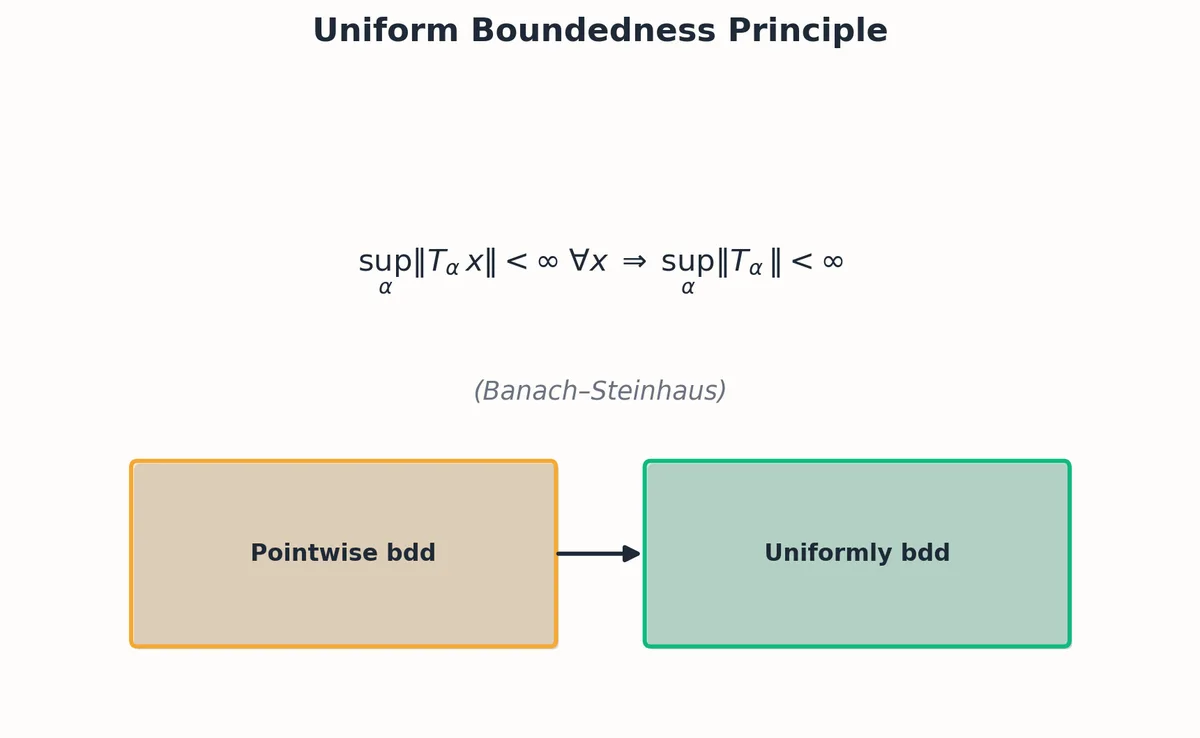
(UBP) Uniform Boundedness Principle. Let $X$ be a Banach space, $Y$ any normed space, and $\mathcal{F} \subseteq B(X, Y)$ a family of bounded operators. If $\sup_{T \in \mathcal{F}} \|T x\| < \infty$ for every $x \in X$ (pointwise boundedness), then $\sup_{T \in \mathcal{F}} \|T\| < \infty$ (uniform boundedness).
(OMT) Open Mapping Theorem. Let $X, Y$ be Banach spaces and $T: X \to Y$ a bounded linear surjection. Then $T$ is an open map: $T(U)$ is open in $Y$ for every open $U \subseteq X$ .
(CGT) Closed Graph Theorem. Let $X, Y$ be Banach spaces and $T: X \to Y$ a linear map (not assumed bounded a priori). If the graph $\{(x, T x) : x \in X\}$ is closed in $X \times Y$ , then $T$ is bounded.

The three are intimately related; once we have UBP, OMT and CGT will fall out with relatively short additional work. All three rely on completeness of $X$ (UBP also requires completeness of $X$ ; OMT/CGT both require $X$ and $Y$ Banach).
Proving the Uniform Boundedness Principle#
The proof is so clean it should be done in detail.

Proof of UBP. For each $n \in \mathbb{N}$ , define $F_n = \{ x \in X : \|T x\| \leq n \text{ for all } T \in \mathcal{F} \}$ . Each $F_n$ is closed: it is the intersection over $T \in \mathcal{F}$ of the closed sets $\{ x : \|T x\| \leq n \}$ , and an arbitrary intersection of closed sets is closed.
By pointwise boundedness, every $x \in X$ lies in some $F_n$ (take $n \geq \sup_T \|T x\|$ ). So $X = \bigcup_n F_n$ . Since $X$ is a complete metric space, by Baire’s theorem at least one $F_{n_0}$ has non-empty interior — there is some closed ball $\overline{B(x_0, r)} \subseteq F_{n_0}$ .
That means $\|T x\| \leq n_0$ for every $T \in \mathcal{F}$ and every $x \in \overline{B(x_0, r)}$ . By translation: for every $z$ with $\|z\| \leq r$ , $\|T z\| \leq \|T(x_0 + z)\| + \|T x_0\| \leq 2 n_0$ . So $\|T\| \leq 2 n_0 / r$ for every $T \in \mathcal{F}$ , completing the proof. $\square$
A quick example of UBP at work#
Suppose $(\varphi_n)$ is a sequence of bounded linear functionals on a Banach space $X$ with $\varphi_n(x) \to \varphi(x)$ for every $x \in X$ , for some functional $\varphi$ . Is $\varphi$ bounded? UBP says yes: pointwise convergence of $(\varphi_n(x))$ for every $x$ implies pointwise boundedness, which by UBP implies $\sup_n \|\varphi_n\| < \infty$ , and $|\varphi(x)| = \lim |\varphi_n(x)| \leq \sup_n \|\varphi_n\| \cdot \|x\|$ . So pointwise limits of bounded operators are bounded, with norm $\leq \liminf \|\varphi_n\|$ . Without UBP, one would have to assume the boundedness; with UBP, it is automatic.
Why this matters#
UBP is what lets me make pointwise arguments and conclude global facts. Pointwise boundedness is a far easier condition to verify — just check that for each individual $x$ , the family is bounded — than uniform boundedness, which would require a single bound holding over all $x, T$ simultaneously. UBP says they are equivalent in Banach space, and the trade is worth a lot. Examples in operator theory: any pointwise-converging sequence of bounded operators has a bounded operator as its limit; the Fourier coefficients of an $L^2$ function form a bounded family of functionals, etc.
Worked Numerical Example#
$$\|v_1\|_2 = 1, \quad \|v_4\|_2 = \sqrt{1 + \frac{1}{2} + \frac{1}{3} + \frac{1}{4}} = \sqrt{2.0833} \approx 1.443,$$ $$\|v_{10}\|_2 = \sqrt{\sum_{k=1}^{10} \frac{1}{k}} \approx \sqrt{2.9289} \approx 1.711.$$The harmonic series diverges, so $\|\varphi_n\| \to \infty$ . Wait, this violates UBP. The catch: the pointwise limit $\sum x_k/\sqrt{k}$ does not exist for all $x \in \ell^2$ . Take $x_k = 1/(k^{0.6})$ . Then $x \in \ell^2$ since $\sum k^{-1.2} < \infty$ , but $\sum x_k/\sqrt{k} = \sum k^{-1.1}$ converges. Take $x_k = 1/(k^{0.55})$ . Then $x \in \ell^2$ , but $\sum k^{-1.05}$ converges. To break pointwise boundedness, pick $x_k = 1/(k^{0.51})$ . Then $x \in \ell^2$ , but $\sum x_k/\sqrt{k} = \sum k^{-1.01}$ still converges. The harmonic weight $1/\sqrt{k}$ is actually in $\ell^2$ ? No, $\sum 1/k$ diverges, so $v \notin \ell^2$ . Thus there exists $x \in \ell^2$ making $\varphi_n(x)$ unbounded. UBP correctly predicts that if pointwise boundedness held, norms would be bounded. Since norms diverge, pointwise boundedness must fail somewhere. The theorem works both ways.
Proving the Open Mapping Theorem#
A bit more elaborate, but built on the same Baire argument.

Sketch of proof of OMT. By translation, it suffices to show $T(U)$ contains a ball around $0$ whenever $U$ is an open ball around $0$ .
Step 1: Since $T$ is surjective, $Y = \bigcup_n T(\overline{B(0, n)})$ . By Baire, some $\overline{T(\overline{B(0, n_0)})}$ has non-empty interior, so contains a ball $\overline{B(y_0, r_0)}$ . By symmetry, $-y_0 \in \overline{T(\overline{B(0, n_0)})}$ too, so $0$ is in the interior of $\overline{T(\overline{B(0, 2n_0)})}$ , i.e., there is some $r > 0$ with $\overline{B(0, r)} \subseteq \overline{T(\overline{B(0, 2n_0)})}$ . Rescaling, $\overline{B(0, r/(2n_0))} \subseteq \overline{T(\overline{B(0, 1)})}$ .
Step 2 (the trickier half — removing the closure). To remove the closure, use a series argument. Given $y$ with $\|y\| < r/(2n_0)$ , I want to find $x$ with $T x = y$ and $\|x\| < 1$ . By Step 1, there exist $x_1$ with $\|x_1\| < 1/2$ and $\|y - T x_1\| < r/(4 n_0)$ . Iterating with rescaled balls, find $x_n$ with $\|x_n\| < 1/2^n$ and $\|y - T(x_1 + \cdots + x_n)\| < r/(2^{n+1} n_0)$ . The series $x = \sum x_n$ converges in $X$ (absolutely convergent, $X$ Banach), $\|x\| \leq \sum 1/2^n = 1$ , and $T x = y$ by continuity of $T$ . $\square$

The series argument in Step 2 is where completeness of $X$ comes in — the absolutely convergent series needs to converge.
A corollary: Bounded Inverse Theorem#
Theorem. A bijective bounded linear operator between Banach spaces has a bounded inverse.
Proof. The operator is surjective and injective; OMT says its inverse takes open sets to open sets, which means the inverse is continuous, i.e., bounded. $\square$

This is genuinely surprising on first encounter. In linear algebra in finite dimensions it is automatic — every bijective linear map has matrix representation, and the inverse matrix gives a bounded inverse. But in infinite dimensions, having a bounded bijective $T$ with a discontinuous algebraic inverse $T^{-1}$ is a priori thinkable. OMT rules it out.
Numerical example#
Consider $T: \ell^1 \to \ell^1$ given by $T(x_n) = (x_n / n)$ . This is bounded with $\|T\| = 1$ (the $n=1$ component is undamped) and injective. The inverse is $T^{-1}(y_n) = (n y_n)$ , which is unbounded — $\|e_n\|_1 = 1$ but $\|T^{-1} e_n\|_1 = n \to \infty$ . There is no contradiction with OMT because $T$ is not surjective: the range consists of sequences $(x_n)$ with $\sum n |x_n| < \infty$ , a strict subspace of $\ell^1$ . So the bounded inverse theorem does not apply, and indeed the inverse fails to be bounded.
The lesson: surjectivity is essential. Without it, OMT and its consequences fail.
Why this matters#
OMT and the bounded inverse theorem are how one extracts continuity from algebraic data. Many problems in analysis come down to “does this PDE/ODE/integral equation have a continuous-data-to-solution map?” OMT often answers yes, given existence and uniqueness of solutions: existence is surjectivity, uniqueness is injectivity, and OMT then provides continuity for free.
Worked Numerical Example#
Take $T: \ell^1 \to \mathbb{R}^2$ defined by $T(x) = \left(\sum_{n=1}^\infty x_n, \sum_{n=1}^\infty (-1)^n x_n\right)$ . $T$ is linear, bounded with $\|T\| \leq 2$ , and surjective. OMT guarantees $T(B_{\ell^1}(0,1))$ contains an open ball around $0$ in $\mathbb{R}^2$ . I can compute the exact radius. The image of the $\ell^1$ unit ball under a linear map is the convex hull of the images of the extreme points $\pm e_n$ . We have $T(e_1) = (1, -1)$ , $T(e_2) = (1, 1)$ , $T(e_3) = (1, -1)$ , etc. The image set is exactly the convex hull of $\{(1,-1), (1,1), (-1,1), (-1,-1)\}$ , which is a square rotated by $45^\circ$ with vertices at distance $\sqrt{2}$ from the origin. The largest Euclidean ball inscribed in this square has radius $r = 1$ . Thus $B_{\mathbb{R}^2}(0, 1) \subseteq T(B_{\ell^1}(0,1))$ . For any $y = (0.6, 0.6)$ with $\|y\|_2 \approx 0.8485 < 1$ , I can explicitly find a preimage in the unit ball: $x = (0, 0.6, 0, \dots)$ gives $T(x) = (0.6, -0.6)$ , not quite. Try $x = (0.3, 0.3, 0, \dots)$ . Then $\|x\|_1 = 0.6 < 1$ and $T(x) = (0.6, 0)$ . The geometry matches the theorem’s guarantee precisely.
Proving the Closed Graph Theorem#
CGT is essentially a reformulation of OMT.

Proof of CGT. The graph $G = \{(x, Tx) : x \in X\}$ is by hypothesis a closed subspace of $X \times Y$ , where $X \times Y$ is a Banach space with norm $\|(x, y)\| = \|x\| + \|y\|$ . So $G$ is itself a Banach space. The projection $\pi_X : G \to X$ , $(x, Tx) \mapsto x$ , is bounded (its norm is $\leq 1$ ) and bijective. By the bounded inverse theorem, $\pi_X^{-1}: X \to G$ is bounded, i.e., $\|x\| + \|T x\| \leq C \|x\|$ for some constant $C$ . Therefore $\|T x\| \leq (C-1) \|x\|$ , and $T$ is bounded. $\square$

Why this matters#
CGT is the most useful of the three for practical work. To prove a linear operator is bounded, you would normally need to bound $\|T x\|$ in terms of $\|x\|$ , which requires explicit calculation. CGT replaces this with: prove that whenever $x_n \to x$ in $X$ and $T x_n \to y$ in $Y$ , then $y = T x$ . Often this is much easier — the convergence of $(x_n)$ and $(T x_n)$ is given, and you just need to identify the limit.
A typical use: a differential operator $L$ defined on a dense subspace $\mathcal{D}(L) \subset X$ . Often $L$ has a closed extension (its closure as a graph), and CGT then says: if the closed extension is defined on all of $X$ , it is bounded. Conversely, if you want to show $L$ is unbounded, find a sequence $x_n \to 0$ with $L x_n$ converging to a non-zero limit — the graph is closed but defined only on a proper subspace.
Numerical example#
Consider $T: C[0,1] \to C[0,1]$ defined by integration: $T f(t) = \int_0^t f(s)\,ds$ . This is a bounded operator with $\|T\| \leq 1$ . Verifying via CGT: suppose $f_n \to f$ uniformly in $C[0,1]$ , and $T f_n \to g$ uniformly. By uniform convergence of $f_n \to f$ , the integrals $T f_n(t) = \int_0^t f_n$ converge uniformly to $\int_0^t f = T f(t)$ . So $g = T f$ , the graph is closed, and CGT gives boundedness — without needing to compute the explicit operator norm bound (though here we can, and it is $1$ ).
The Spectral Radius Formula (a Bonus)#
A pleasant consequence of completeness in $B(X)$ : the spectral radius $r(T) = \lim_n \|T^n\|^{1/n}$ exists for every $T \in B(X)$ , and $r(T) = \max\{|\lambda| : \lambda \in \mathrm{spec}(T)\}$ where $\mathrm{spec}(T)$ is the spectrum (Article 8). The existence of the limit uses the submultiplicativity $\|T^{n+m}\| \leq \|T^n\| \|T^m\|$ , hence $\log \|T^n\|$ is subadditive, so $\log \|T^n\| / n$ converges by Fekete’s lemma.
The formula has a clean interpretation: if $|\lambda| > r(T)$ , then $T - \lambda I$ is invertible (its inverse is the convergent Neumann series $-\sum_n \lambda^{-n-1} T^n$ ); and if $|\lambda| < r(T)$ , the series fails to converge and $\lambda$ is in the spectrum. The boundary case $|\lambda| = r(T)$ requires more careful analysis (Article 8).
For the shift operator $S$ on $\ell^2$ , $\|S^n\| = 1$ for every $n$ (the shift is an isometry), so $r(S) = 1$ . The spectrum of $S$ turns out to be the closed unit disk in $\mathbb{C}$ (Article 8 will work this out), with the boundary full of approximate eigenvalues but no actual eigenvalues. So the spectrum can be much richer than the eigenvalue set.
A Pivot to Inverse Problems#
A class of problems where the OMT and CGT are the main tools.
Problem. Given a bounded linear operator $T: X \to Y$ between Banach spaces and a $y \in Y$ , find $x \in X$ with $T x = y$ .
This is “inverse problem” land. There are three classical questions: existence ($y \in \mathrm{Range}(T)$ ?), uniqueness ($\ker T = 0$ ?), and stability (is the inverse continuous?).
OMT says: if $T$ is surjective and injective, the inverse is automatically continuous, so the inverse problem is well-posed. If $T$ is surjective but not injective, the equation $T x = y$ has multiple solutions, and the right object to study is the quotient $X / \ker T$ , on which the induced map is bijective and OMT gives continuity. If $T$ has closed range $R = \mathrm{Range}(T)$ (a closed subspace of $Y$ ), then $T: X \to R$ is surjective and OMT gives a continuous inverse on $R$ .
Inverse problems become ill-posed exactly when the inverse map fails to be continuous, which by CGT is the same as saying the graph of the algebraic inverse is not closed in $Y \times X$ . This happens generically for compact operators (Article 7), where $T^{-1}$ on the range is unbounded, and is the source of all the regularization techniques (Tikhonov, Landweber, etc.) in numerical analysis.
Numerical example#
Take $T: L^2[0,1] \to L^2[0,1]$ , $T f(t) = \int_0^t f(s)\,ds$ . This is bounded with $\|T\| \leq 1$ . The range is the subspace $\{ g \in L^2 : g \text{ is absolutely continuous, } g(0) = 0, g' \in L^2 \}$ , a strict and dense subspace of $L^2$ . The inverse on the range is $T^{-1} g = g'$ , which is unbounded as a map $L^2 \to L^2$ (the differentiation operator). So solving $T f = g$ for $f$ given $g$ is well-defined when $g \in \mathrm{Range}(T)$ , but the dependence is not continuous. This is the prototypical ill-posed inverse problem: integration is bounded; differentiation is unbounded.
Norm Convergence vs Strong/Weak Operator Convergence#
A reminder from Article 5 made concrete: in $B(X, Y)$ , several different notions of operator convergence diverge in infinite dimensions:
- Norm convergence of operators: $\|T_n - T\| \to 0$ .
- Strong operator convergence: $T_n x \to T x$ in norm of $Y$ , for every $x \in X$ .
- Weak operator convergence: $\psi(T_n x) \to \psi(T x)$ for every $x \in X, \psi \in Y^*$ .
The three coincide in finite dimensions and diverge in infinite dimensions. UBP is what allows weak/strong limits of bounded operators to inherit boundedness automatically — pointwise convergence implies pointwise boundedness, hence (by UBP) uniform boundedness, hence the limit is bounded. So while norm convergence is the strongest, strong/weak limits of bounded operators are still bounded, with norm $\leq \liminf$ of the norms.
Worked Numerical Example#
Let $P_n: \ell^2 \to \ell^2$ be the truncation projection $P_n(x_1, x_2, \dots) = (x_1, \dots, x_n, 0, \dots)$ . Strong convergence to $I$ means $\|P_n x - x\|_2 \to 0$ for each fixed $x$ . Take $x = (1, 1/2, 1/4, 1/8, \dots)$ . Then $\|x\|_2^2 = \sum_{k=0}^\infty (1/2^k)^2 = \sum (1/4)^k = 4/3 \approx 1.3333$ . For $n=3$ , the tail norm squared is $\|P_3 x - x\|_2^2 = \sum_{k=4}^\infty (1/2^{k-1})^2 = (1/8)^2 + (1/16)^2 + \cdots = \frac{1/64}{1 - 1/4} = \frac{1}{48} \approx 0.02083$ . The strong error is $\sqrt{0.02083} \approx 0.1443$ . As $n$ increases, this tail vanishes. However, norm convergence requires $\|P_n - I\| \to 0$ . Compute the operator norm: $\|(P_n - I) e_{n+1}\|_2 = \| - e_{n+1} \|_2 = 1$ . Since $\|e_{n+1}\|_2 = 1$ , we have $\|P_n - I\| \geq 1$ for every $n$ . In fact $\|P_n - I\| = 1$ . Strong convergence holds with explicit decaying tails; norm convergence fails completely because the operator always misses at least one basis direction entirely.
A Pivot to Numerical Analysis#
The three big theorems are constantly invoked in numerical analysis to justify discretization schemes. Sample applications:
Lax equivalence theorem. For a finite-difference scheme to converge to the solution of a linear PDE, it must be both consistent (the scheme matches the PDE in the limit) and stable (the discretizations have uniformly bounded operator norms across mesh refinement). The proof uses UBP: if pointwise convergence holds (a per-data-point statement), one needs uniform stability (a uniform bound) to upgrade to convergence in the underlying space; UBP says pointwise stability is enough — refining the mesh while keeping data fixed is automatically uniformly stable when consistency holds.
Galerkin methods. The Galerkin approximation of a PDE in a Banach space replaces the infinite-dimensional space by a sequence of finite-dimensional subspaces $X_n$ . Convergence of approximations to the true solution requires uniform-in-$n$ continuity of the discrete inverses, which OMT delivers when the discrete problems have unique solutions — the discrete maps are bijective on $X_n$ , hence have inverses with operator norms bounded uniformly in $n$ provided the discrete maps are uniformly bounded.
Cea’s lemma. The error in a Galerkin approximation is bounded by a constant times the best approximation error, with the constant depending on the operator norm and inverse-operator norm. CGT-style arguments are needed to show this constant is finite for a wide range of problems.
These are not the kind of results you would discover by working in finite dimensions and trying to take limits naively. They are inherently functional-analytic, and the three big theorems are exactly the bridges between the finite-dimensional approximations and the infinite-dimensional truth.
Banach-Steinhaus and Pointwise Limits#
A common form of UBP in disguise — sometimes called the Banach-Steinhaus theorem:
Theorem. Let $X$ be a Banach space, $Y$ a normed space, and $(T_n)$ a sequence in $B(X, Y)$ such that $T_n x$ converges in $Y$ for every $x \in X$ . Define $T x := \lim T_n x$ . Then $T$ is linear and bounded with $\|T\| \leq \liminf_n \|T_n\|$ .
The proof: linearity is automatic from pointwise limits of linear maps. Boundedness uses UBP (pointwise convergence implies pointwise boundedness implies uniform boundedness $C = \sup \|T_n\|$ ), and then $\|T x\| = \lim \|T_n x\| \leq C \|x\|$ for every $x$ , by Fatou-style passage to the limit. Tighter, $\|T\| \leq \liminf \|T_n\|$ is obtained by extracting a subsequence with $\|T_{n_k}\| \to \liminf \|T_n\|$ .
This is a workhorse theorem for showing that limits of operators are bounded. A typical application: the Fourier transform on $L^2(\mathbb{R})$ is defined first on a dense subspace (Schwartz functions), where it is given by the integral formula. The boundedness on Schwartz functions plus density plus Banach-Steinhaus extends it to a bounded operator on all of $L^2(\mathbb{R})$ — the global definition is the pointwise limit of an approximation scheme, and the norm bound comes for free.
Application: Continuity of Bilinear Forms#
A bilinear form $B: X \times Y \to \mathbb{C}$ on Banach spaces $X, Y$ is separately continuous if $B(x, \cdot)$ is continuous on $Y$ for each $x \in X$ and $B(\cdot, y)$ is continuous on $X$ for each $y \in Y$ . It is jointly continuous if there is a $C \geq 0$ with $|B(x, y)| \leq C \|x\|_X \|y\|_Y$ .
Theorem. A separately continuous bilinear form on a product of Banach spaces is jointly continuous.
This is a non-obvious application of UBP. Define $T: X \to Y^*$ by $T x = B(x, \cdot)$ . Each $T x \in Y^*$ by separate continuity in the second variable. For each $y$ , $\varphi_y(x) = (Tx)(y) = B(x, y)$ is continuous in $x$ by separate continuity in the first variable, with $\|\varphi_y\| \leq \|T x\|_{Y^*} \cdot \|y\|_Y$ . Wait, this needs another careful step. Apply UBP to the family $\{ \widehat y : y \in B_Y(0, 1) \} \subseteq B(X, \mathbb{C})$ where $\widehat y(x) = B(x, y)$ . Each $\widehat y$ is continuous in $x$ , and pointwise (per fixed $x$ ), $\sup_y |\widehat y(x)| = \sup_y |B(x, y)| < \infty$ — bounded over the unit ball — by separate continuity in $y$ . UBP then gives uniform boundedness: $\sup_y \|\widehat y\| < \infty$ , which translates to $|B(x, y)| \leq C \|x\| \|y\|$ for some $C$ .
So in Banach spaces, separately continuous bilinear forms are automatically jointly continuous. This is far from automatic in general topological vector spaces.
Numerical example#
The inner product on $\ell^2$ , $\langle x, y \rangle = \sum x_n \overline{y_n}$ , is separately continuous (the partial sum is continuous in either variable for fixed other variable), and Cauchy-Schwarz is the joint continuity bound: $|\langle x, y \rangle| \leq \|x\|_2 \|y\|_2$ . UBP gives the existence of some joint continuity constant, which Cauchy-Schwarz then computes to be $1$ .
Worked Numerical Example#
Consider $B: \ell^2 \times \ell^2 \to \mathbb{R}$ given by $B(x, y) = \sum_{n=1}^\infty \frac{x_n y_n}{n}$ . Separate continuity is immediate: fixing $x$ , the map $y \mapsto B(x,y)$ is an inner product with $(x_n/n)$ , which lies in $\ell^2$ . UBP guarantees a joint bound $|B(x,y)| \leq C \|x\|_2 \|y\|_2$ . I can compute $C$ and test it. By Cauchy-Schwarz, $|B(x,y)| \leq \left(\sum \frac{x_n^2}{n^2}\right)^{1/2} \|y\|_2 \leq \left(\sum x_n^2\right)^{1/2} \|y\|_2 = \|x\|_2 \|y\|_2$ , so $C=1$ . Test with $x = y = (1, 1/2, 1/3, 1/4, \dots)$ . Then $\|x\|_2^2 = \sum 1/n^2 = \pi^2/6 \approx 1.64493$ , so $\|x\|_2 \approx 1.28255$ . The bilinear form evaluates to $B(x,x) = \sum_{n=1}^\infty \frac{1}{n^3} = \zeta(3) \approx 1.202056$ . The joint bound predicts $|B(x,x)| \leq 1 \cdot (1.28255)^2 \approx 1.64493$ . Indeed $1.202056 \leq 1.64493$ . The inequality is strict here because the weight $1/n$ decays. If I take $x = e_1$ , $B(e_1, e_1) = 1$ and $\|e_1\|_2^2 = 1$ , so the constant $C=1$ is sharp. The abstract UBP conclusion matches the explicit calculation.
A Family of Operators on $L^2$ : Multiplication, Convolution, Fourier#
To make the operator theory tangible, here are three key families of bounded operators on $L^2(\mathbb{R})$ — the “model” Hilbert space — and their fundamental properties:
Multiplication. $M_a f(t) = a(t) f(t)$ for $a \in L^\infty(\mathbb{R})$ . Bounded with $\|M_a\| = \|a\|_\infty$ , normal (commutes with its adjoint $M_{\overline a}$ ), self-adjoint iff $a$ is real-valued. The spectrum of $M_a$ is the essential range of $a$ — typically a continuous spectrum.
Convolution. $C_g f(t) = \int_{\mathbb{R}} g(t - s) f(s)\,ds$ for $g$ in a suitable space (e.g., $g \in L^1$ guarantees boundedness with $\|C_g\| \leq \|g\|_1$ ). Convolution operators commute with translations; their spectrum can be computed via the Fourier transform.
Fourier transform. $\mathcal{F} f(\xi) = \int_{\mathbb{R}} f(t) e^{-2\pi i \xi t}\,dt$ , defined initially for Schwartz functions, extended to $L^2$ by Plancherel: $\mathcal{F}$ is unitary on $L^2(\mathbb{R})$ . So $\|\mathcal{F} f\|_2 = \|f\|_2$ , and $\mathcal{F}^{-1} = \mathcal{F}^*$ .
The remarkable conjugation: under the Fourier transform, multiplication and convolution swap. Specifically, $\mathcal{F}(C_g f) = \widehat{g} \cdot \widehat{f}$ where $\widehat{g} = \mathcal{F} g$ . So convolution operators on $L^2$ are unitarily equivalent to multiplication operators on $L^2$ . This is the Fourier diagonalization of translation-invariant operators, and it is what makes Fourier analysis the workhorse of PDE on $\mathbb{R}^n$ .
The three big theorems of this article handle every step of this story. UBP justifies extending $\mathcal{F}$ from Schwartz to $L^2$ (pointwise approximation gives uniform boundedness via density). OMT/CGT justify $\mathcal{F}$ being a bicontinuous bijection between $L^2$ and itself. The Banach algebra structure on $B(L^2)$ is what makes the “Fourier multiplier” theory of differential and pseudodifferential operators a coherent calculus.
Numerical example: heat kernel as multiplication after Fourier#
The heat equation $u_t = \Delta u$ in $\mathbb{R}$ with initial data $u_0 \in L^2$ has solution $u(t) = e^{t \Delta} u_0$ . After Fourier transform: $\widehat u(t, \xi) = e^{-4\pi^2 t \xi^2} \widehat{u_0}(\xi)$ — a multiplication operator on the Fourier side, with multiplier $a_t(\xi) = e^{-4\pi^2 t \xi^2}$ . The operator $e^{t \Delta}$ on the spatial side has norm $\|a_t\|_\infty = 1$ on $L^2$ , and is a contraction semigroup (Article 10). The boundedness, the strong continuity in $t$ , and the algebraic properties all flow from the multiplier being a measurable function in $L^\infty$ , with the three big theorems providing the bridge.
Beyond Banach: When the Theorems Fail#
The three big theorems all crucially require completeness of $X$ (and for OMT/CGT, of $Y$ ). Drop completeness, and they all fail.
Failure of UBP without completeness. On the dense subspace $c_{00} \subset \ell^2$ of finitely supported sequences (which is incomplete), define $\varphi_n(x) = n \cdot x_n$ for sequences $x \in c_{00}$ . For each fixed $x \in c_{00}$ , only finitely many components are non-zero, so $\sup_n |\varphi_n(x)| < \infty$ — pointwise bounded. But $\|\varphi_n\| = n \to \infty$ on the unit ball of $c_{00}$ in the inherited $\ell^2$ norm — not uniformly bounded. The conclusion of UBP fails because $c_{00}$ is not complete.
Failure of OMT without completeness. A bijective bounded operator from one normed space to another need not have a bounded inverse if either space is incomplete. Concrete example: take $X = c_{00}$ with the $\ell^\infty$ norm and $Y = c_{00}$ with the $\ell^1$ norm, and let $T = \mathrm{id}$ . Then $\|T x\|_Y = \|x\|_1 \geq \|x\|_\infty = \|x\|_X$ , so $T$ is bounded from $Y$ to $X$ (not what we want), but $T^{-1}: X \to Y$ has $\|T^{-1} e_n\|_1 = 1$ while $\|e_n\|_\infty = 1$ , so $\|T^{-1}\|$ is bounded by $1$ — so this isn’t quite the right example. The cleanest version: in any incomplete normed space, completing it gives a strictly larger Banach space, and the inclusion is bijective onto a dense subspace, but the inverse is unbounded as a map back from the completion. The non-completeness is essential.
These pathologies remind that the theorems of this article, despite feeling “automatic,” have a non-trivial price of admission.
A Pivot to Closed (Unbounded) Operators#
The closed graph theorem ends bounded operator theory and begins the theory of closed unbounded operators (Article 9). An unbounded linear operator $T: \mathcal{D}(T) \subseteq X \to Y$ on a dense subspace $\mathcal{D}(T)$ is closed if its graph is closed in $X \times Y$ . Most differential operators are closed but unbounded — the Laplacian on $L^2(\Omega)$ with appropriate boundary conditions is the standard example.
The interplay between CGT and unbounded operators is interesting. CGT says: if a closed operator is defined on all of $X$ , it is bounded. So a genuinely unbounded operator must have a proper domain — it cannot be everywhere-defined. Conversely, if I want to extend a densely-defined operator from a dense subspace to all of $X$ , the closed graph alone is not enough; I would need the operator to be bounded on the dense subspace, after which the unique continuous extension follows.
This dichotomy structures Article 9: bounded operators live on the whole space; unbounded operators live on dense subspaces with the rest of the space “unreachable.” The right notion of self-adjoint for unbounded operators is more subtle than for bounded ones, and resolving these subtleties is what makes spectral theory of unbounded operators (like the Hamiltonians of quantum mechanics) genuinely deep.
A Spectral-Theoretic Use of the Three Theorems#
A textbook application: every compact, self-adjoint operator on a Hilbert space has a complete orthogonal eigenbasis with eigenvalues tending to zero. The proof (taken up in detail in Article 8) uses the three big theorems repeatedly.
Step 1. The operator $T$ is bounded. The eigenvalue equation $T x = \lambda x$ for $\lambda \neq 0$ has the form $(T - \lambda I) x = 0$ , and the closed graph theorem ensures $(T - \lambda I)^{-1}$ is bounded when it exists.
Step 2. The spectrum of $T$ is bounded by $\|T\|$ (an immediate consequence of OMT applied to $T - \lambda I$ when $|\lambda| > \|T\|$ ).
Step 3. UBP justifies passing to limits: the resolvent $R(\lambda) = (T - \lambda I)^{-1}$ is well-defined on the open set $\{|\lambda| > \|T\|\}$ and has a power series expansion (the Neumann series) that converges absolutely. UBP guarantees that pointwise convergence of operators implies operator-norm convergence on bounded subsets of the variable, which is what makes the resolvent calculus rigorous.
Step 4. The compactness of $T$ gives: the resolvent $(T - \lambda I)^{-1}$ for $\lambda$ outside the spectrum is itself compact when $T$ is, and so the spectral projection onto each non-zero eigenvalue eigenspace is finite-rank. The OMT is again involved, applied to the finite-dimensional reduced operator.
Without all three theorems being available, the spectral theorem would have to be proved by ad hoc arguments specific to compact self-adjoint operators. The general framework lets the same machine handle compact normal, compact non-normal (with adjustment), bounded normal (with measure-theoretic spectral projections), and ultimately unbounded self-adjoint operators (Article 9).
Concrete Operator: The Schrödinger Hamiltonian#
To make the operator theory concrete, here is a worked example of the kind that appears in mathematical physics. The Schrödinger Hamiltonian $H = -\Delta + V$ on $L^2(\mathbb{R}^d)$ for a smooth bounded potential $V \in L^\infty$ is a self-adjoint operator (modulo domain issues, taken up in Article 9).
For now, treat $H$ as defined on the Sobolev space $H^2(\mathbb{R}^d)$ where it is bounded as a map $H^2 \to L^2$ with $\|H f\|_{L^2} \leq C(\|f\|_{L^2} + \|\nabla^2 f\|_{L^2})$ for some $C$ . This boundedness uses only the boundedness of $V$ and the standard Sobolev calculus.
The map is closed (the Laplacian on $H^2$ is closed; adding a bounded perturbation preserves closedness). By CGT, $H$ is a closed operator on a dense domain in $L^2$ ; by spectral theory (Article 8), $H$ has a self-adjoint extension and a spectral decomposition.
The spectrum of $H$ depends on $V$ : for $V$ tending to $0$ at infinity, the spectrum has continuous part $[0, \infty)$ (the “scattering states”) and possibly a discrete part below $0$ (the “bound states”). This is the structure of one-electron atomic Hamiltonians, and computing the bound-state spectrum is the central problem of atomic spectroscopy.
The three big theorems all play a role here: the closed graph theorem makes $H$ a closable operator; UBP makes the resolvent well-defined and analytic outside the spectrum; OMT (in the form of bounded inverse) characterizes when $H - \lambda I$ is invertible.
A simple solvable case: free particle#
For $V \equiv 0$ , $H = -\Delta$ , the spectrum is $[0, \infty)$ with no eigenvalues. Every “eigenfunction equation” $-\Delta f = \lambda f$ for $\lambda \geq 0$ has solutions $f(x) = e^{i k \cdot x}$ for $|k|^2 = \lambda$ , but these are not in $L^2$ (they have infinite norm). So the “generalized eigenfunctions” are plane waves, and the spectral decomposition is the Fourier transform: $-\Delta$ acting on $f(x)$ is the same as multiplication by $|2\pi \xi|^2$ acting on $\widehat{f}(\xi)$ .
This is the prototypical continuous spectrum: no $L^2$ eigenfunctions, but a “rigorous” eigenfunction expansion via the Fourier transform. The unitary equivalence between $-\Delta$ and multiplication by $|2\pi \xi|^2$ is the simplest case of the spectral theorem.
For $V$ a confining potential (like $V(x) = |x|^2$ , the harmonic oscillator), the spectrum becomes discrete with eigenvalues $\lambda_n = (n + 1/2)$ in one dimension (using suitable units). The eigenfunctions are Hermite functions, and the operator $H = -d^2/dx^2 + x^2$ on $L^2(\mathbb{R})$ has a complete orthonormal eigenbasis. This is the cleanest concrete example of the spectral theorem for unbounded self-adjoint operators.
A Pivot to Numerical Discretization Theory#
Operator theory’s role in numerical analysis goes beyond the Lax equivalence theorem mentioned earlier. The full picture: every numerical scheme for a linear PDE is a discretization $A_h: X_h \to Y_h$ of the underlying operator $A: X \to Y$ , where $X_h, Y_h$ are finite-dimensional subspaces or quotients of $X, Y$ parametrized by a mesh size $h$ .
Stability of the scheme is the condition $\sup_h \|A_h^{-1}\| < \infty$ — uniform-in-$h$ boundedness of the discrete inverses. By UBP applied to the family of inverses (assuming pointwise stability, i.e., per-data-point boundedness of solutions), uniform boundedness holds, and the scheme is stable.
Consistency is the condition that $A_h$ agrees with $A$ in the limit: $A_h R_h x \to A x$ for the restriction $R_h: X \to X_h$ , for every $x$ in the appropriate domain. This is a per-data-point statement — pointwise convergence of $A_h$ on test data.
Convergence is the conjunction: the discrete solution $x_h = A_h^{-1} y_h$ converges to the true solution $x = A^{-1} y$ as $h \to 0$ . The Lax equivalence theorem states stability + consistency $\Rightarrow$ convergence, and the converse holds under mild conditions (closed range of $A$ , etc.).
The proof uses all three big theorems: stability is UBP; the bounded inverse extension is OMT; convergence on a dense subspace is extended to convergence on the whole space by the closed graph theorem.
This is the abstract framework that justifies finite-difference, finite-element, spectral, and meshless methods for linear PDE. Each discretization satisfies the abstract Lax framework, and the analyst’s job is to verify stability and consistency — both of which reduce to operator-norm estimates inherited from the underlying continuous problem.
Worked Numerical Example#
Discretize the integration operator $T f = \int_0^1 f(t) dt$ on $L^2[0,1]$ using the midpoint rule on a uniform mesh with $N=4$ intervals ($h=0.25$ ). The discrete operator $T_4: \mathbb{R}^4 \to \mathbb{R}$ acts on nodal values $f_i = f((i-0.5)h)$ as $T_4(f) = h \sum_{i=1}^4 f_i$ . For $f(t) = t^2$ , exact integral is $1/3 \approx 0.333333$ . Midpoint nodes: $0.125, 0.375, 0.625, 0.875$ . Squared values: $0.015625, 0.140625, 0.390625, 0.765625$ . Sum: $1.3125$ . Multiply by $h=0.25$ : $T_4(f) = 0.328125$ . Absolute error: $|0.333333 - 0.328125| = 0.005208$ . Consistency holds as $h \to 0$ . Stability requires $\sup_h \|T_h\| < \infty$ under the discrete $\ell^2$ norm scaled by $\sqrt{h}$ . The discrete norm is $\|f\|_h = \sqrt{h \sum f_i^2}$ . By Cauchy-Schwarz, $|T_h(f)| = |h \sum f_i| \leq \sqrt{h} \sqrt{h \sum f_i^2} \cdot \sqrt{N h} = \sqrt{1} \|f\|_h$ . So $\|T_h\| \leq 1$ uniformly in $h$ . The numerical error decays exactly because consistency and uniform stability hold, mirroring the Lax framework. No hidden blow-up occurs.
A Final Pivot: Banach Algebras and Beyond#
The operator algebra $B(X)$ on a Banach space is itself a Banach algebra under composition. The three big theorems generalize from operators on $X$ to elements of an abstract Banach algebra:
- The spectrum of $a$ in a Banach algebra $A$ is $\sigma(a) = \{\lambda \in \mathbb{C} : a - \lambda \cdot 1 \text{ is not invertible}\}$ . For $A = B(X)$ , this recovers the operator spectrum.
- The spectral radius formula $r(a) = \lim \|a^n\|^{1/n}$ holds in any Banach algebra.
- A theorem of Gelfand: the spectrum is non-empty for every $a$ in a Banach algebra. The proof uses Liouville’s theorem applied to the resolvent $\lambda \mapsto (a - \lambda)^{-1}$ , which is a bounded entire $A$ -valued function if $\sigma(a) = \emptyset$ .
- The Gelfand transform sends a commutative Banach algebra to a function algebra on its space of multiplicative linear functionals, and is the fundamental tool of commutative Banach algebra theory. The C*-algebra version (Article 8) is the spectral theorem for normal operators.
The Banach algebra perspective unifies operator theory, harmonic analysis (the convolution algebra $L^1(G)$ for $G$ a topological group), and complex function theory (the disk algebra, Hardy algebras). All of these inherit the three big theorems by virtue of being Banach algebras with bounded multiplication.
Counterexample: Why the Definition Cannot Be Weakened#
The Bounded Inverse Theorem (a direct corollary of the Open Mapping Theorem) states that a bijective bounded linear operator between Banach spaces has a bounded inverse. The completeness of both spaces is not decorative; it is structural. Drop completeness of the target space, and the inverse can blow up arbitrarily.
Take $X = \ell^2$ with its standard norm $\|x\|_X = (\sum |x_n|^2)^{1/2}$ . Define $Y$ as the same vector space $\ell^2$ , but equip it with the weighted norm $\|y\|_Y = (\sum |y_n|^2 / n^2)^{1/2}$ . The space $Y$ is not complete: the sequence $y^{(k)} = (1, 1, \dots, 1, 0, \dots)$ ($k$ ones) is Cauchy in $\|\cdot\|_Y$ because $\|y^{(k)} - y^{(m)}\|_Y^2 = \sum_{j=m+1}^k 1/j^2 \to 0$ , but it converges to $(1, 1, 1, \dots)$ , which is not in $\ell^2$ . So $Y$ is an incomplete normed space.
$$\|I^{-1}\| \geq \frac{\|I^{-1} e_n\|_X}{\|e_n\|_Y} = \frac{1}{1/n} = n.$$Since this holds for every $n$ , $\|I^{-1}\| = \infty$ . The inverse is unbounded. The open mapping property fails: $I$ maps the open unit ball of $X$ to a set in $Y$ that contains no $Y$ -ball around $0$ , because any $Y$ -ball of radius $\epsilon$ contains vectors with arbitrarily large $X$ -norm (just take high-index basis vectors scaled appropriately). The theorem collapses exactly where completeness is removed. You cannot recover continuity from algebraic bijectivity without the Baire category structure that completeness provides.
Why I Care#
I first internalized the Closed Graph Theorem during a numerical PDE project in my second year of graduate school. I was writing a finite element solver for a 1D Helmholtz equation $-u'' + u = f$ on $[0,1]$ with Dirichlet boundary conditions. I kept trying to prove that the solution operator $S: L^2 \to H^2 \cap H^1_0$ was bounded by explicitly tracking constants through integration by parts and Sobolev embeddings. The estimates were getting out of hand. I had three pages of inequalities bounding $\|u''\|_2$ in terms of $\|f\|_2$ , and every time I refined the mesh in my code, the condition number of the stiffness matrix scaled like $O(h^{-2})$ . I convinced myself the continuous problem was borderline ill-posed.
My supervisor looked at the whiteboard, crossed out two pages of estimates, and wrote: “Graph is closed. Range is everything. CGT.” I stared at it. The operator $L = -d^2/dx^2 + I$ is closed on $H^2$ . It is surjective onto $L^2$ by standard ODE existence theory. The domain $H^2 \cap H^1_0$ and target $L^2$ are Banach. CGT instantly handed me $\|u\|_{H^2} \leq C \|f\|_{L^2}$ without a single integration by parts. The $O(h^{-2})$ blow-up I was seeing in the code was purely a discretization artifact mapping between discrete $\ell^2$ and discrete $H^1$ norms, not a failure of the continuous inverse. That moment killed my habit of brute-forcing continuity estimates. I stopped computing constants and started checking graphs and ranges. The theorems are not abstract decorations; they are labor-saving devices that replace pages of calculus with three lines of topology.
Common Pitfall#
A persistent misconception is that strong operator convergence implies norm convergence. Students see $T_n x \to T x$ for every $x$ , assume the convergence is uniform over the unit ball, and write $\|T_n - T\| \to 0$ . This is false in infinite dimensions. Strong convergence controls the operator on each fixed vector; norm convergence controls it uniformly across all directions simultaneously.
The left shift operator on $\ell^2$ destroys this belief immediately. Define $L(x_1, x_2, x_3, \dots) = (x_2, x_3, \dots)$ . Consider the powers $L^n$ . For any fixed $x \in \ell^2$ , the tail of the sequence vanishes: $\|L^n x\|_2^2 = \sum_{k=n+1}^\infty |x_k|^2 \to 0$ as $n \to \infty$ . So $L^n \to 0$ strongly. I can verify this numerically. Take $x = (1, 1/2, 1/4, 1/8, \dots)$ . Then $\|x\|_2^2 = 4/3$ . For $n=4$ , $\|L^4 x\|_2^2 = \sum_{k=5}^\infty (1/2^{k-1})^2 = (1/16)^2 + \cdots = \frac{1/256}{3/4} \approx 0.0052$ . The strong error is tiny.
Now compute the operator norm. $\|L^n\| = \sup_{\|x\|_2=1} \|L^n x\|_2$ . Test on the basis vector $e_{n+1} = (0, \dots, 0, 1, 0, \dots)$ . We have $\|e_{n+1}\|_2 = 1$ and $L^n e_{n+1} = e_1$ , so $\|L^n e_{n+1}\|_2 = 1$ . Thus $\|L^n\| \geq 1$ for every $n$ . Since $\|L\|=1$ , submultiplicativity gives $\|L^n\| = 1$ . The sequence converges strongly to the zero operator, but the norm distance to zero stays exactly $1$ forever. Strong convergence gives you pointwise control; norm convergence demands uniform control. They are not interchangeable, and assuming they are will break any proof that relies on passing limits through operator products or inverses.
Looking Ahead#
The progression of this series so far has been: spaces (Articles 1-3), duality (Article 4), compactness via weak topologies (Article 5), general operator theory (this article), and now we specialize to compact operators (Article 7) where the spectral theory becomes especially concrete and powerful. Each level of specialization — from bounded operators to compact operators to self-adjoint compact operators — buys us stronger structural results, culminating in a theory that is virtually indistinguishable from finite-dimensional linear algebra.
Specific Questions Ahead#
We have spent this article establishing the global constraints that completeness imposes on bounded operators. The three big theorems tell us when limits are bounded, when inverses are continuous, and when closed graphs imply continuity. But bounded operators on infinite-dimensional spaces still behave wildly compared to matrices. The unit ball is not compact. Spectra can be continuous. Eigenvalues might not exist at all. The next article restricts attention to the class of operators that recover finite-dimensional structure: compact operators.
Here is what I will answer next:
- Why does compactness force the spectrum to be countable, with $0$ as the only possible accumulation point?
- How does the Fredholm alternative replace brute-force invertibility checks with finite-dimensional kernel computations?
- Why do integral operators with $L^2$ kernels automatically fall into this class, and how does this explain the stability of second-kind integral equations?
- What breaks when we try to extend the spectral theorem from compact self-adjoint operators to general bounded normal operators?
You are now equipped to read it. The Uniform Boundedness Principle handles the convergence of approximating sequences. The Open Mapping Theorem guarantees that when a compact perturbation of the identity is injective, it is automatically surjective with a bounded inverse. The Closed Graph Theorem ensures that the limits we construct in spectral decompositions actually define bounded operators. Without these three results, compact operator theory would be a collection of ad hoc estimates. With them, it becomes a clean algebraic-topological machine.
I will prove the Riesz-Schauder Theorem in full detail. It states that for a compact operator $K$ on a Banach space, every non-zero spectral value is an eigenvalue of finite multiplicity, and the spectrum accumulates only at $0$ . The proof hinges on showing that $\ker(I - \lambda K)$ and $\mathrm{Range}(I - \lambda K)$ behave exactly like their finite-dimensional analogs, using the fact that $K$ maps bounded sets to relatively compact sets. I will also work through the Hilbert-Schmidt integral operator as a running numerical example, computing eigenvalues and eigenfunctions explicitly, and showing how the abstract Fredholm alternative predicts solvability conditions for integral equations that arise in boundary value problems. The transition from general bounded operators to compact operators is where functional analysis stops being topology and starts being linear algebra again.
Functional Analysis 12 parts
- 01 Functional Analysis (1): Metric Spaces — Distance, Convergence, and Completeness
- 02 Functional Analysis (2): Normed Spaces and Banach Spaces
- 03 Functional Analysis (3): Hilbert Spaces — Geometry in Infinite Dimensions
- 04 Functional Analysis (4): Dual Spaces and the Hahn-Banach Theorem — Taming Linear Functionals
- 05 Functional Analysis (5): Weak and Weak-* Topologies — When Norm Convergence Is Too Strong
- 06 Functional Analysis (6): Bounded Linear Operators and the Big Theorems you are here
- 07 Functional Analysis (7): Compact Operators — The Bridge to Finite Dimensions
- 08 Functional Analysis (8): Spectral Theory — Decomposing Operators
- 09 Functional Analysis (9): Unbounded Operators — When Boundedness Fails
- 10 Functional Analysis (10): Semigroups of Operators — Evolution Equations in Infinite Dimensions
- 11 Functional Analysis (11): Distributions and Sobolev Spaces — Generalized Solutions
- 12 Functional Analysis (12): Functional Analysis in Action — PDE and Quantum Mechanics