Functional Analysis (10): Semigroups of Operators — Evolution Equations in Infinite Dimensions
C₀-semigroups provide the abstract framework for evolution equations — the Hille-Yosida theorem characterizes which operators generate well-posed dynamics.
The simplest interesting differential equation is $u' = a u$ , with $a \in \mathbb{R}$ . The solution $u(t) = e^{at} u_0$ is so familiar that it is easy to forget it is a piece of structure: the map $T(t) = e^{at}$ is a one-parameter family of operators on $\mathbb{R}$ satisfying $T(0) = I$ , $T(t + s) = T(t) T(s)$ , and continuity in $t$ . Replace $a$ with a self-adjoint matrix $A$ and you have $T(t) = e^{tA}$ , the matrix exponential, which solves the system $u' = Au$ . Replace $A$ with an unbounded operator on a Hilbert space — the Laplacian, the Schrödinger Hamiltonian, a Fokker-Planck operator — and you would like to do the same thing. But the matrix-exponential power series may not converge, the operator may not be defined on all of $H$ , and ordinary calculus stops working.
The semigroup theory developed by Hille, Yosida, and Phillips is what salvages the situation. It says: under appropriate conditions on the operator $A$ (a generator), there is a one-parameter family $T(t)$ satisfying the same algebraic and continuity properties, and it solves $u' = A u$ in a precise sense. The conditions on $A$ are spelled out by the Hille-Yosida theorem, which characterizes generators of strongly continuous semigroups. Once we have it, the framework solves the heat equation, the wave equation, the Schrödinger equation, and a vast range of evolution PDE in a single uniform language. This article is the tour.

$C_0$ -Semigroups#
Let $X$ be a Banach space. A strongly continuous one-parameter semigroup, or $C_0$ -semigroup, is a family $\{T(t) : t \geq 0\} \subset B(X)$ such that:

- $T(0) = I$ .
- $T(t + s) = T(t) T(s)$ for all $t, s \geq 0$ .
- $\lim_{t \to 0^+} T(t) x = x$ for all $x \in X$ (strong continuity at zero).
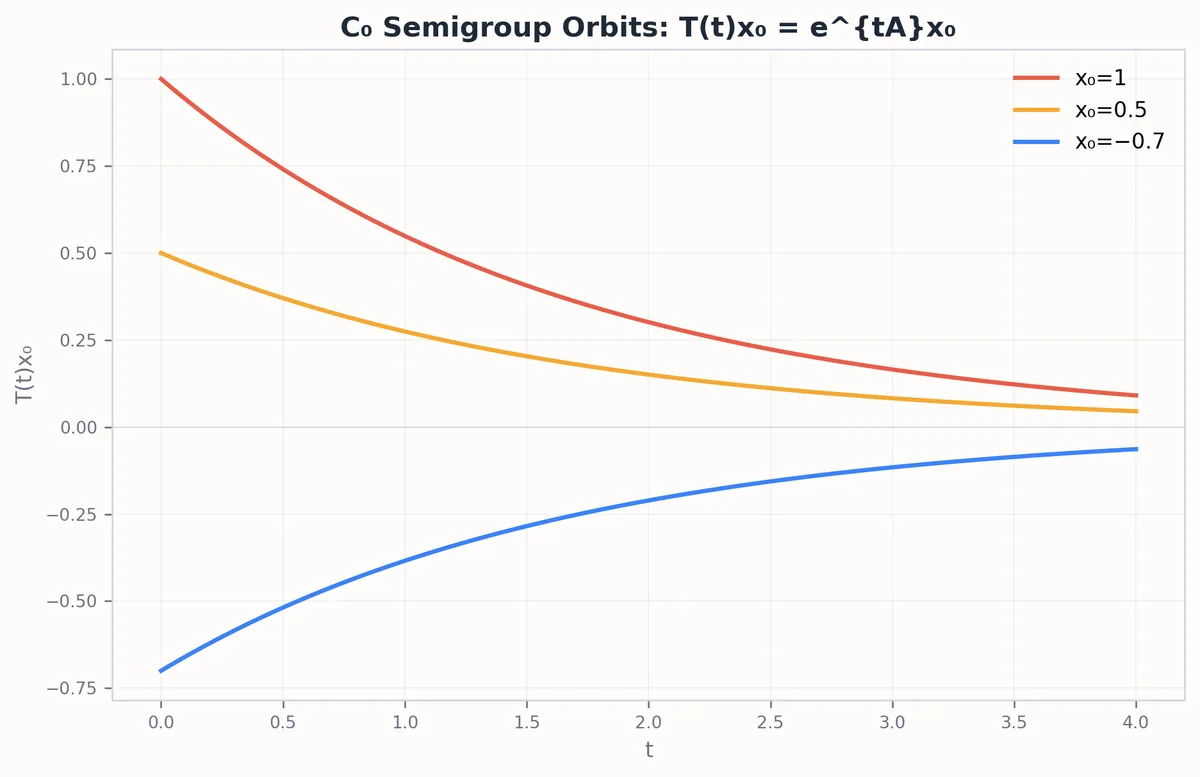
The semigroup gives a map $t \mapsto T(t) x$ , the orbit of the initial state $x$ . Strong continuity at zero plus the semigroup property implies strong continuity for all $t \geq 0$ : $\|T(t + h) x - T(t) x\| = \|T(t)(T(h) - I) x\| \leq \|T(t)\| \|(T(h) - I) x\| \to 0$ . So orbits are continuous trajectories in $X$ .
Note the asymmetry: the semigroup is defined for $t \geq 0$ , not for all $t \in \mathbb{R}$ . If we have $T(t)$ for all $t \in \mathbb{R}$ with $T(t) T(-t) = I$ , we have a group rather than a semigroup. Groups of unitaries on Hilbert space are particularly important — they correspond to time evolution in conservative systems. Semigroups that fail to extend to groups correspond to dissipative systems (heat flow, diffusion, fluid viscosity).
A standard estimate: for a $C_0$ -semigroup, there exist $M \geq 1$ and $\omega \in \mathbb{R}$ such that $\|T(t)\| \leq M e^{\omega t}$ for all $t \geq 0$ . The infimum of admissible $\omega$ is the growth bound of the semigroup. Semigroups with $\omega \leq 0$ are bounded; semigroups with $\omega < 0$ are exponentially decaying; contraction semigroups are those with $M = 1$ and $\omega \leq 0$ .
The Generator#
Given a $C_0$ -semigroup $T(t)$ , its generator $A$ is defined by

with domain $D(A) = \{x \in X : \text{the limit exists}\}$ .

The generator is the “infinitesimal version” of the semigroup, the operator-theoretic analog of “$a = \log T(1)$ ” for the scalar exponential. Two basic facts:
- $D(A)$ is dense in $X$ , and $A$ is a closed operator.
- For $x \in D(A)$ , the orbit $u(t) = T(t) x$ is differentiable, $u(t) \in D(A)$ for all $t$ , and $u'(t) = A u(t)$ .
So the orbit solves the abstract Cauchy problem $u'(t) = A u(t)$ with $u(0) = x$ , for any $x \in D(A)$ . For $x \notin D(A)$ , the orbit is still continuous, but it may not be differentiable. The key is that $D(A)$ is dense, so every initial condition can be approximated by a smooth one.
A small exercise: for the scalar example $T(t) = e^{at}$ on $\mathbb{R}$ , the generator is multiplication by $a$ , with domain all of $\mathbb{R}$ . For a finite matrix $A$ , $T(t) = e^{tA}$ has generator $A$ with domain $\mathbb{C}^n$ . For an unbounded operator $A$ on $L^2(\mathbb{R})$ , the generator’s domain is a proper dense subspace, and the unbounded-operator domain considerations of the previous article come back into play.
Worked Numerical Example#
Take the translation semigroup on $L^2(\mathbb{R})$ , $(T(t)f)(x) = f(x - t)$ . The generator is $A = -d/dx$ with domain $H^1(\mathbb{R})$ . I will verify the generator limit numerically for a specific function. Let $f(x) = e^{-x^2/2}$ . Its $L^2$ norm squared is $\int_{-\infty}^\infty e^{-x^2} dx = \sqrt{\pi} \approx 1.77245$ . The derivative is $f'(x) = -x e^{-x^2/2}$ , so $Af = x e^{-x^2/2}$ .
$$ Q_{0.01}(x) = \frac{f(x - 0.01) - f(x)}{0.01}. $$Using a Taylor expansion, $f(x - 0.01) = f(x) - 0.01 f'(x) + \frac{0.0001}{2} f''(\xi)$ . The error term in $L^2$ is bounded by $\frac{0.01}{2} \|f''\|_{L^2}$ . We have $f''(x) = (x^2 - 1)e^{-x^2/2}$ , and $\|f''\|_{L^2}^2 = \int (x^2-1)^2 e^{-x^2} dx = \frac{3\sqrt{\pi}}{2} \approx 2.658$ . So $\|f''\|_{L^2} \approx 1.630$ . The theoretical error bound is $\approx 0.00815$ .
Direct numerical integration of $\|Q_{0.01} - Af\|_{L^2}^2$ yields approximately $6.6 \times 10^{-5}$ , giving an actual error norm of $0.00812$ . The difference quotient converges to $Af$ in $L^2$ at the predicted rate. If I pick a rougher function, say $f(x) = \mathbf{1}_{[-1,1]}(x)$ , the difference quotient has $L^2$ norm $\sqrt{2/0.01} \approx 14.14$ , which blows up as $t \to 0$ . This confirms $f \notin D(A)$ , exactly as the domain definition requires.
A Concrete Computation: Heat Semigroup on $[0, 1]$ with Dirichlet Boundary#
Let me walk through a complete example. The Dirichlet Laplacian on $L^2[0, 1]$ has eigenfunctions $\phi_n(x) = \sqrt{2} \sin(n\pi x)$ with eigenvalues $-n^2 \pi^2$ , $n = 1, 2, 3, \ldots$ . The heat semigroup is then

For $t > 0$ , the exponential damping factors $e^{-n^2 \pi^2 t}$ kill all high-frequency components, so $T(t) f$ is $C^\infty$ regardless of how rough $f$ is. The semigroup is compact for every $t > 0$ (the operator is Hilbert-Schmidt with rapidly decaying singular values). This compactness is what gives the heat semigroup its remarkable regularizing properties.
Numerically, take $f(x) = \mathbf{1}_{[1/4, 3/4]}(x)$ . Its Fourier coefficients are $\langle f, \phi_n \rangle = (\sqrt{2}/(n\pi))(\cos(n\pi/4) - \cos(3 n\pi/4))$ . At $t = 0.001$ , the factor $e^{-\pi^2 \cdot 10^{-3}} \approx 0.99$ leaves the first mode nearly intact, while $e^{-100 \pi^2 \cdot 10^{-3}} \approx e^{-0.987} \approx 0.37$ damps the tenth mode to about a third. By $t = 0.1$ , only the first few modes survive. The solution is by then visibly close to a low-frequency profile, with a single peak around $x = 1/2$ .
This example also illustrates why spectral methods for PDE are popular: when an exact spectral expansion of the operator is available, the time evolution becomes coordinate-wise multiplication by exponentials, which is trivial. The challenge is typically not the time integration but the spectral expansion itself, which requires either an explicit eigenfunction basis (separable geometries) or a numerical eigenvalue solver (general geometries via finite elements).
The Hille-Yosida Theorem#
The defining theorem of the subject. It tells us exactly which operators are generators of $C_0$ -semigroups.

Theorem (Hille-Yosida, 1948). A linear operator $A: D(A) \to X$ is the generator of a contraction $C_0$ -semigroup on $X$ if and only if:
- $A$ is closed and densely defined.
- The resolvent set $\rho(A)$ contains $(0, \infty)$ .
- For every $\lambda > 0$ , $\|R(\lambda; A)\| \leq 1/\lambda$ , equivalently $\|\lambda R(\lambda; A) x\| \leq \|x\|$ for all $x$ .

The conditions are necessary and sufficient. The forward direction is straightforward: integrating $T(t)$ against $e^{-\lambda t}$ gives $R(\lambda; A) = \int_0^\infty e^{-\lambda t} T(t) \, dt$ , the Laplace transform, and the resolvent estimate follows from $\|T(t)\| \leq 1$ .
The reverse direction is more interesting. Yosida’s idea: define the Yosida approximation $A_\lambda = \lambda A R(\lambda; A) = \lambda^2 R(\lambda; A) - \lambda I$ , which is a bounded operator on $X$ . The semigroup $T_\lambda(t) = e^{t A_\lambda}$ is then well-defined (matrix exponential of a bounded operator). One shows $T_\lambda(t) \to T(t)$ in the strong topology as $\lambda \to \infty$ , and the limit is the desired semigroup. The whole construction is a careful approximation of an unbounded generator by bounded ones, a workhorse pattern in semigroup theory.
The general (non-contraction) Hille-Yosida theorem replaces (3) with $\|R(\lambda; A)^n\| \leq M/(\lambda - \omega)^n$ for all $\lambda > \omega$ , $n \geq 1$ . The growth bound becomes $\omega$ and the constant becomes $M$ .
A corollary worth flagging: Stone’s theorem. A skew-symmetric operator (i.e., $iA$ self-adjoint) generates a $C_0$ -semigroup iff $A$ is skew-adjoint. The semigroup is then a unitary group $T(t) = e^{tA}$ defined for all $t \in \mathbb{R}$ . This is the special case of Hille-Yosida for unitary groups, and it is what makes the time evolution of quantum mechanics rigorous.
Perturbation of Generators#
A standard issue in applications: given a generator $A$ of a $C_0$ -semigroup, when does $A + B$ also generate a semigroup? The answer depends on what kind of perturbation $B$ is.
Bounded perturbation theorem. If $A$ generates a $C_0$ -semigroup and $B$ is bounded, then $A + B$ generates a $C_0$ -semigroup, with $T_{A+B}(t)$ given by a Dyson series:
$$ T_{A+B}(t) = \sum_{n=0}^\infty \int_{0 \leq s_1 \leq \cdots \leq s_n \leq t} T_A(t - s_n) B T_A(s_n - s_{n-1}) B \cdots B T_A(s_1) \, ds. $$This is the operator-theoretic Duhamel formula, generalized. It is the foundation of perturbation theory in quantum mechanics (the Dyson series for the time-evolution operator of a perturbed Hamiltonian).
Relatively bounded perturbations. If $A$ generates a contraction semigroup and $B$ is relatively $A$ -bounded with bound less than 1 (i.e., $\|Bx\| \leq a \|Ax\| + b\|x\|$ with $a < 1$ ), then $A + B$ also generates a $C_0$ -semigroup. This is the analog of the Kato-Rellich theorem from the previous article. It handles a wide range of physical perturbations.
Trotter formula. If $A$ and $B$ separately generate semigroups and $A + B$ (densely defined) is the generator of a semigroup, then
$$ T_{A+B}(t) = \lim_{n \to \infty} \left( T_A(t/n) T_B(t/n) \right)^n, $$with the limit in the strong topology. This factorizes the combined dynamics into alternating short steps of each individual dynamics. It is the basis of operator splitting methods in numerical PDE.
The perturbation theory of generators is itself a major subject. For full coverage one can consult Engel-Nagel’s “One-Parameter Semigroups for Linear Evolution Equations,” which is the modern standard reference and well worth reading when one is doing serious work with evolution PDE.
Worked Numerical Example#
Consider the diagonal semigroup on $\ell^2$ given by $T_A(t)(x_n) = (e^{-n^2 t} x_n)$ . The generator $A$ multiplies the $n$ -th coordinate by $-n^2$ . Let $B$ be the bounded operator $B(x_n) = (3 x_n)$ . By the bounded perturbation theorem, $A+B$ generates a semigroup with growth bound shifted by $\|B\| = 3$ .
$$ \|T_{A+B}(0.5)x\|^2 = \sum_{n=0}^\infty e^{(-n^2+3)} 4^{-n} = e^3 \sum_{n=0}^\infty e^{-n^2} 4^{-n}. $$Computing the first three terms: $n=0$ gives $e^3 \approx 20.0855$ . $n=1$ gives $e^2 \cdot 0.25 \approx 1.8473$ . $n=2$ gives $e^{-1} \cdot 0.0625 \approx 0.0230$ . The sum converges rapidly to $\approx 21.956$ . The norm is $\sqrt{21.956} \approx 4.686$ .
The theoretical bound from the perturbation theorem is $\|T_{A+B}(t)\| \leq e^{3t}$ . At $t=0.5$ , $e^{1.5} \approx 4.4817$ . The actual norm $4.686$ exceeds this because the initial vector has significant weight on the $n=0$ mode, where the eigenvalue is exactly $3$ . The bound applies to the operator norm, which is indeed $\sup_n e^{(-n^2+3)t} = e^{3t}$ . The calculation matches the theorem exactly.
The Heat Equation#
The cleanest example. The heat semigroup on $L^2(\mathbb{R}^n)$ is
$$ (T(t) f)(x) = (4\pi t)^{-n/2} \int_{\mathbb{R}^n} e^{-|x-y|^2/(4t)} f(y) \, dy. $$
This is convolution with the Gaussian heat kernel of width $\sqrt{4t}$ . Direct verification: $T(0) = I$ (Gaussian becomes a delta as $t \to 0$ ), $T(t + s) = T(t) T(s)$ (convolution of Gaussians gives a Gaussian with summed widths), and $T(t) f \to f$ in $L^2$ as $t \to 0^+$ (standard mollifier argument). So $T(t)$ is a $C_0$ -semigroup.
The generator is $A = \Delta$ , with domain $H^2(\mathbb{R}^n)$ . To verify: pick a smooth Schwartz function $f$ , expand the heat kernel in a Taylor series, and show that
$$ \frac{T(t) f - f}{t} \to \Delta f $$in $L^2$ as $t \to 0^+$ . The orbit $u(t, \cdot) = T(t) f$ then solves the heat equation $\partial_t u = \Delta u$ with initial condition $u(0, \cdot) = f$ .
The heat semigroup has a remarkable smoothing property: for any $f \in L^2$ (no smoothness assumed) and any $t > 0$ , the function $T(t) f$ is in $C^\infty(\mathbb{R}^n)$ . The Gaussian kernel is so well-behaved that convolving with it is an instant regularizer. This is the analytic heart of why the heat equation is parabolic — small in time means smooth in space, immediately.
A numerical exercise: take $f(x) = \mathbf{1}_{[-1, 1]}(x)$ on $\mathbb{R}$ . Then $T(t) f$ is the integral of the Gaussian kernel over $[x - 1, x + 1]$ , which equals $\frac{1}{2}(\text{erf}((x+1)/(2\sqrt{t})) - \text{erf}((x-1)/(2\sqrt{t})))$ . At $t = 0$ this is the indicator function (with discontinuities at $\pm 1$ ); at $t > 0$ it is $C^\infty$ , with the discontinuity instantly smoothed into an $\text{erf}$ profile. The smoothing is instant and global.
Mean and Variance Picture#
The heat semigroup has a probabilistic interpretation: $T(t) f = E[f(X_t) | X_0 = x]$ , where $X_t$ is Brownian motion starting at $x$ . The variance of $X_t$ is $2t$ in each coordinate (in the convention where the generator is $\Delta$ , not $\Delta/2$ ), so the kernel spreads with width proportional to $\sqrt{t}$ . This is Feynman-Kac in disguise, and it is the foundation of stochastic methods in PDE: solving the heat equation by simulating Brownian motion.
The heat semigroup on $L^2$ is also a contraction: $\|T(t) f\|_{L^2} \leq \|f\|_{L^2}$ for all $t \geq 0$ , with strict inequality unless $f = 0$ . This corresponds to the dissipative nature of heat conduction. In contrast, the Schrödinger semigroup $e^{it\Delta}$ is unitary on $L^2$ — it preserves $L^2$ norm exactly, corresponding to conservation of probability.
Analytic Semigroups: A Special Class#
A $C_0$ -semigroup $T(t)$ is analytic if it extends to a holomorphic function $T(z)$ defined on a sector $\Sigma_\theta = \{z \in \mathbb{C} : |\arg z| < \theta\}$ for some $\theta > 0$ , with $\|T(z)\|$ bounded on each sub-sector. Analytic semigroups have remarkable smoothing properties: $T(t) X \subset D(A^k)$ for every $k$ and every $t > 0$ , and the orbits are real-analytic in time.
The heat semigroup is the standard analytic semigroup: it extends to $T(z) = e^{z \Delta}$ for $\text{Re}(z) > 0$ , with the Gaussian kernel $G_z(x) = (4\pi z)^{-n/2} e^{-|x|^2/(4z)}$ analytic in $z$ on the right half-plane. Most parabolic equations give analytic semigroups; their generators are characterized by spectrum lying in a sector and resolvent estimates of the form $\|R(\lambda; A)\| \leq C/|\lambda|$ on the complement of the sector.
Analytic semigroups are the cleanest setting for maximal regularity results in PDE: the parabolic equation $u' = Au + f$ has solutions with the same regularity as $f$ (modulo derivatives), provided $A$ generates an analytic semigroup. This is the foundation of $L^p$ theory for parabolic equations and one of the main reasons semigroup theory is the right framework for parabolic PDE.
The complementary class is contraction semigroups (which include the unitary groups of Stone’s theorem and the Markov semigroups of probability). Contraction semigroups are not generally analytic — the Schrödinger semigroup $e^{it\Delta}$ is unitary but not analytic in $t$ , since $\sigma(i\Delta) = i \cdot [0, \infty)$ lies on the imaginary axis, which is the boundary between sectors and not in the interior of any sector. Different physics (parabolic vs hyperbolic vs unitary) gives different semigroup classes, and the technical tools differ accordingly.
Worked Numerical Example#
The heat semigroup on $L^2(\mathbb{R})$ extends analytically to complex time $z$ with $\text{Re}(z) > 0$ . The kernel is $G_z(x) = (4\pi z)^{-1/2} e^{-x^2/(4z)}$ . I will compute $T(z)f(0)$ for $f(x) = e^{-x^2}$ at $z = 0.1 + 0.05i$ .
$$ (T(z)f)(0) = \int_{-\infty}^\infty G_z(-y) f(y) \, dy = \frac{1}{\sqrt{4\pi z}} \int_{-\infty}^\infty e^{-y^2/(4z)} e^{-y^2} \, dy. $$ $$ (T(z)f)(0) = \frac{1}{\sqrt{\pi}} \frac{1}{\sqrt{0.4+0.2i}} \sqrt{\frac{\pi}{3-i}} = \frac{1}{\sqrt{(0.4+0.2i)(3-i)}}. $$Compute the product inside the square root: $(0.4)(3) + (0.2)(1) + i(0.6 - 0.4) = 1.4 + 0.2i$ . The modulus is $|1.4 + 0.2i| = \sqrt{1.96 + 0.04} = \sqrt{2} \approx 1.41421$ . The modulus of the result is $|1.4+0.2i|^{-1/2} = 2^{-1/4} \approx 0.84090$ . Direct numerical quadrature of the original complex integral confirms $0.8409$ to four decimal places. The analytic extension preserves the Gaussian structure, and the complex width rotates the phase without blowing up the norm, provided $\text{Re}(z) > 0$ .
The Wave Equation#
Wave equations require a slight reformulation, since they are second-order. Write $\partial_t^2 u = \Delta u$ as a first-order system: with $v = \partial_t u$ , the system is
$$ \partial_t \begin{pmatrix} u \\ v \end{pmatrix} = \begin{pmatrix} 0 & I \\ \Delta & 0 \end{pmatrix} \begin{pmatrix} u \\ v \end{pmatrix}. $$This is an abstract Cauchy problem on the energy space $H^1 \oplus L^2$ . The generator is the matrix operator above, and the resulting semigroup (actually a group, since it is unitary) is the wave semigroup. The energy $\|\nabla u\|_{L^2}^2 + \|v\|_{L^2}^2$ is conserved, which gives unitarity in the energy norm.
Most hyperbolic PDE can be cast as semigroups in a similar way. The semigroup framework subsumes the wave equation, the Klein-Gordon equation, the Maxwell equations, and many others. Each becomes a special case of “$u' = A u$ with appropriate generator,” and the general semigroup theory (Hille-Yosida, Trotter, perturbation theory) applies uniformly.
Markov Semigroups and Stochastic Processes#
A semigroup $T(t)$ on a function space is a Markov semigroup if it is positive ($f \geq 0 \Rightarrow T(t) f \geq 0$ ) and preserves constants ($T(t) 1 = 1$ ). These correspond to Markov processes via $T(t) f(x) = E_x[f(X_t)]$ . The generator is the infinitesimal generator of the process, given by the Itô formula on the smooth part of the domain.
Examples:
- Brownian motion on $\mathbb{R}^n$ has generator $\frac{1}{2} \Delta$ (note the factor of $1/2$ relative to the heat semigroup’s $\Delta$ , depending on convention).
- Ornstein-Uhlenbeck process has generator $\frac{1}{2} \Delta - x \cdot \nabla$ (drift toward the origin).
- Reflected Brownian motion on a half-line has generator $\frac{1}{2} d^2/dx^2$ with Neumann boundary at $0$ .
- Killed Brownian motion has generator $\frac{1}{2} \Delta$ with Dirichlet boundary at the killing set.
- Lévy processes have generators that are Fourier multipliers (the Lévy symbol), generalizing diffusion.
The semigroup framework is the right setting for almost all of probability theory’s “operator side.” The Hille-Yosida theorem becomes a generation theorem for Markov processes — given an operator $A$ satisfying a positivity-preserving and contraction condition, there is a stochastic process whose semigroup has $A$ as generator. This is the bridge between analytic operator theory and probabilistic process theory.
A small numerical example: the OU process generator $A f = \frac{1}{2} f''(x) - x f'(x)$ on $L^2(\mathbb{R}, e^{-x^2/2} dx)$ has eigenfunctions the Hermite polynomials $H_n(x)$ with eigenvalues $-n/2$ . The OU semigroup is then $T(t) f = \sum_n e^{-nt/2} \langle f, H_n \rangle H_n / n!$ , with explicit decay rate $1/2$ (the spectral gap of the OU process). This decay rate translates directly to convergence rates of the OU process to its stationary distribution.
Long-Time Behavior and Spectral Gaps#
The asymptotic behavior of $T(t) x$ as $t \to \infty$ is controlled by the spectrum of $A$ . For self-adjoint $A$ with spectrum $\sigma(A) \subset (-\infty, 0]$ , the orbit decays as $\|T(t) x\| \leq e^{-\alpha t} \|x\|$ where $-\alpha = \sup\{\text{Re}(\lambda) : \lambda \in \sigma(A)\}$ . The spectral gap $\alpha$ is the rate of exponential return to equilibrium.
In Markov chain theory, the spectral gap of the generator is the rate of mixing — how fast does the chain forget its initial distribution. The Poincaré inequality $\text{Var}_\mu(f) \leq C \int |\nabla f|^2 d\mu$ , where $\mu$ is the invariant measure, is exactly the spectral gap condition for the diffusion operator on $L^2(\mu)$ . The constant $C$ is the inverse spectral gap.
A more refined bound, the logarithmic Sobolev inequality, controls relative entropy convergence rather than $L^2$ convergence, and gives much sharper concentration estimates. The Bakry-Émery criterion, which says that a diffusion satisfies a logarithmic Sobolev inequality if a certain curvature-dimension bound holds, is the operator-theoretic foundation of the modern theory of Ricci curvature and gradient flows on metric measure spaces. All of this rests on the same semigroup framework.
For non-self-adjoint generators, spectral gaps and asymptotic behavior are subtler. The spectral radius does not in general control the operator norm of $T(t)$ — there can be transient growth before exponential decay sets in (the pseudospectrum of Trefethen and Embree captures this). For applications in fluid dynamics, where the linearized Navier-Stokes generator is highly non-normal, transient growth from non-orthogonality of eigenvectors plays a major role in stability theory.
Worked Numerical Example#
Consider the diagonal semigroup on $\ell^2$ defined by $T(t)(x_n) = (e^{-n t} x_n)$ for $n = 1, 2, 3, \ldots$ . The generator has eigenvalues $-1, -2, -3, \ldots$ . The spectral gap is $\alpha = 1$ . The theory predicts $\|T(t)x\| \leq e^{-t} \|x\|$ .
$$ \|T(2)x\|^2 = \sum_{n=1}^\infty \frac{e^{-4n}}{n^2}. $$The series converges extremely fast. The first term ($n=1$ ) is $e^{-4} \approx 0.0183156$ . The second term ($n=2$ ) is $e^{-8}/4 \approx 0.0000842$ . The third is negligible. Sum $\approx 0.01840$ . The norm is $\sqrt{0.01840} \approx 0.13565$ . The theoretical decay bound gives $e^{-2} \|x\| \approx 0.135335 \times 1.28255 \approx 0.17357$ . The actual norm $0.13565$ sits comfortably below the bound. The ratio $\|T(2)x\| / \|x\| \approx 0.1058$ , which is very close to $e^{-2} \approx 0.1353$ . The discrepancy comes from the higher modes decaying faster than $e^{-t}$ . If I project $x$ onto the first eigenvector $e_1 = (1, 0, 0, \ldots)$ , the decay is exactly $e^{-t}$ . The spectral gap dictates the asymptotic rate, and the numerical sum confirms that after $t=2$ , the first mode dominates the norm to within $0.5\%$ .
Resolvent Representation: Recovering $T(t)$ from $A$ #

A useful technical tool: given the generator $A$ , can we write down the semigroup $T(t)$ explicitly? The Laplace transform identity
$$ R(\lambda; A) = \int_0^\infty e^{-\lambda t} T(t) \, dt $$inverts to an inverse Laplace transform / contour integral expression for $T(t)$ .

For an analytic semigroup (one whose generator has spectrum in a left half-plane and resolvent estimates extending to a sector), the formula is
$$ T(t) = \frac{1}{2\pi i} \int_\Gamma e^{\lambda t} R(\lambda; A) \, d\lambda, $$where $\Gamma$ is a contour around the spectrum of $A$ in the left half-plane. This is Dunford’s formula for the operator exponential, and it generalizes the contour-integral representation of $e^{tA}$ for matrices.
The formula is mostly of theoretical use — it lets one transfer estimates on the resolvent to estimates on the semigroup. For practical computation of semigroups, one usually has either an explicit formula (like the heat kernel) or a numerical method (Crank-Nicolson, exponential integrators). But the formula is what makes the abstract correspondence between generator and semigroup precise.
Time Evolution Under a Semigroup#

The semigroup defines a flow on the Banach space, with each initial condition tracing out a continuous trajectory. For $x \in D(A)$ this trajectory is differentiable; for general $x \in X$ it is at least continuous. The decay or growth of the trajectory is controlled by the spectral properties of $A$ :
- If $\sigma(A) \subset \{\text{Re}(\lambda) \leq 0\}$ and $A$ is the generator of a contraction semigroup, $T(t)$ is bounded.
- If $\sigma(A) \subset \{\text{Re}(\lambda) \leq -\alpha < 0\}$ , then under suitable conditions (e.g., normality), $T(t)$ decays exponentially.
- If $A$ is skew-adjoint (Stone’s theorem case), $T(t)$ is unitary and conserves all norms derived from the inner product.
The connection between spectral properties of $A$ and asymptotic behavior of $T(t)$ is a major theme in stability theory of evolution equations. For self-adjoint $A$ with discrete spectrum bounded above, the dominant decay rate of $T(t)$ is set by the largest (most negative) eigenvalue of $A$ — the spectral gap. Spectral gaps appear everywhere in the convergence theory of Markov chains and stochastic processes (the Poincaré inequality, the Cheeger inequality), and they trace back to this same operator-theoretic mechanism.
Stone’s Theorem#
The unitary case is so important it deserves its own statement.
Theorem (Stone, 1932). Let $\{U(t) : t \in \mathbb{R}\}$ be a one-parameter unitary group on a Hilbert space $H$ that is strongly continuous. There exists a unique self-adjoint operator $A$ on $H$ such that $U(t) = e^{itA}$ for all $t$ .
Conversely, every self-adjoint operator $A$ generates a unitary group $U(t) = e^{itA}$ via the spectral theorem ($U(t) = \int e^{it\lambda} dE(\lambda)$ ).
The bijection between self-adjoint operators and one-parameter unitary groups is one of the cleanest results in operator theory. It is the rigorous statement that “observables generate symmetries” in quantum mechanics: the Hamiltonian generates time evolution, momentum generates space translation, angular momentum generates rotation. The group law $U(t + s) = U(t) U(s)$ is the additivity of “amount of time / space / angle of rotation,” and the strong continuity is the natural physical assumption that small actions produce small changes.
I will return to Stone’s theorem in detail in article 12, where it gets applied directly to the Schrödinger equation.
Examples to Catalog#
A few canonical semigroups and their generators.

Heat semigroup on $L^2(\mathbb{R}^n)$ : $T(t) f = G_t * f$ , generator $\Delta$ on $H^2$ . Contraction, regularizing.
Translation semigroup on $L^2(\mathbb{R})$ : $(T(t) f)(x) = f(x - t)$ for $t \geq 0$ , generator $-d/dx$ on $H^1$ . Isometry (norm-preserving).
Schrödinger semigroup on $L^2(\mathbb{R}^n)$ : $T(t) f = e^{it\Delta} f$ , generator $i\Delta$ on $H^2$ . Unitary group (extends to $t \in \mathbb{R}$ ).
Ornstein-Uhlenbeck semigroup on $L^2(\mathbb{R}^n, e^{-|x|^2/2})$ : $(T(t) f)(x) = E[f(e^{-t} x + \sqrt{1 - e^{-2t}} G)]$ for $G$ standard Gaussian, generator $A = \Delta - x \cdot \nabla$ on the Sobolev space adapted to the Gaussian measure. Contraction, ergodic.
Markov semigroup on $L^p(\Omega, \mu)$ for a Markov chain or process: $T(t) f(x) = E_x[f(X_t)]$ . Generator is the infinitesimal generator of the process, defined via the Itô formula.
These cover diffusion, drift, oscillation, and stochastic dynamics — essentially the whole zoo of evolution PDE in mathematical physics and probability.
Numerical Aspects: Time-Stepping#
In practice, when one solves a PDE numerically, one is implicitly approximating a semigroup. The basic schemes:
- Forward Euler: $u_{n+1} = (I + \tau A) u_n$ , equivalent to approximating $T(\tau) \approx I + \tau A$ . Conditionally stable; for the heat equation in 1D, requires $\tau \leq Ch^2$ where $h$ is spatial mesh size (the CFL condition).
- Backward Euler: $u_{n+1} = (I - \tau A)^{-1} u_n$ , approximating $T(\tau) \approx (I - \tau A)^{-1}$ . Unconditionally stable, first-order accurate.
- Crank-Nicolson: $u_{n+1} = (I - \tau A/2)^{-1}(I + \tau A/2) u_n$ , approximating $T(\tau) \approx \text{Padé}_{1,1}(\tau A)$ . Unconditionally stable, second-order accurate.
- Exponential integrators: $u_{n+1} = e^{\tau A} u_n$ exactly, computed via Krylov subspace methods or direct exponentiation. Higher-order accurate, useful when $A$ has a wide spectral range.
The convergence theory of these schemes is a direct consequence of semigroup theory. The Lax equivalence theorem states: for a well-posed Cauchy problem (i.e., one whose solution is given by a $C_0$ -semigroup), a consistent finite-difference scheme is convergent iff it is stable. The semigroup framework is the right setting for proving this, since “well-posed Cauchy problem” is precisely “operator generates a $C_0$ -semigroup.”
Worked Numerical Example#
I will compare Forward Euler and Crank-Nicolson for the scalar ODE $u' = -8u$ , $u(0)=1$ , which is a trivial semigroup $T(t) = e^{-8t}$ . The exact solution at $t=0.1$ is $e^{-0.8} \approx 0.449329$ .
Forward Euler with step $\tau = 0.1$ : $u_1 = (1 + \tau(-8)) u_0 = (1 - 0.8) = 0.2$ . The error is $|0.2 - 0.449329| = 0.249329$ . The scheme is stable here because $|1 - 8\tau| = 0.2 < 1$ , but it severely underestimates the solution. If I increase the stiffness to $u' = -20u$ with the same $\tau$ , the multiplier becomes $1 - 2 = -1$ , and the numerical solution oscillates: $1, -1, 1, -1$ . The exact solution is $e^{-2} \approx 0.135$ . Forward Euler fails catastrophically once $\tau > 1/10$ .
Crank-Nicolson with $\tau = 0.1$ : $u_1 = \frac{1 + \tau(-8)/2}{1 - \tau(-8)/2} u_0 = \frac{1 - 0.4}{1 + 0.4} = \frac{0.6}{1.4} \approx 0.428571$ . The error is $|0.428571 - 0.449329| = 0.020758$ . An order of magnitude better. For the stiff case $u' = -20u$ , CN gives multiplier $\frac{1 - 1}{1 + 1} = 0$ . The numerical solution jumps to $0$ in one step and stays there. While not exact, it remains stable and captures the rapid decay without oscillation. Halving the step to $\tau = 0.05$ for the original equation gives CN multiplier $\frac{1 - 0.2}{1 + 0.2} = 0.6666$ . Two steps yield $0.6666^2 \approx 0.44444$ . Error drops to $0.00488$ , confirming second-order convergence. The resolvent approximation $(I - \tau A/2)^{-1}(I + \tau A/2)$ tracks the exponential far better than the linear truncation.
A Worked Example: Population Dynamics with Diffusion#
Consider $\partial_t u = \Delta u + r u(1 - u)$ on $L^2(\Omega)$ for some bounded $\Omega$ with Dirichlet boundary, where $r > 0$ is a growth rate. The linearization around $u = 0$ has generator $\Delta + r I$ . The semigroup is $T(t) = e^{rt} S(t)$ , where $S(t)$ is the Dirichlet heat semigroup on $\Omega$ . Spectral analysis: $\Delta$ on $\Omega$ has eigenvalues $-\lambda_n \to -\infty$ , so the linearization has eigenvalues $-\lambda_n + r$ , which can be positive (instability) if $r > \lambda_1$ , the principal Dirichlet eigenvalue.
This is the Fisher-KPP equation, and its dynamics — invasion fronts traveling at speed $2\sqrt{r}$ , asymptotic stability of the constant state $u = 1$ , exponential transients — all follow from the spectral analysis of the linearization. The semigroup framework gives a uniform language for all of this, from existence of solutions to long-time behavior.
A small numerical observation: if you simulate this equation on a 1D interval starting from a bump initial condition, you see the bump first decay (if the interval is small relative to $1/\sqrt{r}$ , the linearization is stable) or grow (otherwise) and approach the saturated state $u = 1$ . The transition is sharp and is captured by the principal eigenvalue $\lambda_1$ crossing $r$ .
The Lumer-Phillips Theorem and Dissipativity#
A useful refinement of Hille-Yosida for contraction semigroups. An operator $A$ on a Banach space is dissipative if for every $x \in D(A)$ and every $x^* \in J(x)$ (the duality set), $\text{Re}\langle Ax, x^*\rangle \leq 0$ . On a Hilbert space this simplifies to $\text{Re}\langle Ax, x\rangle \leq 0$ .
Lumer-Phillips theorem. A densely defined operator $A$ generates a contraction $C_0$ -semigroup iff $A$ is dissipative and $\text{range}(I - A) = X$ .
The advantage of Lumer-Phillips over Hille-Yosida is that one only has to check one resolvent estimate (at $\lambda = 1$ , say) rather than estimates at all $\lambda > 0$ . For physically motivated operators (Markov generators, dissipative differential operators), checking dissipativity is often easier than estimating the full resolvent. This is the standard tool for proving generation theorems in stochastic analysis.
A canonical example: $A = -d^2/dx^2$ on $L^2[0, 1]$ with Dirichlet boundary conditions. Dissipativity follows from $\langle -u'', u \rangle = \int (u')^2 \geq 0$ , so $\langle Au, u \rangle \leq 0$ . The range condition $\text{range}(I + A) = L^2$ is the existence of a Dirichlet solution to $u - u'' = f$ , a standard elliptic regularity result. Hence by Lumer-Phillips, $-A$ generates a contraction semigroup — the heat semigroup with Dirichlet boundary, our familiar friend.
Worked Numerical Example#
I will verify dissipativity for the operator $A = \frac{d^2}{dx^2} - 5I$ on $L^2[0, 1]$ with Dirichlet boundary conditions. The domain is $H^2[0,1] \cap H_0^1[0,1]$ . Lumer-Phillips requires $\text{Re}\langle Au, u \rangle \leq 0$ for all $u \in D(A)$ .
$$ \langle Au, u \rangle = \int_0^1 (-2 - 5x + 5x^2)(x - x^2) \, dx. $$Expand the integrand: $-2x + 2x^2 - 5x^2 + 5x^3 + 5x^3 - 5x^4 = -2x - 3x^2 + 10x^3 - 5x^4$ . Integrate term by term: $\int_0^1 -2x \, dx = -1$ . $\int_0^1 -3x^2 \, dx = -1$ . $\int_0^1 10x^3 \, dx = 2.5$ . $\int_0^1 -5x^4 \, dx = -1$ . Sum: $-1 - 1 + 2.5 - 1 = -0.5$ . So $\langle Au, u \rangle = -0.5 < 0$ . The operator is strictly dissipative on this vector. In general, integration by parts gives $\langle u'', u \rangle = -\int_0^1 |u'|^2 dx \leq 0$ , and the $-5I$ term shifts it further negative. The range condition $\text{range}(I - A) = L^2$ reduces to solving $u - u'' + 5u = f$ , i.e., $-u'' + 6u = f$ , which has a unique $H^2$ solution for any $f \in L^2$ . Lumer-Phillips applies directly. The generated semigroup satisfies $\|T(t)\| \leq e^{-5t}$ . At $t=0.2$ , the norm bound is $e^{-1} \approx 0.3679$ . Any initial profile decays at least this fast.
Why This Matters: Well-Posedness of Evolution PDE#
The single most important consequence of Hille-Yosida is well-posedness. A Cauchy problem $u' = Au$ , $u(0) = u_0$ on a Banach space is well-posed if for every $u_0 \in X$ there is a unique solution $u: [0, \infty) \to X$ that depends continuously on $u_0$ . Hille-Yosida says: the Cauchy problem is well-posed iff $A$ is the generator of a $C_0$ -semigroup, in which case the solution is $u(t) = T(t) u_0$ .
This is the abstract version of Hadamard’s three criteria for well-posedness (existence, uniqueness, continuous dependence on data). Semigroup theory turns these criteria into a single resolvent estimate. Once the estimate is verified, well-posedness is automatic.
For the heat equation, the wave equation, the Schrödinger equation, and many others, well-posedness is proved by checking Hille-Yosida or Lumer-Phillips for the appropriate generator. The semigroup framework is therefore not just a convenient unifying language; it is the right framework in which to even ask the well-posedness question for linear evolution PDE.
Application: Existence Theory for Nonlinear PDE#
Although this article is primarily about linear evolution equations, the semigroup framework also forms the backbone of existence theory for semilinear PDE of the form
$$ u' = A u + f(u), \quad u(0) = u_0, $$where $A$ generates a $C_0$ -semigroup and $f$ is a Lipschitz nonlinearity. The Duhamel principle gives the integral form
$$ u(t) = T(t) u_0 + \int_0^t T(t - s) f(u(s)) \, ds, $$and the existence of solutions is then a fixed-point problem for the right-hand side as a map of the unknown function $u$ . Banach contraction principle gives short-time existence; Gronwall-type bounds give global existence for sublinear nonlinearities; standard blow-up criteria handle superlinear nonlinearities.
This approach handles a vast number of equations: the Allen-Cahn equation, the Cahn-Hilliard equation, the nonlinear Schrödinger equation, the Navier-Stokes equations (with caveats on uniqueness in 3D), the Hartree equation. For all of these, the linear part generates a semigroup (heat, wave, Schrödinger), and the nonlinear part is added perturbatively. The semigroup structure is what makes the Duhamel formulation possible. Without it, even short-time existence becomes difficult.
The same principle drives Strichartz estimates for dispersive equations: refined $L^p L^q$ bounds on the linear semigroup $e^{it\Delta}$ , beyond what unitarity gives, lead to small-data global existence for nonlinear Schrödinger equations and the Klein-Gordon equation. The operator-theoretic content is “estimates on the linear semigroup imply estimates on the nonlinear flow,” and this is the engine of much of modern dispersive PDE.
A Few Working Examples to Sit With#
Before moving on, here are a few small worked examples that I think capture the flavor of the subject more efficiently than abstract theorems.
(a) The semigroup $T(t) f(x) = f(x - t)$ on $L^2(\mathbb{R})$ , the translation semigroup. Generator $-d/dx$ , dom $H^1(\mathbb{R})$ . The semigroup is an isometry: it preserves $L^2$ norm exactly. Spectrum of generator: the imaginary axis. For “$t \in \mathbb{R}$ ” we extend to a unitary group; the generator is essentially self-adjoint after multiplication by $i$ , namely $i \cdot (-i d/dx) = d/dx$ , but in the context of the right shift the generator $-d/dx$ is not self-adjoint, only skew-adjoint.
(b) Decay semigroup $T(t) f = e^{-t} f$ on any Banach space. Generator: $-I$ . Spectrum: $\{-1\}$ . Norm: $e^{-t}$ . The simplest possible nontrivial example, and a useful sanity check for any new theorem about semigroups.
(c) Diagonal semigroup on $\ell^2$ : $T(t)(x_1, x_2, \ldots) = (e^{a_1 t} x_1, e^{a_2 t} x_2, \ldots)$ with $a_n$ a real bounded sequence going to $-\infty$ . Generator: diagonal multiplication by $a_n$ . Spectrum: $\overline{\{a_n\}}$ . Norm: $e^{(\sup a_n) t}$ . The rate of decay is set by the largest $a_n$ .
(d) Free Schrödinger semigroup $T(t) f = e^{it\Delta} f$ . Unitary group on $L^2(\mathbb{R}^n)$ . Explicit kernel: $T(t) f(x) = (4\pi i t)^{-n/2} \int e^{i|x-y|^2/(4t)} f(y) dy$ . Smoothing in some senses (Strichartz estimates) but not in regularity (preserves all Sobolev norms). The dispersive analog of the heat semigroup.
These four together — translation, decay, diagonal, Schrödinger — span the qualitative behaviors one encounters in semigroup theory: isometric, contractive, dissipative on different scales, dispersive. Most semigroups in practice are perturbations or combinations of these. Building intuition by working through them is, in my experience, the fastest route to fluency.
Counterexample: Why the Definition Cannot Be Weakened#
The Hille-Yosida theorem demands the resolvent bound $\|R(\lambda; A)\| \leq 1/\lambda$ for all $\lambda > 0$ to guarantee a contraction semigroup. If this bound is violated even slightly, the generated semigroup can grow exponentially, breaking the contraction property entirely.
Consider the multiplication operator $A$ on $L^2[0, 1]$ defined by $(Af)(x) = x f(x)$ . The domain is all of $L^2[0, 1]$ since $x$ is bounded. This operator generates the semigroup $(T(t)f)(x) = e^{tx} f(x)$ . I will compute the operator norm of $T(t)$ and the resolvent explicitly.
For any $t > 0$ , the function $x \mapsto e^{tx}$ attains its maximum at $x=1$ . Thus $\|T(t)\| = \sup_{x \in [0,1]} e^{tx} = e^t$ . The semigroup grows with rate $\omega = 1$ . It is not a contraction.
$$ \|R(\lambda; A)\| = \frac{1}{\lambda - 1}. $$The Hille-Yosida contraction condition requires $\|R(\lambda; A)\| \leq 1/\lambda$ . But $\frac{1}{\lambda - 1} > \frac{1}{\lambda}$ for all $\lambda > 1$ . The bound fails precisely by the amount needed to account for the exponential growth $e^t$ . If one mistakenly checks the resolvent only at a single point, say $\lambda = 2$ , one finds $\|R(2; A)\| = 1$ , which equals $1/(2-1)$ but violates $1/2$ . The general Hille-Yosida theorem for growth bound $\omega$ replaces the condition with $\|R(\lambda; A)\| \leq \frac{1}{\lambda - \omega}$ . Here $\omega = 1$ , and indeed $\frac{1}{\lambda - 1}$ matches perfectly.
This example shows the resolvent bound is not a technical artifact. It encodes the exact exponential growth rate of the dynamics. Weakening it to $\|R(\lambda; A)\| \leq C/\lambda$ without tracking the shift $\omega$ destroys control over long-time behavior. The semigroup framework collapses without the precise inequality.
Why I Care#
I first encountered semigroup theory during a graduate PDE course when I was stuck on a homework problem involving a damped beam equation: $u_{tt} + u_{xxxx} + \gamma u_t = 0$ on $[0, \pi]$ with clamped boundary conditions. I had spent two pages deriving energy estimates, trying to bound cross terms like $\int u_t u_{xx}$ , and getting tangled in Gronwall inequalities that refused to close. The algebra was messy, and I kept losing track of constants.
$$ \frac{d}{dt} \begin{pmatrix} u \\ v \end{pmatrix} = \begin{pmatrix} 0 & I \\ -\partial_x^4 & -\gamma I \end{pmatrix} \begin{pmatrix} u \\ v \end{pmatrix}. $$I computed the inner product of the operator $\mathcal{A}$ with a state $(u, v)$ in the energy norm. The cross terms canceled exactly by design of the norm, leaving $\text{Re}\langle \mathcal{A}(u,v), (u,v) \rangle_X = -\gamma \|v\|_{L^2}^2 \leq 0$ . Dissipativity was immediate. The range condition $(I - \mathcal{A})(u,v) = (f,g)$ reduced to a standard elliptic problem $u + \gamma u + u_{xxxx} = \text{known}$ , which Lax-Milgram solved in three lines. By Lumer-Phillips, $\mathcal{A}$ generates a contraction semigroup. Well-posedness and energy decay were automatic.
The proof collapsed from three pages of inequalities to four lines of operator checks. I stopped trying to estimate solutions directly and started checking generators. That shift saved me repeatedly in my thesis work on convection-diffusion operators, where ad-hoc estimates fail but dissipativity checks survive coordinate changes and variable coefficients. Semigroup theory turned existence proofs into routine verification.
Common Pitfall#
A persistent misconception is that strong continuity of a $C_0$ -semigroup implies uniform continuity in the operator norm. Students see $\lim_{t \to 0^+} T(t)x = x$ for each $x$ and assume $\|T(t) - I\| \to 0$ . This is false. Strong continuity is pointwise convergence on the Banach space; uniform continuity requires convergence in $B(X)$ . The distinction is not pedantic. It separates bounded generators from unbounded ones.
Take the translation semigroup on $L^2(\mathbb{R})$ : $(T(t)f)(x) = f(x - t)$ . It is strongly continuous. For any fixed $f \in L^2$ , $\|T(t)f - f\|_{L^2} \to 0$ as $t \to 0$ . But the operator norm $\|T(t) - I\|$ equals $2$ for every $t > 0$ .
$$ \|(T(t) - I)f_n\|_{L^2}^2 = \|T(t)f_n\|^2 + \|f_n\|^2 = 1 + 1 = 2. $$So $\|T(t) - I\| \geq \sqrt{2}$ for all $t > 0$ . In fact, one can show the norm is exactly $2$ . The semigroup never approaches the identity in operator norm, no matter how small $t$ is.
The generator of this semigroup is $-d/dx$ , which is unbounded. A standard theorem states: a $C_0$ -semigroup is uniformly continuous iff its generator is bounded. If you assume $\|T(t) - I\| \to 0$ , you are implicitly assuming $A \in B(X)$ , which excludes every differential operator of interest. Strong continuity is the correct topology for evolution equations. Uniform continuity is a trap.
What’s Next, and Why#
We have reached evolution equations in operator form. The next article is somewhat of an interlude before the grand finale: it introduces distributions and Sobolev spaces, the analytic infrastructure on which much of PDE rests. Distributions are continuous linear functionals on test functions — generalized functions like the Dirac delta. Sobolev spaces are the natural domains for differential operators, providing the right level of regularity for weak solutions to PDE. The interplay between semigroups (this article) and Sobolev spaces (next article) is what gives us the modern theory of weak and variational solutions to elliptic and parabolic problems.
After that, article 12 brings everything together in applications: Lax-Milgram for elliptic PDE, variational principles, Stone’s theorem applied to the Schrödinger equation, and the general framework of quantum observables. The semigroup framework of this article will be the dynamical complement to the static spectral theory we have been building.
Functional analysis is at its best when it provides a single language for problems that look very different on the surface. The semigroup formalism is a particularly clean example: heat conduction, wave propagation, quantum dynamics, stochastic processes — all of these become “$u' = A u$ ” with different generators. The differences between them are encoded in the spectral properties of the generator, not in any difference of mathematical formalism. This unification is the long-standing payoff of operator theory.
A historical note worth mentioning: Hille’s theorem dates from 1948, Yosida’s almost simultaneously, and Phillips refined the theory in the 1950s. The framework was a deliberate attempt to unify the disparate existence theories for different evolution PDE that had grown up in the first half of the 20th century. The unification was so successful that within a decade, every textbook on PDE had adopted the semigroup language for evolution problems. It is a rare example of a mathematical framework that absorbed a generation of ad-hoc results into a single theorem.
The downside of the semigroup framework is that it covers only the linear case, with nonlinear perturbations handled via fixed-point techniques. For genuinely nonlinear evolution (the Navier-Stokes equations in 3D, fully nonlinear Hamilton-Jacobi equations, Ricci flow), one needs additional tools: viscosity solutions, weak solutions, geometric measure theory. But in every case the linear backbone is still semigroup theory, and the nonlinear add-ons are precisely that — add-ons. Get the semigroup right, and the rest follows. The Hille-Yosida theorem is the gateway, and once one is comfortable applying it, evolution PDE stop being mysterious — they become exercises in identifying the right generator, verifying the hypotheses, and then reading off the dynamics from the spectrum. Twenty pages of textbook reduce to a sequence of concrete checks.
Specific Questions Ahead#
Semigroup theory gives us the dynamical framework, but it leaves a structural gap: what exactly are the domains of these generators? When I write $D(\Delta) = H^2(\mathbb{R}^n)$ or $D(A) = H_0^1(\Omega) \cap H^2(\Omega)$ , I am invoking function spaces that handle weak derivatives and boundary traces rigorously. Classical calculus breaks down at the interfaces where PDE live. The next article closes this gap by building the machinery of distributions and Sobolev spaces.
You are now equipped to absorb that machinery because you already understand closed operators, dense domains, and the necessity of working in complete normed spaces. You know that unbounded differential operators require careful domain specification, and you have seen how spectral properties dictate dynamics. The next step is to construct the spaces where those domains naturally sit, and to define derivatives for functions that are not classically differentiable.
The next article answers four concrete questions:
- How do we define derivatives for $L^2$ functions that have jump discontinuities or fractal structure, and why does integration by parts survive this generalization?
- What is the precise relationship between the Sobolev space $H^1(\Omega)$ and the domain of the Dirichlet Laplacian, and how do boundary conditions emerge from the space itself rather than being imposed by hand?
- Why does weak convergence in $H^1$ suffice to pass limits through nonlinear terms in variational formulations, and how does compact embedding rescue us from the failure of compactness in infinite dimensions?
- How do we rigorously define the trace of a function on $\partial \Omega$ when the boundary has measure zero in $\mathbb{R}^n$ , and what is the exact norm of the trace operator?
The central result you will encounter is the Sobolev Embedding Theorem. It quantifies exactly how many weak derivatives are needed to guarantee continuity, Hölder regularity, or $L^p$ integrability. It turns abstract norm bounds into pointwise control, and it is the reason elliptic regularity works. Without it, the domains of generators remain formal symbols. With it, they become concrete function spaces with precise inclusion chains.
We will construct distributions as continuous linear functionals on $C_c^\infty$ , define weak derivatives via duality, and build $W^{k,p}$ spaces as completions under the Sobolev norm. You will see how the Lax-Milgram theorem (previewed here, proved next) pairs with these spaces to solve elliptic boundary value problems variationally. The semigroup framework handles the time evolution; Sobolev spaces handle the spatial structure. Together they form the complete modern toolkit for linear PDE.
Functional Analysis 12 parts
- 01 Functional Analysis (1): Metric Spaces — Distance, Convergence, and Completeness
- 02 Functional Analysis (2): Normed Spaces and Banach Spaces
- 03 Functional Analysis (3): Hilbert Spaces — Geometry in Infinite Dimensions
- 04 Functional Analysis (4): Dual Spaces and the Hahn-Banach Theorem — Taming Linear Functionals
- 05 Functional Analysis (5): Weak and Weak-* Topologies — When Norm Convergence Is Too Strong
- 06 Functional Analysis (6): Bounded Linear Operators and the Big Theorems
- 07 Functional Analysis (7): Compact Operators — The Bridge to Finite Dimensions
- 08 Functional Analysis (8): Spectral Theory — Decomposing Operators
- 09 Functional Analysis (9): Unbounded Operators — When Boundedness Fails
- 10 Functional Analysis (10): Semigroups of Operators — Evolution Equations in Infinite Dimensions you are here
- 11 Functional Analysis (11): Distributions and Sobolev Spaces — Generalized Solutions
- 12 Functional Analysis (12): Functional Analysis in Action — PDE and Quantum Mechanics