
LeetCode (5): Patterns — Binary Search
A working coder's guide to binary search: three templates, rotated arrays, peak finding, and binary search on the answer with worked traces and figures.

Binary search is the algorithm everyone thinks they understand until they have to write it under interview pressure. The idea is one sentence — halve the search space at every step — but the implementation is a minefield of off-by-one errors, infinite loops, and subtly wrong return values. The goal of this article is not to give you yet another recitation of the standard template. Instead, it aims to provide a mental model that explains why each template looks the way it does, along with a small toolkit (three templates plus the answer-space pattern) that covers the vast majority of LeetCode problems.
We will build everything from a single invariant: at every iteration the answer, if it exists, lives inside our current search interval. Once that invariant is internalised, the choice between < and <=, between right = mid and right = mid - 1, becomes mechanical instead of mysterious.
The Mental Model#

Binary search is a shrinking interval problem. We maintain two pointers l and r that delimit the slice of the array still under consideration. Each iteration we pick the midpoint m, look at nums[m], and use that single observation to throw away half of the remaining interval. The figure above shows the typical behaviour: a sorted array of 16 elements, target 23, four iterations and the window collapses from 16 to 1.
The whole algorithm rests on one invariant:
Invariant. If the target exists, it is in
[l, r](or[l, r), depending on convention) at every iteration.
If you preserve the invariant, the algorithm is correct. If you violate it — for example by setting r = mid - 1 after observing nums[mid] == target while still searching for the leftmost occurrence — you will lose the answer and the rest of the run is garbage.
Why is binary search logarithmic? After $k$ iterations the window contains at most $\lceil n / 2^k \rceil$ elements, so we need $k = \lceil \log_2 n \rceil$ iterations to shrink to one. A billion elements take about 30 comparisons, which is the entire reason databases, file systems and version-control bisect tools rely on it.
When binary search applies. The classical condition is “the array is sorted”, but the deeper condition is monotonicity of a predicate. If you can write a function feasible(x) whose answer flips from False to True (or vice versa) exactly once as x increases, you can binary-search for the flip point. The “answer-space” problems later in this article exploit this directly.
The Standard Template#
The standard template finds any index where nums[i] == target in a sorted array, returning -1 if none exists. We use the closed interval [l, r] and the loop condition l <= r:
| |
There are exactly three things to get right:
- Initial bounds.
r = len(nums) - 1becauseris an inclusive index. - Loop condition.
l <= rbecause the interval[l, r]is non-empty wheneverl <= r. - Updates. When
nums[m] != target, the value atmis decisively not the answer, so we exclude it viam + 1orm - 1.
The midpoint formula l + (r - l) // 2 is mathematically the same as (l + r) // 2 but it does not overflow when l + r exceeds INT_MAX. Python’s bigints make this academic, but the habit transfers to C++ and Java, where it is not academic at all.
LeetCode 704 — Binary Search#
Given a sorted array nums and a target value, return the index of target or -1 if it is not found.
| |
This is literally the template. Edge cases handle themselves: an empty array gives r = -1, the loop body never executes, we return -1. A single-element array works because l == r == 0 and l <= r is true exactly once.
Boundary Templates: First / Last Occurrence#
Many problems do not just ask whether the target exists; they ask for the first or last position where some condition holds, or for the position where a new element should be inserted. The standard template is not enough because when nums[m] == target we cannot return immediately — there might be earlier (or later) matches.

The figure above traces both templates on nums = [1, 2, 5, 5, 5, 5, 8, 9] with target = 5. They share almost identical code; the entire difference is whether the < is strict.
Left bound: first index i with nums[i] >= target#
| |
Three details are non-negotiable:
r = len(nums), notlen(nums) - 1. We use the half-open interval[l, r)so that the answer “should be inserted at the very end” is representable asl = len(nums).l < rmatches the half-open convention:[l, r)is empty exactly whenl == r.r = m, notm - 1. Whennums[m] >= target, positionmitself is a valid candidate for the answer, so we cannot exclude it.
After the loop, l is the leftmost index where nums[i] >= target. To turn this into “first occurrence of target”, check l < len(nums) and nums[l] == target.
Right bound: last index i with nums[i] <= target#
| |
Same skeleton, the only change is <= instead of <. After the loop, l is the leftmost index where nums[i] > target, so l - 1 is the rightmost match. Validate with l - 1 >= 0 and nums[l - 1] == target.
LeetCode 35 — Search Insert Position#
This problem is the left-bound template, no modifications:
| |
For nums = [1, 3, 5, 6], target = 2: m = 2, nums[2] = 5 >= 2, so r = 2. Then m = 1, nums[1] = 3 >= 2, r = 1. Then m = 0, nums[0] = 1 < 2, l = 1. Now l == r, return 1. Inserting 2 at index 1 gives [1, 2, 3, 5, 6], sorted.
LeetCode 34 — First and Last Position#
Apply both templates and validate:
| |
LeetCode 278 — First Bad Version#
The same left-bound template, but the array is replaced by a black-box predicate isBadVersion(v) that flips from False to True exactly once. We are searching the predicate, not an array:
| |
This is the cleanest possible illustration that binary search is about monotonic predicates, not sorted arrays.
Two Interval Conventions#
You may have noticed that Sections 2 and 3 use different conventions: the standard search uses closed [l, r], the boundary templates use half-open [l, r). Both are correct; mixing them within one function is what causes infinite loops.
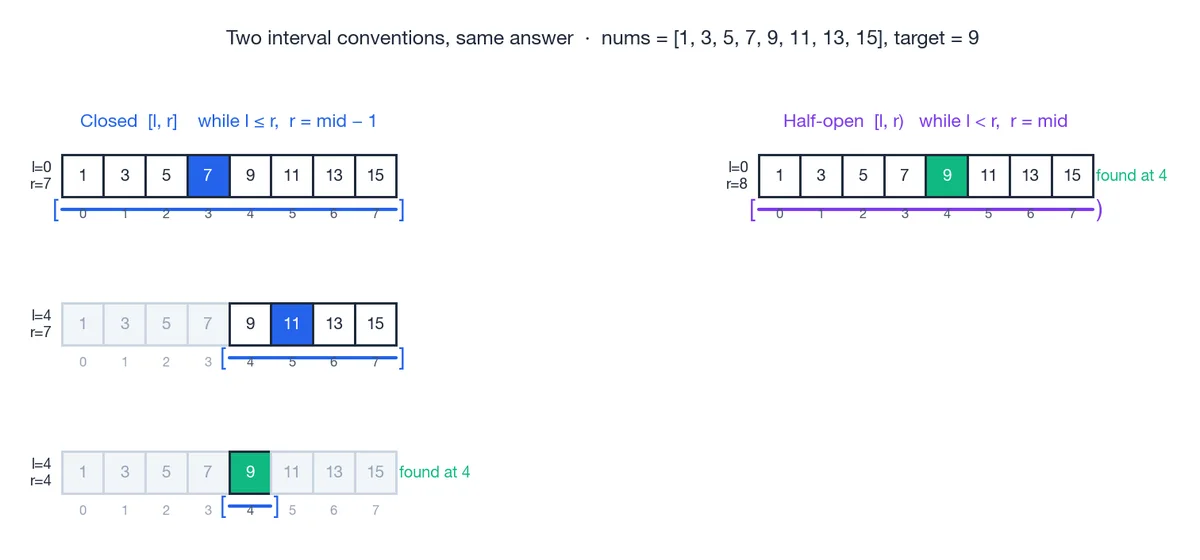
The figure shows the two conventions running side by side on the same input. The interval bracket beneath each step makes the difference visible: closed [l, r] includes the right endpoint, half-open [l, r) does not. The pairing rule is mechanical:
| Convention | Init r | Loop | Right update |
|---|---|---|---|
Closed [l, r] | len(nums)-1 | l <= r | r = m - 1 |
Half-open [l, r) | len(nums) | l < r | r = m |
Pick a convention per function and stick to it. The most common bug — the one that hangs your code in the interview — is using l < r with r = m - 1: the interval can shrink to [l, l] and m = l, after which r = l - 1 < l exits, but only after potentially skipping the answer. The reverse mismatch (l <= r with r = m) is worse: when l == r == m you set r = m = l again and loop forever.
Search in Rotated Sorted Array#
So far the array has been sorted. Rotated arrays are not, but they retain a useful structural property: after splitting at any index, at least one of the two halves is sorted. That is enough to keep using binary search.
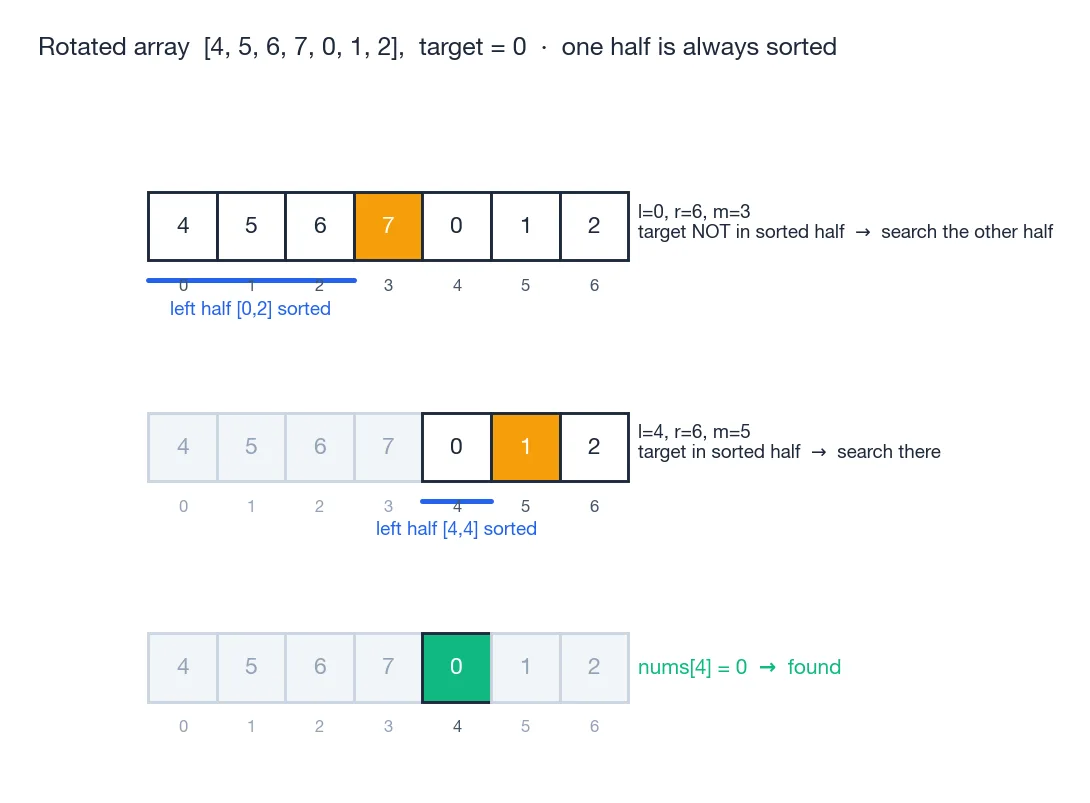
The figure traces nums = [4, 5, 6, 7, 0, 1, 2] searching for 0. At each step we identify which half is sorted (compare nums[l] with nums[m]), check whether the target falls inside that sorted half’s range, and recurse into the sorted half if it does, otherwise into the other half.
LeetCode 33 — Search in Rotated Sorted Array#
A sorted array was rotated at an unknown pivot. Given a target, return its index or -1 if not found. Must run in O(log n) time.
| |
The single subtlety is nums[l] <= nums[m] (note the <=). When l == m the left “half” is the single element nums[l], which is trivially sorted; the equality covers that case.
Find Peak Element#
A peak is an element strictly greater than both neighbours. The array is not sorted, yet binary search still works because we have a monotonic property of a different flavour: the slope.
LeetCode 162 — Find Peak Element#
A peak element is strictly greater than its neighbors. Given an integer array nums where nums[-1] = nums[n] = -inf, find any peak element and return its index. Must run in O(log n) time.
| |
If nums[m] < nums[m + 1] we are climbing; since nums[n] = -inf by convention, we must eventually descend, which means there is a peak strictly to the right of m. If nums[m] >= nums[m + 1] we are descending or at the top; since nums[-1] = -inf, there is a peak at m or to the left. Either way we halve the interval and the invariant — the interval contains at least one peak — is preserved.
This problem is the prototype for “binary search on a monotonic property of an unsorted array”. Once you spot the local-monotonicity argument, the template is mechanical.
Binary Search on the Answer#
The most powerful generalisation of binary search drops the array entirely. Instead, we search over the answer space — the range of possible answer values — using a feasibility check.

The pattern works whenever:
- The answer is a single integer (or real) in a known range $[lo, hi]$ .
- There is a function
feasible(x)that returnsTrueiffxis a valid answer. feasibleis monotonic: there is a single threshold $x^*$ such thatfeasible(x)isFalsebelow it andTrueabove it (or vice versa).
The binary search then locates $x^*$
in $\log(hi - lo)$
iterations, each costing one feasible call. The figure above shows this for Capacity To Ship Packages: the top panel plots days-needed against capacity (a step function that monotonically decreases), the bottom panel shows the bracket [l, r] shrinking to the answer.
LeetCode 1011 — Capacity To Ship Packages Within D Days#
We must ship a list of weights in order within D days; the daily ship capacity is constant and we want the minimum capacity that still meets the deadline.
| |
Three design decisions:
- Lower bound
max(weights). A capacity below the heaviest single package can never ship that package. - Upper bound
sum(weights). A capacity equal to the total ships everything in one day, so it is trivially feasible. - Monotonicity. If capacity
cis feasible, anyc' > cis also feasible, because more capacity per day can only finish sooner. So the feasible set is an upward-closed interval[x*, +inf)and we use the left-bound template to findx*.
LeetCode 875 — Koko Eating Bananas#
Same pattern, almost identical code; the feasibility check is the only thing that changes:
| |
Once you have written one of these, you have written all of them. Split Array Largest Sum (410), Minimum Number of Days to Make m Bouquets (1482), Find K-th Smallest Pair Distance (719) — they all fit this skeleton, and the entire creative work is the feasibility predicate.
The Bug Catalogue#
These are the only four bugs you will write, in roughly decreasing order of frequency.
Mismatched interval and update. Using l < r with r = m - 1, or l <= r with r = m. Lock the pairing in your head: closed goes with <= and m ± 1, half-open goes with < and m. Anything else is wrong.
Wrong return value. Standard template returns m (or -1). Left-bound returns l. Right-bound returns l - 1. Forgetting the - 1 is the classic right-bound mistake. Always validate with a bounds check (0 <= idx < len(nums) and nums[idx] == target) before claiming the target exists.
Forgetting the +1 trick for mid rounding. Patterns like l = m (rather than l = m + 1) need upper mid: m = l + (r - l + 1) // 2. Otherwise when r = l + 1, m = l, and l = m makes no progress — infinite loop. LeetCode 69 (sqrt) is the canonical example.
Integer overflow on (l + r) // 2. Harmless in Python, fatal in C++/Java when l, r approach $2^{31}$
. The habit of writing l + (r - l) // 2 costs nothing and saves you the day you switch languages.
A simple debugging recipe: add print(f"l={l} r={r} m={m} nums[m]={nums[m]}") inside the loop and verify three things: (a) the interval shrinks every iteration, (b) the invariant “answer is inside [l, r]” holds, (c) the value at the returned index is what you expect.
Picking a Template#
A short decision tree covers most problems:
- Find any matching index, no duplicates relevant. Standard template, closed interval.
- First match, insertion point, smallest valid value. Left-bound template.
- Last match, largest valid value. Right-bound template.
- Predicate over a black box (versions, capacities, speeds). Left-bound on the answer space; ignore the array entirely.
- Unsorted but locally monotonic (peaks, rotated arrays). Standard template, but the comparison logic checks the structural property (which half is sorted, which direction climbs) instead of comparing to the target.
When in doubt, prefer the half-open [l, r) convention. It generalises better — it accommodates “insert at the end” naturally, it works unchanged when you switch from indices to floats, and the loop condition l < r makes the termination criterion explicit.
Where Binary Search Lives in Practice#
Binary search is not just an interview trick. It is one of the half-dozen algorithms that genuinely run the world.
Database indexes — B-trees, B+-trees, LSM-tree sorted runs — are layered binary searches with branching factor higher than two. A WHERE id = 12345 lookup on a billion-row table is essentially $\log_{B} n \approx 4$
disk reads where $B$
is the page fanout. Without binary search, OLTP would not exist.
git bisect is binary search on commit history. Mark a commit as good and a later one as bad, then check out the midpoint, test, and recurse. A thousand-commit regression hunt becomes ten test runs.
Standard library functions — bisect_left / bisect_right in Python, lower_bound / upper_bound in C++, Arrays.binarySearch in Java — are exactly the templates from sections 2 and 3. The naming is a giveaway: “lower bound” is left-bound, “upper bound” is right-bound minus one.
Learning rate finders, hyperparameter scheduling, and rate limiters all do binary search on the answer when the predicate (“does training diverge?”, “does p99 latency exceed SLA?”) is expensive but monotonic. Production systems answer “what is the largest QPS we can serve at 99% success?” with the same template that solves Koko Eating Bananas.
Quick Reference#
A compact cheat sheet for revision the night before the interview.
| |
Eight problems to drill until the templates are muscle memory: 704 (standard), 35 (left bound), 34 (both bounds), 278 (predicate), 33 (rotated), 162 (peak), 1011 (answer space), 875 (answer space). If you can write each from scratch in under five minutes, binary search will never trip you up again.
LeetCode Patterns 10 parts
- 01 LeetCode (1): Patterns — Hash Tables
- 02 LeetCode (2): Patterns — Two Pointers
- 03 LeetCode (3): Patterns — Linked List Operations
- 04 LeetCode (4): Patterns — Sliding Window Technique
- 05 LeetCode (5): Patterns — Binary Search you are here
- 06 LeetCode (6): Patterns — Binary Tree Traversal and Construction
- 07 LeetCode (7): Patterns — Dynamic Programming Basics
- 08 LeetCode (8): Patterns — Backtracking Algorithms
- 09 LeetCode (9): Patterns — Greedy Algorithms
- 10 LeetCode (10): Patterns — Stack and Queue