Essence of Linear Algebra (11): Matrix Calculus and Optimization — The Engine Behind Machine Learning
Adjusting the shower temperature is a tiny version of training a neural network: you change a parameter based on an error signal. Matrix calculus is the language that scales this idea to millions of parameters, and optimization is the engine that does the adjusting.

From Shower Knobs to Neural Networks#
Every morning you train a tiny neural network. The water comes out too cold, so you nudge the knob — a parameter — in some direction. A second later you observe a new temperature — the error signal — and nudge again. After three or four iterations you have converged.
Modern deep learning is the same loop, scaled up by seven orders of magnitude. The “knob” is a matrix$W$ with hundreds of millions of entries. The “error” is a scalar loss$L$ . And the question is the same: for each parameter, in which direction should I push, and by how much? The answer lives in a single object: the gradient$\partial L / \partial W$ .
This chapter builds that object from the ground up, and then puts it to work.
What You Will Learn#
- Gradient — the derivative of a scalar with respect to a vector, and why it points uphill
- Directional derivative — the slope along any direction, and why steepest descent is “downhill”
- Jacobian — the derivative of a vector function, the chain rule’s main building block
- Hessian — the matrix of second derivatives, which classifies critical points
- Matrix derivatives — the trace and determinant identities you actually need
- Chain rule and backpropagation — one rule, applied recursively over a computation graph
- Convex optimization — the property that turns “search” into “follow the slope”
- Optimizers — gradient descent, Newton, SGD, momentum, Adam
Prerequisites#
- Single-variable calculus (derivatives, the chain rule)
- Vectors and dot products (Chapter 1 )
- Matrix multiplication (Chapter 3 )
- Symmetric matrices and positive definiteness (Chapter 8 )
The Gradient: Slope in Many Dimensions#
From One Variable to Many#
You run a bubble tea shop. Profit$f$ depends on price$x_1$ and ad spend$x_2$ . You want to know: if I nudge the price a little, or the ad budget a little, how does profit change?
The two partial derivatives answer half the question each:
-$\partial f/\partial x_1$ — holding ad spend fixed, profit per dollar of price change. -$\partial f/\partial x_2$ — holding price fixed, profit per dollar of ad spend.
$$\nabla f = \begin{pmatrix} \partial f/\partial x_1 \\ \partial f/\partial x_2 \end{pmatrix}$$ $$\nabla f(\vec{x}) = \begin{pmatrix} \partial f/\partial x_1 \\ \vdots \\ \partial f/\partial x_n \end{pmatrix} \in \mathbb{R}^n$$Three Geometric Meanings That Justify the Whole Story#
The gradient is more than a stack of partial derivatives; three geometric facts explain why this particular packaging is the right one.
1. Direction. The gradient points in the direction in which$f$ increases fastest. Of all unit directions you could walk from$\vec{x}$ , the one parallel to$\nabla f$ gives you the steepest ascent. Walk against it for the steepest descent — that single sentence is the entire justification for gradient descent.
2. Magnitude.$\|\nabla f\|$ is the rate of increase along that steepest direction. A large gradient means the surface is steep here; a small step makes a big change in$f$ . A near-zero gradient means you’re on a plateau (or at a critical point).
3. Orthogonality. The gradient is perpendicular to the level set$\{\vec{y}: f(\vec{y}) = f(\vec{x})\}$ . On a topographic map, contour lines mark constant altitude; the gradient points straight uphill, perpendicular to those contours.

Three Examples Worth Memorizing#
These three formulas appear constantly. Memorize them.
Linear function.$f(\vec{x}) = \vec{a}^T\vec{x}$ . Then$\nabla f = \vec{a}$ .
The graph is a hyperplane and$\vec{a}$ is its normal direction — the unique direction of fastest increase.
Squared norm.$f(\vec{x}) = \vec{x}^T\vec{x} = \|\vec{x}\|^2$ . Then$\nabla f = 2\vec{x}$ .
A bowl centered at the origin. The gradient points radially outward, away from the minimum.
General quadratic.$f(\vec{x}) = \vec{x}^TA\vec{x}$ with$A$ symmetric. Then$\nabla f = 2A\vec{x}$ .
Every quadratic loss in this book reduces to this formula. If$A$ is not symmetric, replace$A$ with$\tfrac{1}{2}(A+A^T)$ — the gradient only sees the symmetric part anyway.
Directional Derivative: Slope Along Any Path#
$$D_{\vec{d}}f = \nabla f \cdot \vec{d} = \|\nabla f\| \cos\theta$$where$\theta$ is the angle between$\nabla f$ and$\vec{d}$ . Three values of$\theta$ matter:
-$\theta = 0°$ (walk along the gradient): maximum increase$\|\nabla f\|$ . -$\theta = 90°$ (walk along the contour): zero change in$f$ . -$\theta = 180°$ (walk against the gradient): maximum decrease$-\|\nabla f\|$ .
That last line is the theoretical foundation of gradient descent: to decrease$f$ as fast as possible, walk in the direction$-\nabla f$ .
The Jacobian: Vector In, Vector Out#
When the output is also a vector, one gradient is no longer enough — you need a matrix of partial derivatives, one per (input, output) pair.
A Cooking Analogy#
Three seasonings$(x_1, x_2, x_3)$ control three taste metrics$(f_1, f_2, f_3)$ : saltiness, sweetness, spiciness. There are$3 \times 3 = 9$ “how does input$j$ affect output$i$ ?” relationships. Pack them into a$3 \times 3$ matrix and you have the Jacobian.
Definition#
$$J = \frac{\partial \vec{f}}{\partial \vec{x}} = \begin{pmatrix} \partial f_1/\partial x_1 & \cdots & \partial f_1/\partial x_n \\ \vdots & \ddots & \vdots \\ \partial f_m/\partial x_1 & \cdots & \partial f_m/\partial x_n \end{pmatrix}$$Row$i$ is the gradient of$f_i$ . Entry$(i, j)$ is “how much does output$i$ change when input$j$ is nudged?”
Geometric Meaning: Best Linear Approximation#
$$\vec{f}(\vec{x}_0 + \Delta\vec{x}) \approx \vec{f}(\vec{x}_0) + J\,\Delta\vec{x}$$Geometrically,$J$ tells you how the function deforms space locally: a small square in input space becomes a small parallelogram in output space, and$J$ is exactly the matrix that performs that deformation.
Classic Example: Polar Coordinates#
$$J = \begin{pmatrix} \cos\theta & -r\sin\theta \\ \sin\theta & r\cos\theta \end{pmatrix}$$Its determinant is$\det(J) = r$ — the Jacobian factor that turns$dx\,dy$ into$r\,dr\,d\theta$ in polar integrals. Calculus students meet that$r$ as a mysterious extra factor; here it is, derived directly.
The Hessian: Curvature, and Critical Point Classification#
The gradient tells you the slope; the Hessian tells you how the slope changes — the curvature.
Definition#
$$H = \begin{pmatrix} \partial^2 f/\partial x_1^2 & \cdots & \partial^2 f/\partial x_1 \partial x_n \\ \vdots & \ddots & \vdots \\ \partial^2 f/\partial x_n \partial x_1 & \cdots & \partial^2 f/\partial x_n^2 \end{pmatrix}$$If second partials are continuous,$H$ is symmetric (Schwarz/Clairaut). That symmetry is what makes the rest of the chapter work — it lets us talk about eigenvalues of$H$ .
Second-Order Taylor Expansion#
$$f(\vec{x}_0 + \Delta\vec{x}) \approx f(\vec{x}_0) + \nabla f^T \Delta\vec{x} + \frac{1}{2}\Delta\vec{x}^T H \Delta\vec{x}$$Three terms: current value, linear correction (gradient), quadratic correction (curvature).
Classifying Critical Points#
At a point where$\nabla f = \vec{0}$ (a critical point), the linear term vanishes, and the local behavior of$f$ is dictated entirely by the Hessian:
| Hessian property | Type | Geometric picture |
|---|---|---|
| Positive definite ($\lambda_i > 0$ ) | Local minimum | Bottom of a bowl |
| Negative definite ($\lambda_i < 0$ ) | Local maximum | Top of a hill |
| Indefinite (mixed signs) | Saddle point | Horse saddle |
| Semidefinite (some$\lambda_i = 0$ ) | Inconclusive | Flat in some directions |
Worked examples.$f(x,y) = x^2 + y^2$ has$H = \mathrm{diag}(2,2)$ , positive definite, so$(0,0)$ is a minimum.$f(x,y) = x^2 - y^2$ has$H = \mathrm{diag}(2,-2)$ , indefinite, so$(0,0)$ is a saddle.

Why saddle points matter for deep learning. In high-dimensional non-convex losses, almost every critical point you encounter is a saddle, not a true minimum. Modern optimizers must be able to escape them, which is why naive Newton-style methods struggle and why momentum-based methods dominate.
Matrix Derivatives: When Parameters Are Matrices#
In neural networks, parameters are usually matrices (weight matrices). We need “the derivative of a scalar loss with respect to a weight matrix”.
Definition#
$$\frac{\partial f}{\partial X} = \begin{pmatrix} \partial f/\partial x_{11} & \cdots & \partial f/\partial x_{1n}\\ \vdots & \ddots & \vdots\\ \partial f/\partial x_{m1} & \cdots & \partial f/\partial x_{mn} \end{pmatrix}$$The result has the same shape as$X$ . This shape rule is the single most useful sanity check in the whole chapter — if your derivation produces an answer with the wrong shape, you’ve made an algebra mistake.
Identities You Will Actually Use#
| Function | Derivative w.r.t.$X$ | Notes |
|---|---|---|
| $\text{tr}(AX)$ | $A^T$ | Linear in$X$ |
| $\text{tr}(X^TAX)$ | $(A + A^T)X$ | Quadratic;$2AX$ if$A$ is symmetric |
| $\text{tr}(AXB)$ | $A^TB^T$ | The “sandwich” |
| $\det(X)$ | $\det(X)\, X^{-T}$ | Determinant |
| $\ln\det(X)$ | $X^{-T}$ | Log-determinant — ubiquitous in MLE |
| $X^{-1}$ (differential) | $\partial(X^{-1}) = -X^{-1}(\partial X)X^{-1}$ | Inverse |
The trace appears constantly because any scalar function of a matrix can be written as a trace, which then plays well with the cyclic identity$\text{tr}(ABC) = \text{tr}(BCA) = \text{tr}(CAB)$ . The full reference is Petersen & Pedersen’s Matrix Cookbook.

The Chain Rule and Backpropagation#

The Chain Rule, in Matrix Form#
$$\frac{\partial (g \circ \vec{h})}{\partial \vec{x}} = J_h^T \nabla g$$ $$J_{\text{total}} = J_k\,J_{k-1}\,\cdots\,J_1$$River pollution analogy. An upstream factory’s discharge changes by$\delta_1$ ; mid-stream concentration responds by$\delta_2 = J_1\delta_1$ ; downstream ecology responds by$\delta_3 = J_2\delta_2$ . The total response is$\delta_3 = J_2 J_1 \delta_1$ — one multiplication per stage.
Backpropagation: the Chain Rule Done Efficiently#
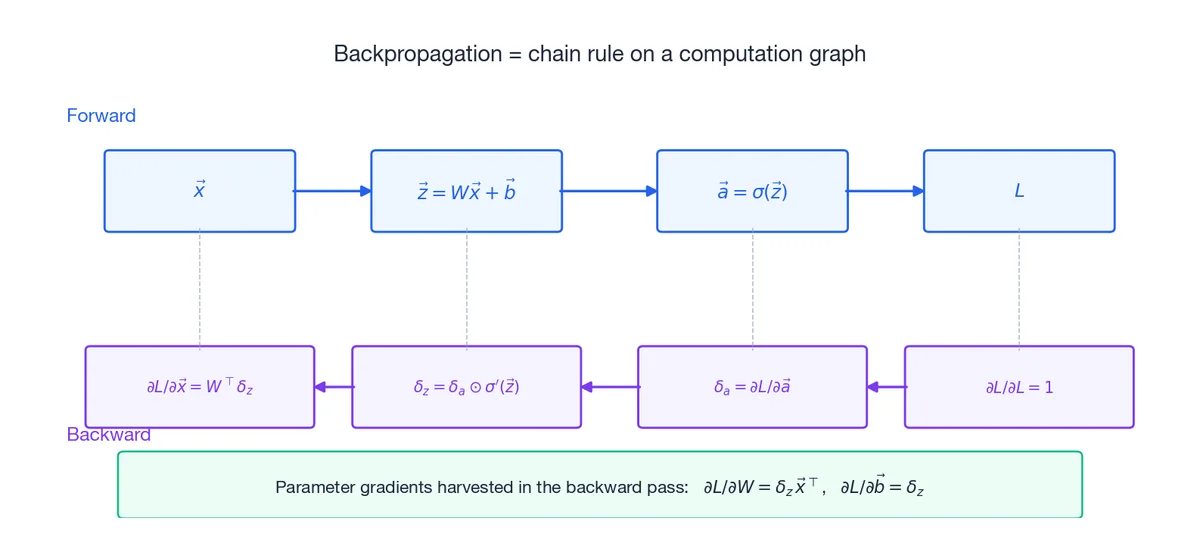
Any composite expression — including a 1000-layer neural network — breaks into elementary operations on a directed acyclic graph called a computation graph. Backpropagation is the chain rule walked backwards over this graph.
Why backwards? Suppose you have$n$ inputs and$1$ output (the usual setup: millions of parameters, one scalar loss).
- Forward-mode (a.k.a. dual numbers) computes the Jacobian-vector product$J\vec{v}$ . To get all gradients you need$n$ such passes.
- Reverse-mode (backpropagation) computes the vector-Jacobian product$\vec{v}^TJ$ . A single pass yields gradients with respect to all$n$ inputs simultaneously.
For deep learning, “$n$ ” is “every parameter in the model” — so reverse-mode is roughly a million times cheaper than forward-mode. That ratio is the only reason deep learning is computationally tractable at all.
Backpropagation Through a Fully Connected Layer#
This is the workhorse derivation; if you internalize one calculation in the chapter, make it this one.
$$\vec{z} = W\vec{x} + \vec{b}, \qquad \vec{a} = \sigma(\vec{z})\quad(\text{element-wise})$$Backward. Suppose later layers have already produced$\delta_a := \partial L / \partial \vec{a}$ . Then:
- Through the activation:$\delta_z = \delta_a \odot \sigma'(\vec{z})$ ($\odot$ is element-wise product).
- Weight gradient:$\dfrac{\partial L}{\partial W} = \delta_z \vec{x}^T$ . Note the shape: outer product of the upstream signal with the input. Same shape as$W$ .
- Bias gradient:$\dfrac{\partial L}{\partial \vec{b}} = \delta_z$ .
- Pass-through to the previous layer:$\dfrac{\partial L}{\partial \vec{x}} = W^T\delta_z$ .
Every modern framework (PyTorch, JAX, TensorFlow) executes exactly this recipe, layer by layer.
Activation Functions and Their Derivatives#
ReLU.$\sigma(z) = \max(0, z)$ , so$\sigma'(z) = 1$ for$z > 0$ and$0$ otherwise. Cheap, no saturation in the positive region. Downside: zero gradient on the negative side — the dreaded “dying ReLU”.
Sigmoid.$\sigma(z) = 1/(1+e^{-z})$ , with the elegant identity$\sigma'(z) = \sigma(z)(1 - \sigma(z))$ . Output in$(0,1)$ , interpretable as probability. Downside: saturates at both ends, so gradients vanish in deep networks.
$$\frac{\partial L}{\partial \vec{z}} = \hat{\vec{y}} - \vec{y}$$“Predicted probability minus true label.” That cleanliness is exactly why softmax + cross-entropy is the default for classification — the gradient is local, cheap, and well-scaled.
Convex Optimization: The Property That Makes Things Easy#
What “Convex” Means#
$$f(\alpha\vec{x} + (1-\alpha)\vec{y}) \leq \alpha f(\vec{x}) + (1-\alpha)f(\vec{y}), \quad \alpha \in [0,1]$$The single fact that makes convexity precious:
Theorem. Every local minimum of a convex function is a global minimum.
For convex problems, “the optimizer converged to a local minimum” is the whole story — there is no worry about getting stuck in a bad basin.
Three Equivalent Characterizations (for$C^2$ functions)#
1.$f$ is convex. 2. The graph lies above each tangent:$f(\vec{y}) \geq f(\vec{x}) + \nabla f(\vec{x})^T(\vec{y} - \vec{x})$ . 3. The Hessian is positive semidefinite everywhere:$H(\vec{x}) \succeq 0$ .
For strict convexity, replace$\succeq$ with$\succ$ .
A Convex-Function Sampler#
| Function | Why it’s convex |
|---|---|
| $\vec{a}^T\vec{x} + b$ | Affine — both convex and concave |
| $\mid\vec{x}\mid_p$ ($p \geq 1$ ) | Triangle inequality |
| $\vec{x}^TA\vec{x}$ with$A \succeq 0$ | Hessian is$2A \succeq 0$ |
| $e^x$ ,$x \log x$ | Second derivative$> 0$ |
| $-\log x$ ($x > 0$ ) | Underlies log-likelihood losses |

KKT Conditions#
For the constrained problem$\min f(\vec{x})$ subject to$g_i(\vec{x}) \leq 0$ and$h_j(\vec{x}) = 0$ , the KKT conditions are necessary at any optimum and sufficient when the problem is convex:
- Primal feasibility:$g_i(\vec{x}^*) \leq 0$ ,$h_j(\vec{x}^*) = 0$ .
- Dual feasibility:$\mu_i \geq 0$ .
- Complementary slackness:$\mu_i\, g_i(\vec{x}^*) = 0$ (an inequality constraint is either tight or its multiplier is zero).
- Stationarity:$\nabla f + \sum_i \mu_i \nabla g_i + \sum_j \nu_j \nabla h_j = \vec{0}$ .
KKT is the workhorse of constrained optimization — and the Lagrangian framework that produces it is also how SVMs, max-entropy models, and PCA are derived.
Optimization Algorithms#
Gradient Descent#
$$\vec{x}_{k+1} = \vec{x}_k - \alpha \nabla f(\vec{x}_k)$$Walk downhill. The step size$\alpha$ is the learning rate: too small and you crawl, too large and you diverge.
For a convex quadratic with condition number$\kappa$ , the convergence rate is roughly$\bigl(\tfrac{\kappa - 1}{\kappa + 1}\bigr)^k$ — so an ill-conditioned problem ($\kappa \gg 1$ ) can be brutally slow, and the trajectory zig-zags across the long axis of the bowl.

Newton’s Method#
$$\vec{x}_{k+1} = \vec{x}_k - H^{-1}\nabla f(\vec{x}_k)$$Approximate$f$ by its second-order Taylor expansion and jump straight to the minimum of that quadratic. The result is quadratic convergence: the number of correct digits roughly doubles per step.
The catch: forming and inverting$H$ costs$O(n^3)$ , prohibitive when$n$ is in the millions. And on non-convex losses, Newton’s method may steer toward a saddle or even a maximum — it goes wherever$\nabla f$ is zero.

Stochastic Gradient Descent (SGD)#
$$\vec{x}_{k+1} = \vec{x}_k - \alpha \nabla \ell_{i_k}$$Massively cheaper per step. The injected noise also helps escape narrow saddles and shallow basins — a feature, not a bug, for non-convex deep learning.
Momentum#
$$\vec{v}_{k+1} = \beta\vec{v}_k + \nabla f(\vec{x}_k), \qquad \vec{x}_{k+1} = \vec{x}_k - \alpha\vec{v}_{k+1}$$The standard mental picture: a heavy ball rolling downhill. Inertia smooths out the path and lets it coast through small bumps.
Adam#
$$m_t = \beta_1 m_{t-1} + (1-\beta_1)\nabla f \qquad v_t = \beta_2 v_{t-1} + (1-\beta_2)(\nabla f)^2$$ $$\vec{x}_{t+1} = \vec{x}_t - \frac{\alpha}{\sqrt{\hat{v}_t} + \epsilon}\hat{m}_t$$Parameters with consistently large gradients get a smaller effective learning rate; quiet parameters get a larger one. With$\beta_1 = 0.9$ ,$\beta_2 = 0.999$ ,$\alpha = 10^{-3}$ it is the default optimizer for most modern deep learning workflows.
Three Worked Applications#
Linear Regression (Closed Form)#
Objective:$L(\vec{w}) = \|X\vec{w} - \vec{y}\|^2$ .
Gradient:$\nabla L = 2X^T(X\vec{w} - \vec{y})$ .
$$\vec{w}^* = (X^TX)^{-1}X^T\vec{y}$$This closed form exists exactly because the loss is a convex quadratic in$\vec{w}$ .
Ridge Regression#
$$\vec{w}^* = (X^TX + \lambda I)^{-1}X^T\vec{y}$$The$\lambda I$ term shifts every eigenvalue of$X^TX$ by$\lambda$ , which guarantees invertibility and tames the condition number — a direct application of Chapter 10 ’s intuition.
PCA as Optimization#
$$\max_{\|\vec{w}\|=1} \vec{w}^T\Sigma\vec{w}$$The Lagrangian is$\vec{w}^T\Sigma\vec{w} - \lambda(\vec{w}^T\vec{w} - 1)$ , and setting its gradient to zero gives$\Sigma\vec{w} = \lambda\vec{w}$ . PCA is an eigenvalue problem — because of the KKT stationarity condition. The optimizer is the leading eigenvector of$\Sigma$ .
Formula Quick Reference#
Vector Derivatives#
| $f(\vec{x})$ | $\nabla f$ |
|---|---|
| $\vec{a}^T\vec{x}$ | $\vec{a}$ |
| $\vec{x}^T\vec{x}$ | $2\vec{x}$ |
| $\vec{x}^TA\vec{x}$ ($A$ symmetric) | $2A\vec{x}$ |
| $\mid\vec{x}\mid_2$ | $\vec{x}/\mid\vec{x}\mid_2$ |
Matrix Derivatives#
| $f(X)$ | $\partial f/\partial X$ |
|---|---|
| $\text{tr}(AX)$ | $A^T$ |
| $\text{tr}(X^TAX)$ | $(A+A^T)X$ |
| $\det(X)$ | $\det(X)\cdot X^{-T}$ |
| $\ln\det(X)$ | $X^{-T}$ |
Python Examples#
Gradient Checking#
The single best debugging tool for any hand-derived gradient: compare to a centered finite difference.
| |
A relative error below$10^{-7}$ is good; below$10^{-9}$ is excellent.
Comparing GD, Momentum, and Adam#
| |
Exercises#
Basics#
- Compute the gradient of$f(\vec{x}) = 3x_1^2 + 2x_1x_2 + x_2^2$ .
- Find all critical points of$f(x,y) = x^3 - 3xy + y^3$ and classify each one using the Hessian.
- Prove:$\nabla(\vec{x}^TA\vec{x}) = (A + A^T)\vec{x}$ , working from the partial-derivative definition.
Advanced#
- Derive the backpropagation formulas for a two-layer network$f = \sigma_2(W_2\sigma_1(W_1\vec{x} + \vec{b}_1) + \vec{b}_2)$ . Pay attention to shapes at every step.
- Prove that Newton’s method converges in one step on any quadratic function.
- Prove: any local minimum of a convex function is a global minimum (use the chord-above-graph definition).
Programming#
- Implement the gradient checker above and verify it on three different functions, including one matrix-valued.
- Implement SGD, Momentum, and Adam from scratch and compare their convergence on the Rosenbrock function. Plot the paths.
- Implement a two-layer neural network on a toy 2D classification dataset using only numpy, with hand-coded backpropagation (no autograd).
Summary#
| Concept | Key fact | Role in ML |
|---|---|---|
| Gradient | Direction of steepest ascent | Drives gradient descent |
| Jacobian | Best linear approximation | Building block of the chain rule |
| Hessian | Curvature matrix | Classifies critical points |
| Chain rule | Jacobians multiply | Powers backpropagation |
| Convexity | Local min = global min | Guarantee for many losses |
| Adam | Adaptive learning rates | Default optimizer for deep learning |
The single most important takeaway: for a scalar loss with a million parameters, one backward pass over the computation graph yields all million gradients. Everything else in this chapter exists to make that one fact precise and trustworthy.
References#
- Petersen, K. B. & Pedersen, M. S. The Matrix Cookbook. (The reference for matrix derivative identities.)
- Goodfellow, I., Bengio, Y. & Courville, A. (2016). Deep Learning, Chapter 6 — backpropagation in detail.
- Boyd, S. & Vandenberghe, L. (2004). Convex Optimization — the standard text on convexity, Lagrangians, and KKT.
- Nocedal, J. & Wright, S. (2006). Numerical Optimization — the canonical reference for Newton, quasi-Newton, and trust-region methods.
- Kingma, D. P. & Ba, J. (2015). “Adam: A Method for Stochastic Optimization.” ICLR.
Linear Algebra 18 parts
- 01 Essence of Linear Algebra (1): The Essence of Vectors — More Than Just Arrows
- 02 Essence of Linear Algebra (2): Linear Combinations and Vector Spaces
- 03 Essence of Linear Algebra (3): Matrices as Linear Transformations
- 04 Essence of Linear Algebra (4): The Secrets of Determinants
- 05 Essence of Linear Algebra (5): Linear Systems and Column Space
- 06 Essence of Linear Algebra (6): Eigenvalues and Eigenvectors
- 07 Essence of Linear Algebra (7): Orthogonality and Projections — When Vectors Mind Their Own Business
- 08 Essence of Linear Algebra (8): Symmetric Matrices and Quadratic Forms — The Best Matrices in Town
- 09 Essence of Linear Algebra (9): Singular Value Decomposition — The Crown Jewel of Linear Algebra
- 10 Essence of Linear Algebra (10): Matrix Norms and Condition Numbers — Is Your Linear System Healthy?
- 11 Essence of Linear Algebra (11): Matrix Calculus and Optimization — The Engine Behind Machine Learning you are here
- 12 Essence of Linear Algebra (12): Sparse Matrices and Compressed Sensing — Less Is More
- 13 Essence of Linear Algebra (13): Tensors and Multilinear Algebra
- 14 Essence of Linear Algebra (14): Random Matrix Theory
- 15 Essence of Linear Algebra (15): Linear Algebra in Machine Learning
- 16 Essence of Linear Algebra (16): Linear Algebra in Deep Learning
- 17 Essence of Linear Algebra (17): Linear Algebra in Computer Vision
- 18 Essence of Linear Algebra (18): Frontiers and Summary