Ordinary Differential Equations (10): Bifurcation Theory
Bifurcation theory explains how smooth parameter changes cause dramatic qualitative shifts in system behavior. Master saddle-node, transcritical, pitchfork, and Hopf bifurcations through normal forms, stability arguments, and Python visualizations.
A lake stays clear for decades, then turns murky in a single season. A power grid hums along stably, then trips into a cascading blackout in seconds. A column under slowly increasing load is straight, straight, straight — and then suddenly buckles.
These are not prediction failures. The universe is doing exactly what dynamical systems theory says it must: cross a bifurcation. When a parameter drifts past a critical value, the topology of phase space rearranges, and what was once impossible becomes inevitable. This chapter classifies these rearrangements. There are only a few, and once you see the catalog, you’ll spot them everywhere.

What You Will Learn#
- What bifurcation means precisely, and why it has to be defined in terms of topology, not quantity
- The four codimension-1 normal forms: saddle-node, transcritical, supercritical pitchfork, subcritical pitchfork
- The Hopf bifurcation: how a stable spiral spawns a limit cycle when a pair of complex eigenvalues crosses the imaginary axis
- Why subcritical bifurcations are catastrophic (they jump and they hyster) while supercritical ones are gentle
- A first taste of global bifurcations — homoclinic orbits, SNIC, and how they open the door to chaos
- The ideas of codimension and universality that explain why nature reuses the same handful of normal forms
Prerequisites: stability and phase-plane analysis from Chapter 8 , and the chaos vocabulary from Chapter 9 .
What is a bifurcation, really?#
The word bifurcation (Latin furca = fork) was coined by Henri Poincaré around 1885. The intuition is geometric. Picture the long-term behaviour of a one-parameter system$\dot{x} = f(x,\mu)$ as a portrait that depends continuously on$\mu$ . For most values of$\mu$ , small perturbations move the portrait around but do not change its essential shape: the same number of fixed points, the same stability assignments, the same cycles. We call such$\mu$ structurally stable.
A bifurcation is the opposite: a value$\mu_c$ at which the portrait changes its shape discontinuously under arbitrarily small perturbation. New equilibria appear out of nowhere, two of them collide and annihilate, a stable focus becomes a limit cycle, or a periodic orbit doubles its period.
The shift is qualitative, not quantitative. A water pipe gradually narrowing is not a bifurcation. A water pipe suddenly bursting is.
A useful mental model#
Think of$f(x,\mu)$ as a landscape that depends on$\mu$ . The fixed points are where the gradient vanishes; their stability is the curvature there. As$\mu$ slides, the landscape morphs continuously — but whenever a hill flattens to a saddle and then flips into a valley, that moment is a bifurcation. Between bifurcations the landscape is just being pushed around.
The four codimension-1 normal forms#
A miracle of bifurcation theory: near any one-parameter bifurcation, the dynamics are locally equivalent (after a smooth change of coordinates) to one of just four canonical equations. These are the normal forms.

Why “codimension-1”? Because each requires tuning exactly one parameter to occur. To meet two of them at once, you need to tune two parameters, etc. Codimension-1 events are the ones you bump into generically when sliding a single dial.
Saddle-node (fold) bifurcation#
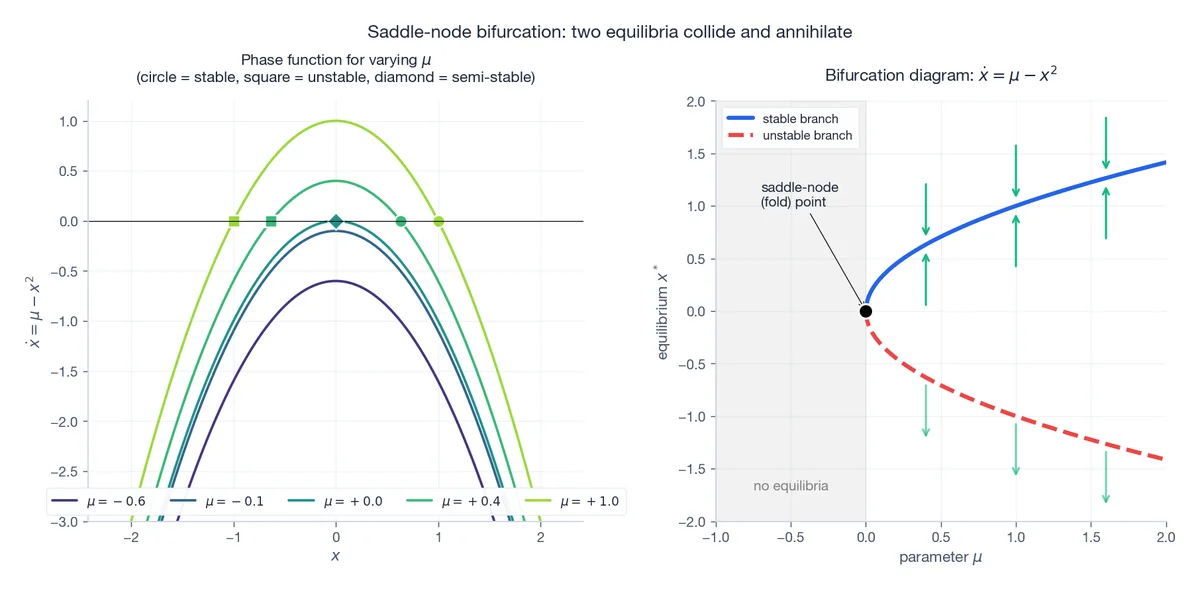
Normal form:$\dot{x} = \mu - x^2.$ Setting$\dot{x}=0$ gives$x^* = \pm\sqrt{\mu}$ . So:
| range of$\mu$ | equilibria |
|---|---|
| $\mu < 0$ | none |
| $\mu = 0$ | one (semi-stable, at$x=0$ ) |
| $\mu > 0$ | two:$+\sqrt{\mu}$ stable,$-\sqrt{\mu}$ unstable |
The linearisation$f_x = -2x$ tells us the stability immediately: at$+\sqrt{\mu}$ we have$f_x = -2\sqrt{\mu} < 0$ (stable), and at$-\sqrt{\mu}$ we have$f_x = +2\sqrt{\mu} > 0$ (unstable). The two equilibria are born together as$\mu$ increases through 0.
Where it shows up
- Lasers: below threshold pump current, the only stationary state is “no light”. Above threshold, a coherent emitting state appears. The “no-light” state continues to exist but coexists with it.
- Neurons (Class I): below the rheobase current the resting state is the only equilibrium. Above it, the resting state collides with a saddle and disappears — the neuron starts firing.
- Lakes flipping from clear to murky: the clear-water equilibrium disappears in a saddle-node fold as nutrient loading crosses a threshold.
The signature of a fold is bistability before annihilation. Just below$\mu_c$ two equilibria coexist; just above$\mu_c$ neither does. The system must go somewhere else, often violently.
Transcritical bifurcation#
Normal form:$\dot{x} = \mu x - x^2.$ Two equilibria always exist:$x^*=0$ and$x^*=\mu$ . They never disappear — they merely swap stability as they cross at$\mu=0$ .
| range of$\mu$ | $x^*=0$ | $x^*=\mu$ |
|---|---|---|
| $\mu < 0$ | stable | unstable |
| $\mu > 0$ | unstable | stable |
This is the bifurcation you get whenever the system has a “trivial” state ($x=0$ ) that must always remain an equilibrium for symmetry or definitional reasons.

Where it shows up
- Epidemiology: the disease-free equilibrium always exists. When the basic reproduction number$R_0$ crosses 1 (the bifurcation parameter), it loses stability to the endemic equilibrium. The transition is exactly transcritical.
- Population dynamics: extinction is always an equilibrium. As an environmental quality parameter crosses a threshold, the extinction state hands off stability to a positive coexistence state.
- Lasers (alternative model): the off-state is always a fixed point; it loses stability to the lasing state at threshold.
Supercritical pitchfork#
Normal form:$\dot{x} = \mu x - x^3.$ Equilibria: always$x^*=0$ , plus$x^*=\pm\sqrt{\mu}$ when$\mu>0$ . The trivial branch loses stability and two new stable branches are born symmetrically.
This is the universal symmetry-breaking bifurcation. The equation is invariant under$x \to -x$ , so any new equilibrium must come with a partner. Below$\mu_c$ the system sits on the symmetric solution; above$\mu_c$ it must commit to one of two equally valid asymmetric solutions.
Subcritical pitchfork (the dangerous one)#
Normal form:$\dot{x} = \mu x + x^3.$ Now the trivial branch loses stability without any nearby stable branch waiting to catch the system. Below$\mu=0$ we have$x^*=0$ stable plus two unstable branches at$\pm\sqrt{-\mu}$ ; above$\mu=0$ , only the unstable trivial branch remains. Trajectories shoot off to infinity.
In real systems higher-order terms eventually re-stabilise things: adding a$-x^5$ term gives the canonical hysteretic model$\dot{x} = \mu x + x^3 - x^5,$ which has a high-amplitude stable branch coexisting with the trivial state in a window$-\tfrac14 \le \mu \le 0$ . Slowly ramping$\mu$ produces the famous hysteresis loop: the system jumps to large amplitude when$\mu$ crosses 0 from below, and only jumps back down when$\mu$ is pulled past$-\tfrac14$ on the way back.

Why it matters
- Buckled columns (Euler buckling): a slender vertical rod under compression undergoes a supercritical pitchfork at the critical load — it bends a small amount one way or the other, reversibly.
- Snapping shells (von Karman buckling of cylinders): the pitchfork is subcritical. The shell sits straight, sits straight, then collapses with a bang into a heavily-deformed configuration. This is why aerospace engineers calculate buckling loads with safety factors of 3-10.
- Ferromagnets near the Curie point: supercritical pitchfork. Magnetisation grows continuously from zero as temperature drops.
- Climate tipping: glacial$\leftrightarrow$ interglacial transitions are often modelled as subcritical-pitchfork (or fold) bifurcations of a temperature-albedo system. The hysteresis window means a tipped state cannot be “untipped” simply by reverting CO$_2$ to its earlier value.
Summary table#
| Bifurcation | Normal form | What happens | “Soft” or “hard”? |
|---|---|---|---|
| Saddle-node | $\dot{x}=\mu-x^2$ | Two equilibria appear/disappear | hard (state vanishes) |
| Transcritical | $\dot{x}=\mu x-x^2$ | Two branches swap stability | soft |
| Supercritical pitchfork | $\dot{x}=\mu x-x^3$ | Symmetric splitting, branches grow from 0 | soft |
| Subcritical pitchfork | $\dot{x}=\mu x+x^3$ | Symmetric splitting outward; jump + hysteresis | hard |
The Hopf bifurcation: a focus gives birth to a cycle#

The bifurcations above are scalar. The first genuinely two-dimensional bifurcation is the Hopf (Andronov-Hopf, really). It is what allows oscillations to appear.
Normal form (polar coordinates):$\dot{r} = \mu r - r^3, \qquad \dot{\theta} = \omega.$ The radial equation is exactly the supercritical pitchfork. So:
- For$\mu \le 0$ , the only attractor is$r=0$ – a stable spiral.
- For$\mu > 0$ , the origin is an unstable spiral and a stable limit cycle of radius$r=\sqrt{\mu}$ encircles it.
In Cartesian form, $\dot{x} = \mu x - \omega y - x(x^2+y^2),$ $\dot{y} = \omega x + \mu y - y(x^2+y^2).$ The Jacobian at the origin is$\bigl(\begin{smallmatrix}\mu & -\omega \\ \omega & \mu\end{smallmatrix}\bigr)$ , with eigenvalues$\lambda = \mu \pm i\omega$ . As$\mu$ crosses zero from below, the complex pair crosses the imaginary axis transversally — this is the Hopf condition.

The Hopf theorem (Hopf 1942). Let$\mathbf{x}_0$ be an equilibrium of$\dot{\mathbf{x}}=\mathbf{f}(\mathbf{x},\mu)$ at$\mu=\mu_c$ , and suppose the Jacobian has a complex pair$\lambda(\mu) = \alpha(\mu) \pm i\beta(\mu)$ satisfying
1.$\alpha(\mu_c)=0$ (the pair is on the imaginary axis), 2.$\beta(\mu_c)\ne 0$ (it is genuinely complex, not double-zero), 3.$\alpha'(\mu_c)\ne 0$ (the pair crosses, not merely touches),
and assume the cubic first Lyapunov coefficient$\ell_1$ is non-zero. Then a one-parameter family of periodic orbits emerges from$\mathbf{x}_0$ at$\mu_c$ , with period$\approx 2\pi/\beta(\mu_c)$ . The cycle is stable if$\ell_1 < 0$ (supercritical) and unstable if$\ell_1>0$ (subcritical).
Subcritical Hopf is the cyclic version of the subcritical pitchfork: it is silent until the bifurcation, then suddenly ejects the system to a distant attractor. Aircraft wing flutter, sudden onset of cardiac arrhythmia, and mode switching in lasers are textbook subcritical Hopfs.
| |
Codimension and universality#
A bifurcation has codimension k if it requires tuning k independent parameters to occur generically. Codimension-1 events fill curves in parameter space; codimension-2 events occur at isolated points where two such curves meet.
Common codimension-2 bifurcations:
- Cusp: where two saddle-node curves meet tangentially. The unfolding is the cusp catastrophe$\dot{x} = \mu_1 + \mu_2 x - x^3$ , which contains a hysteresis region bounded by two saddle-node curves meeting at a point.
- Bogdanov-Takens: a double-zero eigenvalue. The unfolding contains saddle-node, Hopf, and homoclinic curves meeting at one point. Whenever you find a Hopf curve and a fold curve approaching each other in a parameter diagram, look for a BT point at the meeting.
- Bautin (generalised Hopf): where the first Lyapunov coefficient passes through zero, marking the boundary between supercritical and subcritical Hopf. Cycles fold over in a saddle-node-of-cycles bifurcation.
The deep reason these classifications exist is the centre-manifold theorem plus the method of normal forms. Near a codimension-k bifurcation, only a handful of variables (the centre directions) carry the slow dynamics; everything else is enslaved to them. After polynomial coordinate changes, the slow dynamics reduces to the universal normal form. This is why bifurcation theory is finite — almost a periodic table.
Global bifurcations: when the topology changes far from any equilibrium#
Local bifurcations rearrange phase space near a single point. Global bifurcations rearrange it on a large scale, typically by reconnecting invariant manifolds.
Homoclinic bifurcation#
A trajectory that leaves a saddle along its unstable manifold and returns along its stable manifold is a homoclinic orbit. It exists only at isolated parameter values (a codimension-1 phenomenon). Near a homoclinic bifurcation, periodic orbits nearby have arbitrarily long periods — the orbit spends ever more time creeping past the saddle. This produces the universal scaling$T \sim -\log|\mu - \mu_c|$ .
The Shilnikov theorem says: a homoclinic loop to a saddle-focus with appropriate eigenvalue ratio implies the existence of countably many periodic orbits of all periods in a neighborhood — in other words, chaos.
Heteroclinic bifurcation#
Same idea, but the orbit connects different saddles. Heteroclinic cycles can give rise to slow oscillations with extremely long, almost-pause-like phases near each saddle. They are the standard model for “winnerless competition” in neural circuits.
SNIC (saddle-node on invariant circle)#
A saddle-node bifurcation that happens on a closed invariant curve. Below the bifurcation, the curve is broken at the saddle-node pair; above it, the pair has annihilated and the curve is restored as a limit cycle. The limit cycle is born with infinite period (the system creeps through the place where the equilibria used to be) and the period scales as$T \sim 1/\sqrt{\mu_c - \mu}$ . SNIC is the second standard route from quiescence to firing in neurons (Class I excitability), and a key mechanism in El Niño oscillator models.
The route to chaos: period doubling#
Limit cycles can themselves bifurcate. The most famous route is the period-doubling cascade: a stable cycle of period$T$ loses stability and gives birth to a stable cycle of period$2T$ , which in turn doubles to$4T$ , then$8T$ , then$16T$ , accumulating at a finite parameter value beyond which the dynamics is chaotic.
Mitchell Feigenbaum discovered (1978) that the parameter intervals$\Delta_n = \mu_n - \mu_{n-1}$ between successive doublings shrink geometrically with a universal ratio$\delta = \lim_{n \to \infty} \frac{\Delta_n}{\Delta_{n+1}} = 4.6692016\ldots$ independent of the specific system, as long as it has a smooth quadratic maximum. The same constant governs period doubling in dripping faucets, Rayleigh-Bénard convection, and electronic circuits.
The minimal toy model is the logistic map$x_{n+1} = r x_n(1 - x_n)$ :
| $r$ range | behaviour |
|---|---|
| $0 < r < 1$ | extinction:$x \to 0$ |
| $1 < r < 3$ | stable fixed point at$1 - 1/r$ |
| $3 \le r < 3.449$ | period 2 |
| $3.449 \le r < 3.544$ | period 4 |
| $\vdots$ | period 8, 16, 32, … |
| $r > 3.5699$ | chaos (with periodic windows) |
Sharkovsky’s theorem (1964) and the famous corollary “period 3 implies chaos” (Li-Yorke 1975) round out the story: any continuous interval map with a period-3 orbit has orbits of every other period, and uncountably many aperiodic orbits.
For a deeper dive into the chaos that lives beyond the cascade, see Chapter 9 .
Numerical detection and continuation#
In practice we rarely have closed-form normal forms. We have a vector field$\mathbf{f}(\mathbf{x},\mu)$ and want to map out its bifurcations as$\mu$ varies. The standard tools are continuation methods:
- Track an equilibrium branch. Start at a known equilibrium, then use Newton’s method on$\mathbf{f}(\mathbf{x},\mu)=0$ as$\mu$ is incremented. Use pseudo-arclength continuation to handle folds: parametrise the branch by arclength rather than by$\mu$ , so the algorithm can turn corners.
- Monitor the Jacobian eigenvalues along the branch. A real eigenvalue crossing 0 flags a saddle-node, transcritical, or pitchfork (you tell them apart by symmetry and by the second-order coefficient). A complex pair crossing the imaginary axis flags a Hopf.
- Switch branches at detected bifurcations using normal-form coefficients to compute the tangent direction of the new branch.
Production tools: AUTO-07p (the gold standard, Fortran/C), MATCONT (MATLAB), PyDSTool and BifurcationKit.jl (Python/Julia). For research-grade bifurcation work these are essentially mandatory; rolling your own continuation algorithm is a lot of work to get right.
| |
Why this matters#
The deepest message of bifurcation theory is that smooth causes can produce abrupt effects, but only through a small number of canonical mechanisms. When you suspect a system is approaching a tipping point, you can ask concrete diagnostic questions:
- What kind of bifurcation is approaching? Increasing variance and slow recovery from perturbations (critical slowing down) signal a fold or pitchfork. Growing oscillations signal a Hopf.
- Is it super- or sub-critical? If the system is bistable as you approach, it is sub-critical, and the post-bifurcation jump will be large and possibly irreversible.
- Is there hysteresis? If yes, do not assume that reversing the parameter will restore the original state.
- Are there early warning signals? For folds, the recovery rate from small perturbations decays towards zero as$\mu \to \mu_c$ , with universal scaling$\sim |\mu - \mu_c|^{1/2}$ . This is now used in ecology, climate science, and even epidemiology to forecast tipping events.
The taxonomy is small. The phenomena are everywhere.
Exercises#
- Imperfect pitchfork. Show that$\dot{x} = h + \mu x - x^3$ has a saddle-node bifurcation curve in the$(\mu, h)$ plane that meets at a cusp at the origin. Sketch the bifurcation diagrams for$h>0$ ,$h=0$ , and$h<0$ .
- Bifurcations of$\dot{x} = \mu - x - e^{-x}$ . Find all equilibria implicitly via$\mu = x + e^{-x}$ . Show there is a saddle-node at$\mu_c = 1$ ,$x_c = 0$ , and identify the stability of each branch.
- Logistic period-doubling numerically. Compute the doubling parameters$r_n$ for the logistic map up to$n=6$ . Use$\delta_n := (r_n - r_{n-1})/(r_{n+1} - r_n)$ to estimate the Feigenbaum constant.
- Hopf in a predator-prey model. For$\dot{x} = x(1-x) - \tfrac{xy}{a+x},\;\dot{y} = -dy + \tfrac{xy}{a+x}$ , find the parameter combinations producing a Hopf bifurcation of the coexistence equilibrium. Decide super- vs sub-critical numerically.
- Subcritical pitchfork with$x^5$ saturation. For$\dot{x} = \mu x + x^3 - x^5$ , derive the locations of the saddle-node folds at$\mu = -1/4$ and the resulting hysteresis interval. Plot the loop traversed by quasi-statically ramping$\mu$ up and back.
References#
- Strogatz, S. H. (2015). Nonlinear Dynamics and Chaos, 2nd ed. Westview / CRC. The single best entry point.
- Kuznetsov, Y. A. (2004). Elements of Applied Bifurcation Theory, 3rd ed. Springer. The reference for codimension-1 and -2 normal forms.
- Guckenheimer, J. & Holmes, P. (1983). Nonlinear Oscillations, Dynamical Systems, and Bifurcations of Vector Fields. Springer.
- May, R. M. (1976). “Simple mathematical models with very complicated dynamics.” Nature 261, 459-467.
- Scheffer, M. et al. (2009). “Early-warning signals for critical transitions.” Nature 461, 53-59.
- Doedel, E. & Oldeman, B. (2012). AUTO-07p Continuation Software for ODEs.
Previous Chapter: Chapter 9: Chaos Theory and the Lorenz System
Next Chapter: Chapter 11: Numerical Methods for Differential Equations
This is Part 10 of the 18-part series on Ordinary Differential Equations.
ODE Foundations 18 parts
- 01 Ordinary Differential Equations (1): Origins and Intuition
- 02 Ordinary Differential Equations (2): First-Order Methods
- 03 Ordinary Differential Equations (3): Higher-Order Linear Theory
- 04 Ordinary Differential Equations (4): The Laplace Transform
- 05 Ordinary Differential Equations (5): Power Series and Special Functions
- 06 Ordinary Differential Equations (6): Linear Systems and the Matrix Exponential
- 07 Ordinary Differential Equations (7): Stability Theory
- 08 Ordinary Differential Equations (8): Nonlinear Systems and Phase Portraits
- 09 Ordinary Differential Equations (9): Chaos Theory and the Lorenz System
- 10 Ordinary Differential Equations (10): Bifurcation Theory you are here
- 11 Ordinary Differential Equations (11): Numerical Methods
- 12 Ordinary Differential Equations (12): Boundary Value Problems
- 13 Ordinary Differential Equations (13): Introduction to Partial Differential Equations
- 14 Ordinary Differential Equations (14): Epidemic Models and Epidemiology
- 15 Ordinary Differential Equations (15): Population Dynamics
- 16 Ordinary Differential Equations (16): Fundamentals of Control Theory
- 17 Ordinary Differential Equations (17): Physics and Engineering Applications
- 18 Ordinary Differential Equations (18): Frontiers and Series Finale