Optimization (7): Second-Order Methods
Second-order methods break the sqrt(kappa) barrier by using curvature. We prove Newton's quadratic local convergence, derive BFGS from a secant condition + low-rank update, walk through L-BFGS's two-loop recursion that makes it the workhorse for medium-scale ML, and analyze trust-region subproblems with the dogleg solution.
First-order methods top out at $O(\sqrt{\kappa})$ iterations to reach $\epsilon$ -accuracy (article 05). Second-order methods break this barrier by using curvature: Newton’s method has quadratic local convergence — the number of correct digits doubles every iteration — and quasi-Newton methods retain most of this speed without computing the Hessian explicitly.
The cost is in the per-iteration work: Newton solves an $n \times n$ linear system per step ($O(n^3)$ ), BFGS maintains an $n \times n$ matrix ($O(n^2)$ per step + $O(n^2)$ memory), and L-BFGS uses only $O(mn)$ memory for a chosen history $m$ (typically 5–20).
This article gives the convergence proofs, derives the BFGS update from the secant condition, walks through the L-BFGS two-loop recursion line by line, and explains trust-region methods (which use the same Hessian information but with a different globalization strategy).
Last article ended at the wall first-order methods cannot break through: $O(\sqrt{\kappa})$ iterations to reach $\epsilon$ -accuracy, and that’s it.
Second-order methods take the obvious next step: spend more compute per iteration, but make each iteration count. Newton’s method is the headline result — locally quadratic convergence, meaning every iteration roughly doubles your number of correct digits. No first-order method can touch that.
The price is also concrete: Newton solves an $n \times n$ system ($O(n^3)$ ) per step. BFGS keeps an $n \times n$ matrix ($O(n^2)$ ). L-BFGS keeps only the last $m$ updates and gets memory down to $O(mn)$ .
I’ll walk this expensive-to-cheap ladder in order: Newton’s geometry first, then BFGS from the secant condition, then the L-BFGS two-loop recursion line by line, and finally trust regions — which use the same Hessian information but a different globalization strategy.
What You Will Learn#
- Newton’s method: derivation from second-order Taylor approximation, proof of local quadratic convergence under standard assumptions.
- Globalization via line search (Wolfe conditions) and via trust regions.
- The secant condition and how it constrains a quasi-Newton update.
- BFGS as the unique rank-2 update satisfying the secant condition + symmetry + positive-definiteness, plus a quick derivation.
- L-BFGS two-loop recursion: why it computes $H_k g_k$ in $O(mn)$ time without ever forming $H_k$ .
- Trust-region methods: subproblem, Cauchy point, dogleg, when to use them.
Prerequisites#
Articles 01 –02 (convex analysis, smoothness, strong convexity). Linear algebra fluency: matrix inverse, rank-1 updates, Sherman–Morrison formula.
Newton’s method#
Derivation#
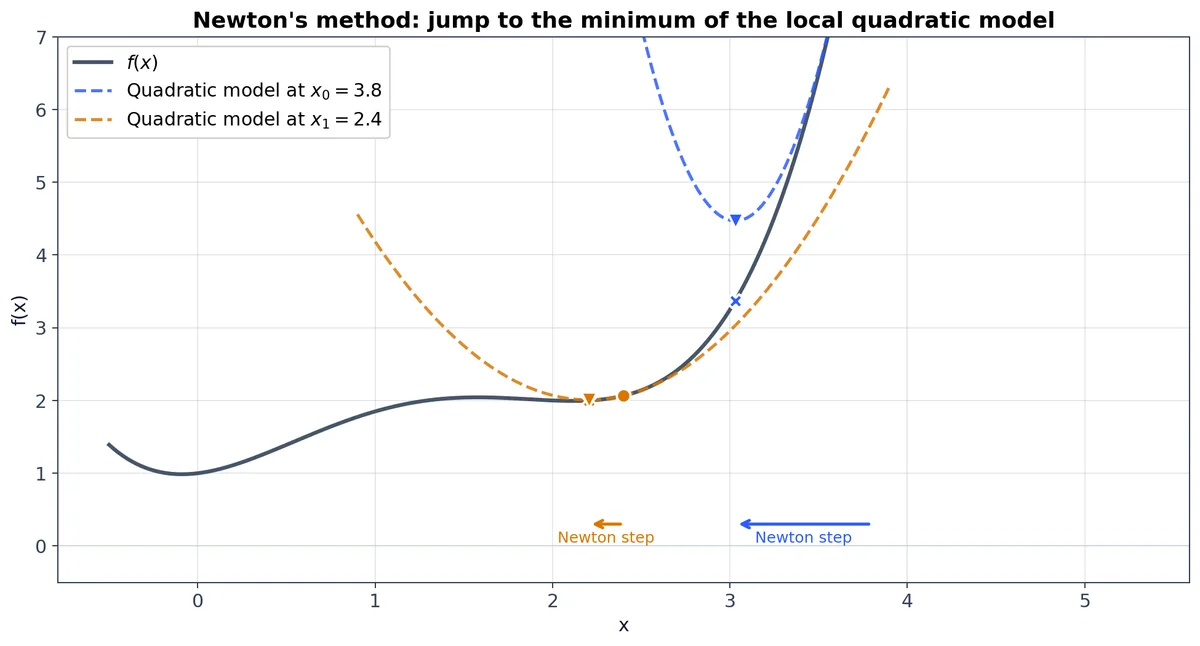
$$ f(x_k + d) \approx f(x_k) + \nabla f(x_k)^\top d + \tfrac{1}{2} d^\top \nabla^2 f(x_k) d. $$ $$ d_k^N = -[\nabla^2 f(x_k)]^{-1} \nabla f(x_k). $$This is the Newton direction. The pure Newton iteration is $x_{k+1} = x_k + d_k^N$ .
Geometrically: Newton’s method approximates $f$ by the local quadratic and jumps to the minimum of that quadratic. If $f$ is itself a quadratic, Newton converges in one step.
Quadratic local convergence#
$$ \|x_{k+1} - x^\star\|_2 \leq \frac{L}{2 \mu} \|x_k - x^\star\|_2^2. $$ $$ x_{k+1} - x^\star = x_k - x^\star - [\nabla^2 f(x_k)]^{-1} \nabla f(x_k). $$ $$ \nabla f(x_k) = \nabla f(x_k) - \nabla f(x^\star) = \int_0^1 \nabla^2 f(x^\star + t(x_k - x^\star)) (x_k - x^\star) \, dt. $$ $$ x_{k+1} - x^\star = [\nabla^2 f(x_k)]^{-1} \int_0^1 [\nabla^2 f(x_k) - \nabla^2 f(x^\star + t(x_k - x^\star))] (x_k - x^\star) \, dt. $$Theorem. Suppose $f$ is twice continuously differentiable, $\nabla^2 f$ is $L$ -Lipschitz (i.e., $\|\nabla^2 f(x) - \nabla^2 f(y)\| \leq L \|x - y\|$ ), and $\nabla^2 f(x^\star) \succeq \mu I$ at a stationary point $x^\star$ . Then for $x_0$ close enough to $x^\star$ , Newton’s method converges with
The integrand is bounded in norm by $L (1 - t) \|x_k - x^\star\|_2$ . Integrating gives $\|\cdot\| \leq \frac{L}{2} \|x_k - x^\star\|_2^2$ . Combined with $\|[\nabla^2 f(x_k)]^{-1}\| \leq 1/\mu$ (for $x_k$ close enough to $x^\star$ ), we get the claim. $\blacksquare$
The “doubling of digits” is concrete: if $\|x_k - x^\star\| = 10^{-3}$ , then $\|x_{k+1} - x^\star\| \leq C \cdot 10^{-6}$ , then $C^2 \cdot 10^{-12}$ , etc. To go from $10^{-3}$ to $10^{-12}$ takes 2 iterations, not the $\log(10^9) / \log(\sqrt{\kappa})$ a first-order method would need.

The catch: globalization#
The convergence theorem only guarantees fast convergence in a neighborhood of $x^\star$ . Far from $x^\star$ , the Newton direction may not even be a descent direction (when $\nabla^2 f \not\succ 0$ ), and the step size may be too large.
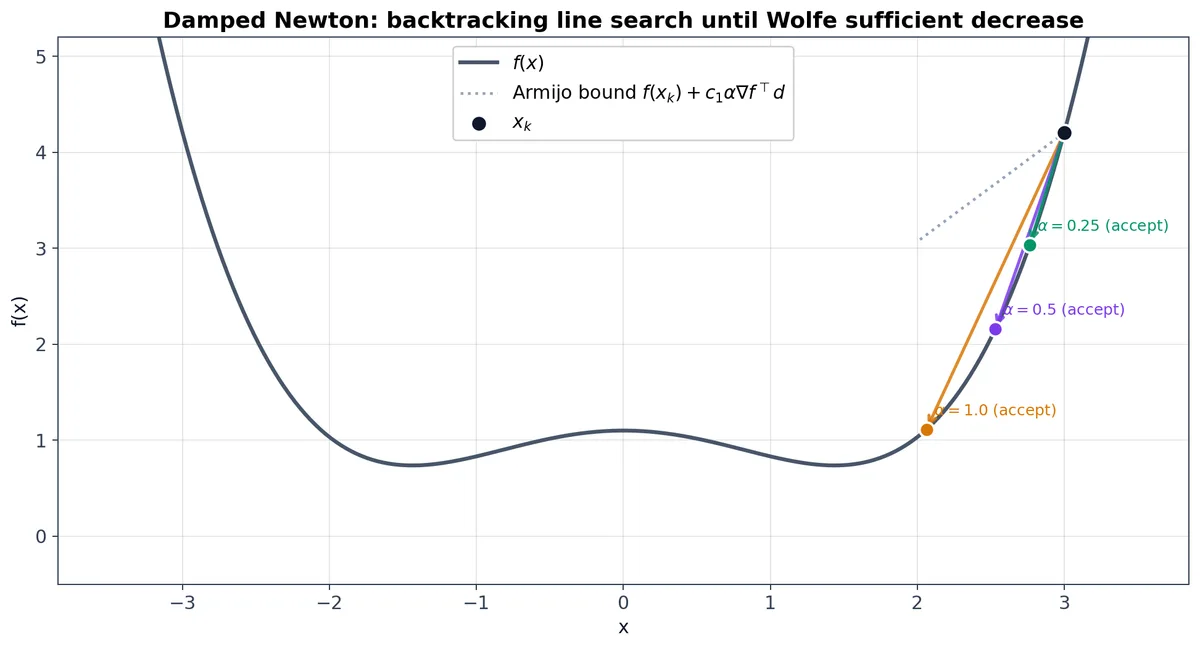
The standard fix is damped Newton: $x_{k+1} = x_k + \alpha_k d_k^N$ where $\alpha_k$ is chosen by a line search to satisfy the Wolfe conditions:
- Sufficient decrease (Armijo): $f(x_k + \alpha d_k) \leq f(x_k) + c_1 \alpha \nabla f(x_k)^\top d_k$ , typical $c_1 = 10^{-4}$ .
- Curvature: $\nabla f(x_k + \alpha d_k)^\top d_k \geq c_2 \nabla f(x_k)^\top d_k$ , typical $c_2 = 0.9$ for Newton-like methods.
Once $x_k$ is close to $x^\star$ , the unit step $\alpha_k = 1$ satisfies both conditions and the algorithm transitions automatically into the quadratic-convergence regime.
When the Hessian is indefinite#
If $\nabla^2 f(x_k) \not\succeq 0$ , the Newton direction may point uphill. Common fixes:
- Modified Cholesky: factor $\nabla^2 f + E$ where $E$ is the smallest diagonal perturbation that makes the matrix positive definite. The result is a descent direction biased toward Newton.
- Trust region (section 4): bound the step length and choose the direction inside the trust region; this handles indefinite Hessians directly.
- Cubic regularization (Nesterov & Polyak, 2006): minimize the model $\nabla f^\top d + \tfrac{1}{2} d^\top \nabla^2 f \, d + \tfrac{M}{6} \|d\|^3$ instead. This has global convergence to second-order critical points.
Quasi-Newton methods: the secant equation#
Newton needs $\nabla^2 f$ , which costs $O(n^2)$ to store and $O(n^3)$ to invert per step. Quasi-Newton methods build an approximation $B_k \approx \nabla^2 f(x_k)$ from gradient differences alone, mimicking the curvature implicit in $\nabla f(x_k) - \nabla f(x_{k-1})$ .
The secant condition#
$$ \nabla f(x_{k+1}) - \nabla f(x_k) = A (x_{k+1} - x_k). $$ $$ B_{k+1} s_k = y_k. \tag{Sec} $$Any quasi-Newton update should preserve this: the new approximation $B_{k+1}$ should reproduce the curvature observed in the most recent step.
BFGS: the canonical quasi-Newton update#
The BFGS (Broyden–Fletcher–Goldfarb–Shanno) update is the unique rank-2 update of $B_k$ that:
- Satisfies (Sec).
- Is symmetric: $B_{k+1} = B_{k+1}^\top$ .
- Stays positive definite if $B_k$ is and $y_k^\top s_k > 0$ (which holds whenever the step satisfies the curvature Wolfe condition).
- Minimizes a weighted Frobenius norm $\|B_{k+1} - B_k\|$ subject to (Sec) and symmetry.
This is the form actually implemented.
Why BFGS works in one paragraph#
If $B_k$ approximates $\nabla^2 f$ well in the directions seen so far ($s_0, \ldots, s_{k-1}$ ), the BFGS update preserves that information while adding the new direction $s_k$ . Over $n$ linearly-independent steps on a quadratic, BFGS reconstructs the exact Hessian and from then on behaves like Newton — the finite termination property.
For non-quadratic $f$ , BFGS achieves superlinear convergence: $\|x_{k+1} - x^\star\| / \|x_k - x^\star\| \to 0$ . The proof (Dennis & Moré, 1974) is delicate; the intuition is that as $x_k \to x^\star$ , the secant condition forces $B_k$ to approximate $\nabla^2 f(x^\star)$ on the directions actually used by the algorithm.
L-BFGS: limited memory#
For $n = 10^6$ , BFGS would need $10^{12}$ floats (8 TB) just to store $H_k$ . L-BFGS (“limited memory” BFGS) keeps only the last $m$ pairs $(s_i, y_i)$ — typically $m = 5$ to $20$ — and reconstructs the action $H_k g$ on demand using the two-loop recursion.
The two-loop recursion#
Given:
- Current gradient $g = \nabla f(x_k)$
- History $\{(s_i, y_i)\}_{i = k-m}^{k-1}$ with $\rho_i = 1 / (y_i^\top s_i)$
- An initial Hessian-inverse approximation $H_k^0$ (commonly $H_k^0 = (s_{k-1}^\top y_{k-1} / y_{k-1}^\top y_{k-1}) I$ — a scalar multiple of identity)
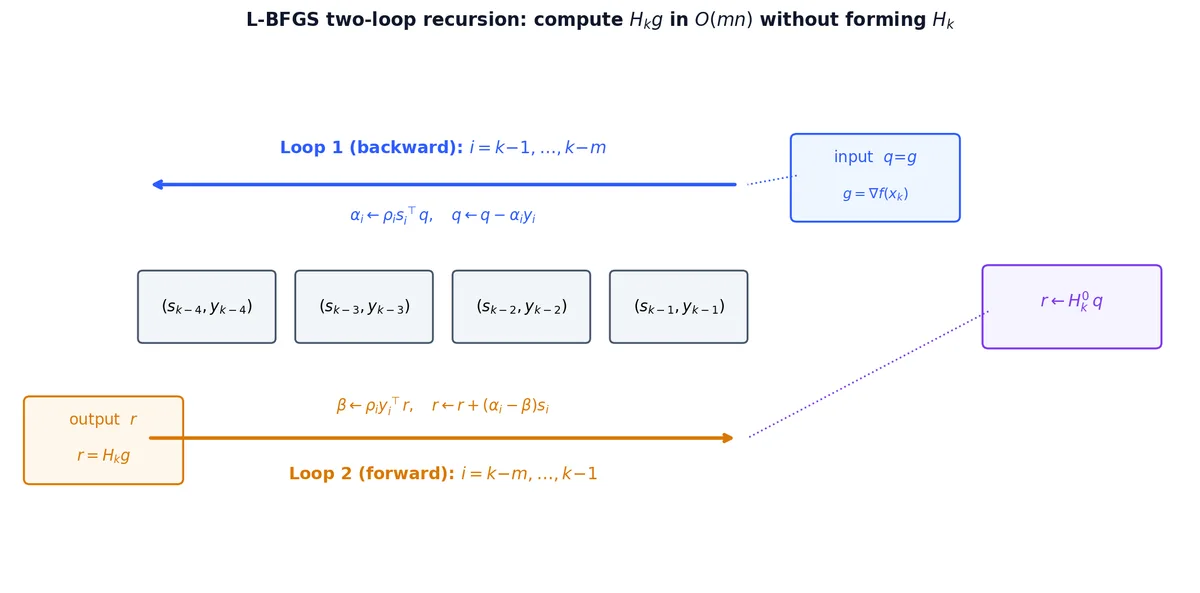
The recursion computes $H_k g$ in $O(mn)$ :
| |
Each loop touches each pair once; the total work is $4mn$ inner products plus a vector scaling — totally bypassing the $O(n^2)$ matrix update.
Where the two-loop comes from#
Apply (BFGS) recursively to expand $H_k$ in terms of $H_k^0$ and the pairs $(s_i, y_i)$ . The first loop unwinds the right-most factor $(I - \rho_i y_i s_i^\top)$ for each $i$ from $k-1$ down to $k-m$ , applied to $g$ . Multiplying by $H_k^0$ gives the middle. The second loop applies the left factors $(I - \rho_i s_i y_i^\top)$ in the reverse order. The $\alpha_i$ values are reused because they appear symmetrically in both factors. (Nocedal & Wright, Numerical Optimization, Algorithm 7.4 has the full derivation.)
Practical L-BFGS#
- Initial $H_0$ . $H_0 = \gamma_k I$ with $\gamma_k = (s_{k-1}^\top y_{k-1}) / (y_{k-1}^\top y_{k-1})$ is the standard choice; it provides scale-invariance.
- Memory size $m$ . $m = 5$ is a sensible default; $m = 20$ for problems where the gain matters. Larger $m$ does not help past a point because old curvature pairs become irrelevant.
- Skipping pairs. If $y_k^\top s_k \leq \epsilon \|s_k\| \|y_k\|$ (say $\epsilon = 10^{-8}$ ), the curvature condition fails and including the pair would damage positive definiteness; skip it.
- Line search. L-BFGS needs a proper Wolfe-condition line search to maintain $y_k^\top s_k > 0$ . A pure Armijo backtracking can break BFGS.
L-BFGS is the default solver for many ML problems: PyTorch’s torch.optim.LBFGS, scikit-learn’s LogisticRegression for moderate-scale problems, scipy’s minimize family. It dominates first-order methods for problems that fit in memory and are not too noisy.
Trust-region methods#
Line search asks “in which direction?” then “how far?”. Trust region asks both at once: within a region of trust around $x_k$ , what is the best step?
The subproblem#
$$ m_k(d) = f(x_k) + g_k^\top d + \tfrac{1}{2} d^\top B_k d. $$ $$ d_k^\star = \arg\min_{\|d\|_2 \leq \Delta_k} m_k(d), $$ $$ \rho_k = \frac{f(x_k) - f(x_k + d_k^\star)}{m_k(0) - m_k(d_k^\star)}. $$If $\rho_k$ is close to 1 the model is good; expand the trust region. If $\rho_k$ is poor or negative, contract the region and reject the step. Standard schedule: shrink $\Delta_k$ by 4 if $\rho_k < 0.25$ , expand by 2 if $\rho_k > 0.75$ and the step lies on the boundary.
Solving the subproblem#
The exact solution requires the Moré–Sorensen algorithm: find $\lambda \geq 0$ such that $(B_k + \lambda I) d = -g_k$ and $\lambda (\|d\|_2 - \Delta_k) = 0$ . This is exact but expensive.
Two cheap approximations:
$$ d_k^C = -\tau \frac{\Delta_k}{\|g_k\|_2} g_k, \quad \tau = \begin{cases} 1 & g_k^\top B_k g_k \leq 0 \\ \min\big(\frac{\|g_k\|_2^3}{\Delta_k g_k^\top B_k g_k}, 1\big) & \text{otherwise.} \end{cases} $$The Cauchy point gives at most a Cauchy decrease — comparable to gradient descent — but is always defined.
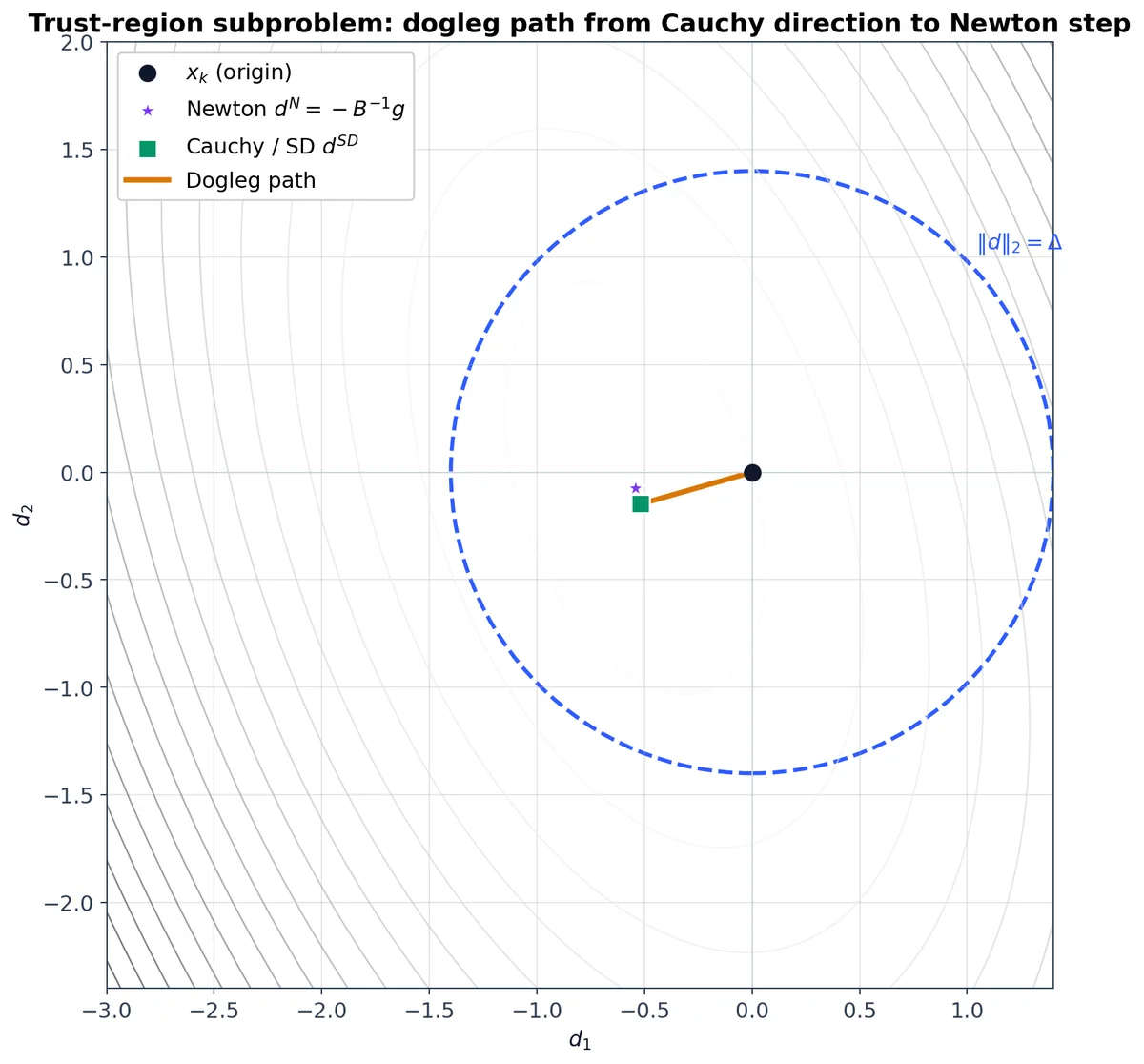
Dogleg. When $B_k \succ 0$ , compute the unconstrained Newton step $d_k^N = -B_k^{-1} g_k$ and the steepest-descent step $d_k^{SD} = -\frac{g_k^\top g_k}{g_k^\top B_k g_k} g_k$ . The dogleg path is
- If $\|d_k^N\|_2 \leq \Delta_k$ : take $d_k = d_k^N$ .
- Else if $\|d_k^{SD}\|_2 \geq \Delta_k$ : take $d_k = -\Delta_k \frac{g_k}{\|g_k\|_2}$ (Cauchy direction, capped).
- Else: take the linear combination that lies on the trust region boundary, giving a quasi-Newton step with reduced length.
The dogleg path is a “broken line” from $0$ to $d_k^{SD}$ to $d_k^N$ . The model decrease along this path is monotone, so the best feasible point is where the path meets the trust region boundary (or $d_k^N$ if interior).
Convergence#
Trust-region methods with Cauchy decrease are globally convergent to a stationary point — i.e., $\|\nabla f(x_k)\| \to 0$ — under mild assumptions on $B_k$ (uniformly bounded). When $B_k = \nabla^2 f(x_k)$ and the iterates are close to a strict minimum, trust regions inherit Newton’s quadratic convergence.
Trust regions are the method of choice for problems with non-convex Hessians (the model handles indefiniteness gracefully) and for very high-precision solutions where each step’s quality matters more than per-step cost.
Choosing among the second-order methods#
| Method | Per-step cost | Memory | Convergence near $x^\star$ | When to use |
|---|---|---|---|---|
| Newton (full) | $O(n^3)$ | $O(n^2)$ | Quadratic | Small $n$ , exact Hessian available, indefinite handled |
| BFGS | $O(n^2)$ | $O(n^2)$ | Superlinear | Medium $n$ ($10^3$ –$10^4$ ), good gradients |
| L-BFGS | $O(mn)$ | $O(mn)$ | Superlinear | Large $n$ ($10^4$ –$10^7$ ), the ML default |
| Trust region | $O(n^3)$ exact | $O(n^2)$ | Quadratic | Indefinite Hessians, high-precision needs |
| Gauss–Newton | $O(n m^2)$ | $O(n^2)$ | Quadratic in residual | Nonlinear least squares ($f = \frac{1}{2} \mid r(x)\mid^2$ ) |
For machine learning at the scale of millions of parameters, second-order methods are usually a poor fit because (a) gradients are noisy stochastic estimates, (b) memory is constrained, and (c) we don’t need high precision — the validation error stops decreasing well before the optimization gap becomes small. SGD-type methods dominate.
For classical scientific computing — physics simulations, parameter estimation, signal recovery on convex domains — L-BFGS and trust-region Newton are the workhorses. They achieve solutions that gradient descent cannot reach in any reasonable wall-clock time.
Summary#
Second-order methods break the $\sqrt{\kappa}$ barrier by using curvature, at a per-iteration cost. The hierarchy:
- Newton — fast, expensive, fragile; needs globalization.
- BFGS — Newton’s curvature, half the cost, full memory.
- L-BFGS — BFGS in $O(mn)$ memory; the modern default.
- Trust region — robustness to indefinite Hessians and bounded steps.
The next article (08) tackles constrained optimization using Lagrangian duality — the same Newton machinery applies, just to the augmented system.
References#
- Nocedal & Wright, Numerical Optimization (2nd ed.), Ch. 3 (line search), 4 (trust region), 6 (BFGS), 7 (L-BFGS) — the canonical reference.
- Boyd & Vandenberghe, Convex Optimization, §9.5 (Newton with damping) and §9.6 (self-concordance).
- Nesterov & Polyak, Cubic regularization of Newton method and its global performance, MathProg 108, 2006 — modern non-convex Newton.
- Liu & Nocedal, On the limited memory BFGS method for large scale optimization, MathProg 45, 1989 — the L-BFGS paper.
Optimization Theory 12 parts
- 01 Optimization (1): Convex Analysis Foundations
- 02 Optimization (2): Smoothness, Strong Convexity, and Nesterov Acceleration
- 03 Optimization (3): The Gradient Descent Family from SGD to AdamW
- 04 Optimization (4): Learning Rate and Schedules
- 05 Optimization (5): Acceleration Beyond Nesterov
- 06 Optimization (6): Composite Optimization and Proximal Methods
- 07 Optimization (7): Second-Order Methods you are here
- 08 Optimization (8): Lagrangian Duality and KKT Conditions
- 09 Optimization (9): Interior-Point Methods and Self-Concordant Barriers
- 10 Optimization (10): Stochastic Optimization and Variance Reduction
- 11 Optimization (11): Non-Convex Optimization and Saddle Escape
- 12 Optimization (12): Discrete and Global Optimization