Optimization (9): Interior-Point Methods and Self-Concordant Barriers
How interior-point methods became the default solver for convex programming: replace inequalities with a logarithmic barrier, parametrize the central path, and apply Newton's method. Includes the self-concordance machinery and the proof of the celebrated O(sqrt(n) log(1/eps)) iteration complexity.
In 1984 Karmarkar showed that LPs could be solved in polynomial time practically — not just theoretically (the ellipsoid method had achieved this on paper). His interior-point method stayed inside the feasible polytope and converged in $O(n L)$ iterations, far better than the simplex method’s exponential worst case. Within a decade, Nesterov & Nemirovski generalized this to all convex programming via the self-concordant barrier framework. The result — $O(\sqrt{n} \log(1/\epsilon))$ Newton iterations for an $n$ -dimensional problem — remains the gold standard for medium-scale convex optimization.
This article unpacks the machinery in three layers:
- The barrier method: replace inequalities with a logarithmic penalty and trace the central path as the penalty weight increases.
- Self-concordance: the analytic property of the barrier that makes Newton’s method behave well — convergence regions of size $O(1)$ instead of $O(\mu / L)$ .
- Primal-dual interior-point: the modern variant that solves primal and dual simultaneously, used in essentially every commercial LP/QP/SDP solver.
We give the central-path complexity proof in full.
In 1984 Karmarkar shook the optimization world: linear programming, he showed, is solvable in polynomial time not just on paper (the ellipsoid method had already done that) but in practice. His algorithm stayed strictly inside the feasible polytope, never touching the edges — that’s where the name “interior-point” comes from.
Within a decade, Nesterov and Nemirovski had generalized the trick to all convex programs, using the framework of self-concordant barriers. The headline iteration count, $O(\sqrt{n} \log(1/\epsilon))$ , is still the gold standard for medium-scale convex optimization today.
I’ll structure the article in three layers:
- The barrier method — replace inequality constraints with a logarithmic penalty, then track the central path as the penalty weight grows.
- Self-concordance — the analytic property of the barrier that keeps Newton’s method well-behaved.
- Primal-dual interior point — the variant that every commercial LP/QP/SDP solver actually runs.
The central-path complexity proof is included in full because it is the climax of the story.
What You Will Learn#
- The logarithmic barrier and the central path.
- Self-concordance: definition, three key implications, the $\sqrt{\nu}$ parameter.
- Damped Newton on a self-concordant function — quadratic convergence in a region of constant size.
- The barrier method’s iteration complexity: $O(\sqrt{\nu} \log(\nu / \epsilon))$ outer Newton steps.
- Primal-dual interior-point methods and why they dominate in practice.
Prerequisites#
Articles 02 (smoothness), 07 (Newton’s method), 08 (Lagrangian, KKT). Some comfort with directional derivatives and reading “Hessian metric” arguments.
The barrier method#
$$ \min_x f_0(x) \quad \text{s.t. } f_i(x) \leq 0, \ i = 1, \ldots, m, \quad Ax = b. $$ $$ \phi(x) = -\sum_{i=1}^m \log(-f_i(x)), $$ $$ \min_x \quad t f_0(x) + \phi(x), \quad Ax = b. \tag{$P_t$} $$This is an equality-constrained convex problem; its solution $x^\star(t)$ traces out the central path.
Central path properties#
For each $t > 0$ :
$x^\star(t)$ is the unique minimizer of ($P_t$ ) (under mild conditions).
- $$
\lambda_i(t) (-f_i(x^\star(t))) = 1/t.
$$
This is the classical KKT system except complementarity is shifted by $1/t$ instead of being exactly zero.
- $$
f_0(x^\star(t)) - p^\star \leq m / t.
$$
Why? Define $\nu(t) = (\nu_1(t), \ldots, \nu_p(t))$ from the equality constraints. Then $(\lambda(t), \nu(t))$ is dual feasible and the Lagrangian evaluated at this dual point is exactly $f_0(x^\star(t)) - m/t$ , by direct calculation.
So as $t \to \infty$
, $x^\star(t) \to x^\star$
, and the duality gap shrinks like $1/t$
.
The naive algorithm and its problem#
For very large $t$ , ($P_t$ ) becomes badly conditioned — the term $t f_0$ dominates near the boundary and Newton’s method has trouble. The fix is to solve a sequence of problems with increasing $t$ , warm-started from the previous solution:
| |
Each outer iteration multiplies $t$ by $\mu$ . The number of outer iterations is $\log(m / (t_0 \epsilon)) / \log \mu$ , typically 20–50. The crucial question is how many Newton steps each inner solve takes — and this is where self-concordance comes in.
Self-concordance#
$$ \Big| \frac{d^3}{dt^3} \phi(x + tu) \Big|_{t=0} \Big| \leq 2 \big(u^\top \nabla^2 \phi(x) u \big)^{3/2}. $$That is, the third directional derivative is controlled by the Hessian metric.
The most important examples:
- $\phi(x) = -\log x$ on $(0, \infty)$ : $\phi'(x) = -1/x$ , $\phi''(x) = 1/x^2$ , $\phi'''(x) = -2/x^3$ . Check: $|\phi'''| / (\phi'')^{3/2} = 2 / x^3 / x^{-3} = 2$ . Tight.
- $\phi(X) = -\log \det X$ on $\mathbf{S}^n_{++}$ : self-concordant.
- The barrier $-\sum_i \log(-f_i(x))$ for affine $f_i$ : self-concordant. (More generally for $f_i$ that are themselves “nice”.)
Why self-concordance matters#
Self-concordance has three magical consequences:
$$ \lambda_\phi(x) := \sqrt{\nabla \phi(x)^\top [\nabla^2 \phi(x)]^{-1} \nabla \phi(x)}. $$ $$ \phi(x) - \phi^\star \leq \lambda_\phi(x)^2 \quad \text{whenever} \quad \lambda_\phi(x) \leq 0.68. $$ $$ \phi(x_+) \leq \phi(x) - \omega(\lambda), $$where $\omega(\lambda) = \lambda - \log(1 + \lambda)$ . As long as $\lambda \geq \frac{1}{4}$ , we have $\omega(\lambda) \geq 0.02$ , so each Newton step decreases $\phi$ by at least a constant.
$$ \lambda_\phi(x_+) \leq 2 \lambda_\phi(x)^2. $$This is quadratic convergence — and the convergence radius $\frac{1}{4}$ is independent of conditioning.
These properties are what makes Newton’s method robust on a self-concordant function: “damped Newton phase” with constant decrease until $\lambda \leq 1/4$
, then “quadratic phase” finishing in $O(\log \log(1/\epsilon))$
steps.
Putting it together for the barrier method#
For each outer iteration of the barrier method, we Newton-solve $\min_x t f_0(x) + \phi(x)$ . If $f_0$ is self-concordant (or more generally if $t f_0 + \phi$ is) and we warm-start from $x^\star(t/\mu)$ (the previous solution), the warm start lies in the quadratic-convergence region of the new objective. So each outer iteration costs $O(1)$ Newton steps, independent of $t$ and the problem size.
Total Newton step count = (number of outer iterations) $\times$ $O(1)$ = $O(\log(m / \epsilon))$ .
But there is a subtlety: we need a sharper bound to capture the effect of the barrier parameter $\nu$ .
The barrier parameter and the $\sqrt{\nu}$ rate#
$$ \nabla \phi(x)^\top [\nabla^2 \phi(x)]^{-1} \nabla \phi(x) \leq \nu. $$Equivalently: $\lambda_\phi(x)^2 \leq \nu$ everywhere.
For $\phi = -\sum_{i=1}^m \log(-f_i(x))$ with affine $f_i$ , $\nu = m$ . For $\phi = -\log \det X$ on $n \times n$ PSD matrices, $\nu = n$ .
$$ \|x^\star(t) - x^\star(t')\|_{\nabla^2 \phi} \leq O(\sqrt{\nu} \log(t'/t)). $$ $$ \frac{\log(m / (t_0 \epsilon))}{\log(1 + 1/\sqrt{\nu})} = O(\sqrt{\nu} \log(\nu / \epsilon)), $$and each inner solve takes $O(1)$ Newton steps. This is the short-step interior-point algorithm with celebrated complexity.
Theorem (Nesterov–Nemirovski, 1994). Solving a convex program with self-concordant barrier of parameter $\nu$ to accuracy $\epsilon$ requires $O(\sqrt{\nu} \log(\nu/\epsilon))$ Newton iterations.
For LP with $m$ inequality constraints, $\nu = m$ and the complexity is $O(\sqrt{m} \log(m/\epsilon))$ — Karmarkar’s bound. For SDP on $n \times n$ matrices, $\nu = n$ , giving $O(\sqrt{n} \log(n/\epsilon))$ .
Long-step vs short-step#
The textbook short-step method ($\mu = 1 + 1/\sqrt{\nu}$ , full Newton steps) has the cleanest theory but is slow in practice — many small outer iterations. Long-step algorithms ($\mu = 10$ or $100$ , damped Newton) violate the strict theory but converge much faster empirically. The theoretical complexity becomes $O(\nu \log(\nu/\epsilon))$ in the worst case, but the practical performance often matches short-step.
Modern solvers use predictor-corrector schemes (Mehrotra, 1992): predict the central path direction with one Newton step, then correct with a second-order term. This is the basis of every commercial LP/QP/SDP solver.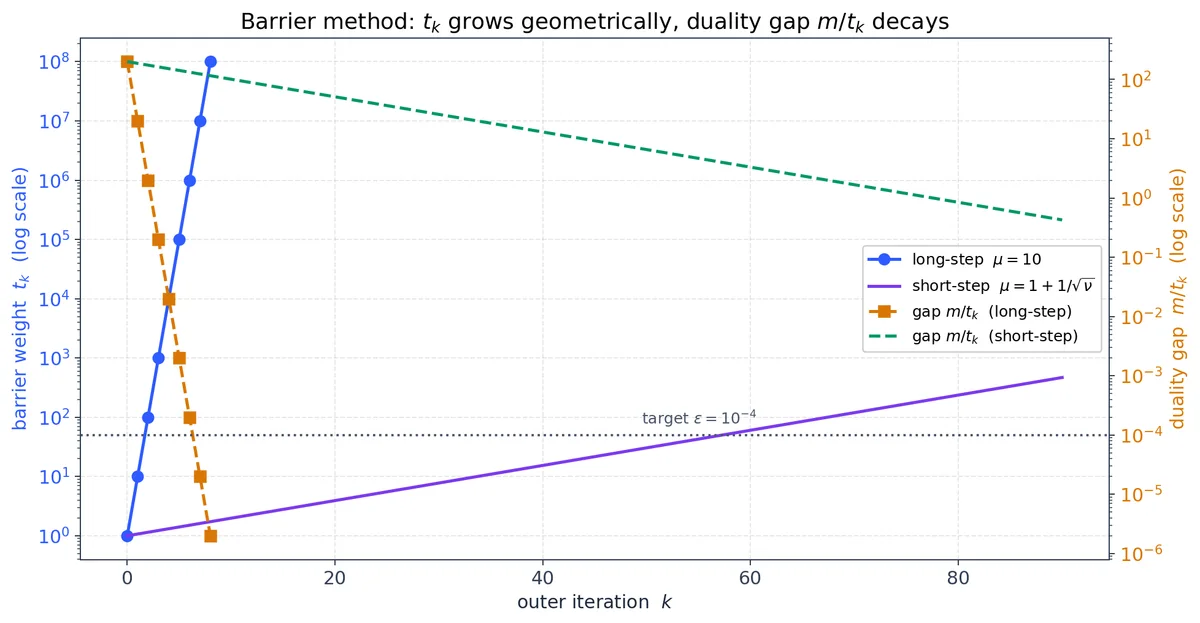
Primal-dual interior-point methods#
The barrier method updates the primal $x$ explicitly and recovers the dual $(\lambda, \nu)$ as a byproduct. Primal-dual methods update both simultaneously.
The primal-dual system#
$$ \begin{aligned} A x &= b \quad \text{(primal feasibility)} \\ A^\top \nu + \lambda &= c \quad \text{(dual feasibility)} \\ x_i \lambda_i &= 1/t \quad \text{(perturbed CS)} \\ x, \lambda &\geq 0 \end{aligned} $$This is a system in $(x, \nu, \lambda)$ with $1/t$ as a perturbation. Newton’s method on this system, with $1/t \to 0$ , converges to the primal-dual optimal pair.
Why primal-dual is preferred#
- No need to find a strictly feasible starting point. Primal-dual methods can start from infeasible iterates and converge to feasibility along the way.
- Better numerical conditioning. The Newton system has block structure that can be exploited (and is more stable than the pure primal Newton system as $t \to \infty$ ).
- Self-correcting: errors in $x$ get corrected through $\lambda$ and vice versa.
The vast majority of solvers (Mosek, Gurobi for QP, SDPT3 for SDP, OSQP for QP) implement primal-dual interior-point methods with predictor-corrector and adaptive step sizes.
Where interior-point shines and where it doesn’t#
Where interior-point dominates:
- LPs and QPs up to $n \approx 10^5$ variables.
- SDPs, second-order cone programs (SOCPs).
- Convex problems with structured constraints (chordal sparsity, etc.).
- High-precision solutions: 12+ digits of accuracy in tens of iterations.
Where first-order wins:
- Very large $n$ ($> 10^7$ ) with sparse structure: each Newton step is $O(n^3)$ in the worst case, so first-order methods scale better.
- Stochastic / streaming data: interior-point requires the full problem in memory.
- Coarse-precision problems where $\epsilon = 10^{-3}$ suffices: SGD and Adam dominate.
The classical workflow in convex modeling: write the problem in CVXPY, the modeling layer translates to standard SDP / SOCP form, an interior-point solver returns the optimum to 10-digit accuracy in seconds. This pipeline made convex optimization a routine engineering tool.
Worked example: LP via the barrier#
$$ B_t(x) = t c^\top x - \sum_{i=1}^m \log(b_i - a_i^\top x). $$ $$ \nabla B_t(x) = t c + A^\top \frac{1}{b - Ax}, \quad \nabla^2 B_t(x) = A^\top \mathrm{diag}\big( (b - Ax)^{-2} \big) A. $$(Here division is componentwise.)
The Newton direction is the solution of the linear system $\nabla^2 B_t(x) \, \Delta x = -\nabla B_t(x)$ . For sparse $A$ , this is solved via sparse Cholesky factorization in $O(n^3)$ worst case but typically much less.
A small worked instance with $n = 100$ , $m = 200$ to high precision typically takes 30 outer iterations and $\sim 100$ total Newton steps — orders of magnitude faster than first-order methods would need.
Summary#
| Concept | Role |
|---|---|
| Logarithmic barrier $\phi$ | Smooth penalty replacing inequality constraints. |
| Central path $x^\star(t)$ | Smooth curve from analytic center to the optimum as $t \to \infty$ . |
| Self-concordance | Analytic property making Newton converge in $O(1)$ -radius regions. |
| Barrier parameter $\nu$ | Controls the step size between central-path points; gives the $\sqrt{\nu}$ rate. |
| Primal-dual IPM | Modern variant; the basis of all commercial convex solvers. |
This completes the deterministic, exact-information optimization story. Articles 10 and 11 turn to stochastic methods (gradients with noise) and non-convex landscapes (no convergence-to-global guarantees) — the regimes where deep learning lives.
References#
- Nesterov & Nemirovski, Interior-Point Polynomial Algorithms in Convex Programming, SIAM, 1994 — the foundational monograph.
- Boyd & Vandenberghe, Convex Optimization, Ch. 11 — the cleanest exposition for engineers.
- Renegar, A Mathematical View of Interior-Point Methods, SIAM, 2001 — self-concordance from a geometric angle.
- Wright, Primal-Dual Interior-Point Methods, SIAM, 1997 — the practical algorithms.
- Mehrotra, On the Implementation of a Primal-Dual Interior Point Method, SIOPT 2, 1992 — the predictor-corrector scheme used in every modern solver.
Optimization Theory 12 parts
- 01 Optimization (1): Convex Analysis Foundations
- 02 Optimization (2): Smoothness, Strong Convexity, and Nesterov Acceleration
- 03 Optimization (3): The Gradient Descent Family from SGD to AdamW
- 04 Optimization (4): Learning Rate and Schedules
- 05 Optimization (5): Acceleration Beyond Nesterov
- 06 Optimization (6): Composite Optimization and Proximal Methods
- 07 Optimization (7): Second-Order Methods
- 08 Optimization (8): Lagrangian Duality and KKT Conditions
- 09 Optimization (9): Interior-Point Methods and Self-Concordant Barriers you are here
- 10 Optimization (10): Stochastic Optimization and Variance Reduction
- 11 Optimization (11): Non-Convex Optimization and Saddle Escape
- 12 Optimization (12): Discrete and Global Optimization