Probability and Statistics (3): Expectation, Variance, and the Moment-Generating Trick
From expectation and variance through covariance, correlation, and moment-generating functions to Chebyshev's inequality — the complete toolkit for summarizing random variables, with proofs for every result.
A probability distribution is a complete description of a random variable — it tells you the probability of every possible outcome. But complete descriptions are unwieldy. When someone asks “how tall are people in this city?”, you don’t hand them a density function; you say “about 170 cm on average, give or take 10 cm.” The average and the spread capture most of what matters in practice.
This article develops the mathematical framework for summarizing distributions. We start with expectation (the center), build up to variance (the spread), and then introduce moment-generating functions — a single formula that encodes every moment of a distribution and, remarkably, uniquely determines the distribution itself.
Expectation#
Definition#
$$E[X] = \sum_{x} x \, p(x)$$where the sum is over all values in the support of $X$ , provided the sum converges absolutely.
$$E[X] = \int_{-\infty}^{\infty} x \, f(x) \, dx$$again provided the integral converges absolutely.
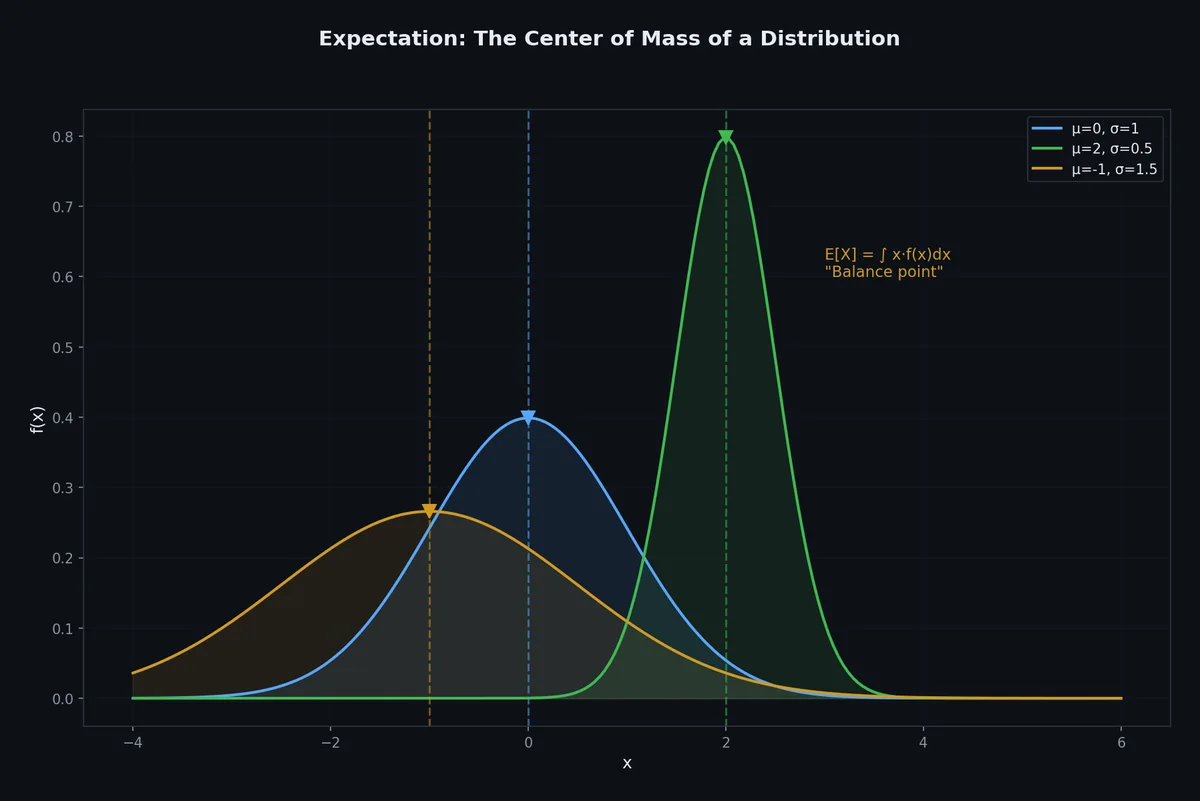
The expectation is the “center of mass” of the distribution. If you placed weights of size $p(x)$ at each point $x$ on a number line, $E[X]$ is the balance point.
Linearity of Expectation#
This is arguably the single most useful property in all of probability.
$$E[aX + bY + c] = aE[X] + bE[Y] + c.$$ $$E[aX + bY + c] = \sum_x \sum_y (ax + by + c) \, p(x, y)$$ $$= a \sum_x \sum_y x \, p(x, y) + b \sum_x \sum_y y \, p(x, y) + c \sum_x \sum_y p(x, y)$$ $$= a \sum_x x \sum_y p(x, y) + b \sum_y y \sum_x p(x, y) + c \cdot 1$$ $$= a \sum_x x \, p_X(x) + b \sum_y y \, p_Y(y) + c = aE[X] + bE[Y] + c. \quad \blacksquare$$Notice: we never assumed independence. Linearity holds always. This is what makes it so powerful.
Example. Find the expected number of fixed points when shuffling $n$ cards (a fixed point is a card that ends up in its original position).
$$E[X] = \sum_{i=1}^n E[X_i] = n \cdot \frac{1}{n} = 1.$$On average, exactly one card stays in place — regardless of $n$ . We computed the expectation of a complicated random variable without ever finding its distribution.
Example. Expected number of inversions in a random permutation of $\{1, 2, \ldots, n\}$ .
$$E[\text{inversions}] = \binom{n}{2} \cdot \frac{1}{2} = \frac{n(n-1)}{4}.$$Again, linearity gives us the answer without analyzing the complex dependencies between inversions. Note that the $X_{ij}$ are not independent (swapping two elements affects multiple pairs), but linearity doesn’t care.
LOTUS: The Law of the Unconscious Statistician#
To compute $E[g(X)]$ for some function $g$ , you might think you need the distribution of $Y = g(X)$ . You don’t.
$$E[g(X)] = \sum_x g(x) \, p(x).$$ $$E[g(X)] = \int_{-\infty}^{\infty} g(x) \, f(x) \, dx.$$The name “unconscious statistician” is tongue-in-cheek: the formula is so natural that people use it without realizing they’ve invoked a theorem.
$$E[X^2] = \int_0^1 x^2 \cdot 1 \, dx = \frac{x^3}{3}\bigg|_0^1 = \frac{1}{3}.$$We used LOTUS with $g(x) = x^2$ and $f(x) = 1$ on $[0,1]$ . No need to derive the distribution of $X^2$ .
Variance#

Definition#
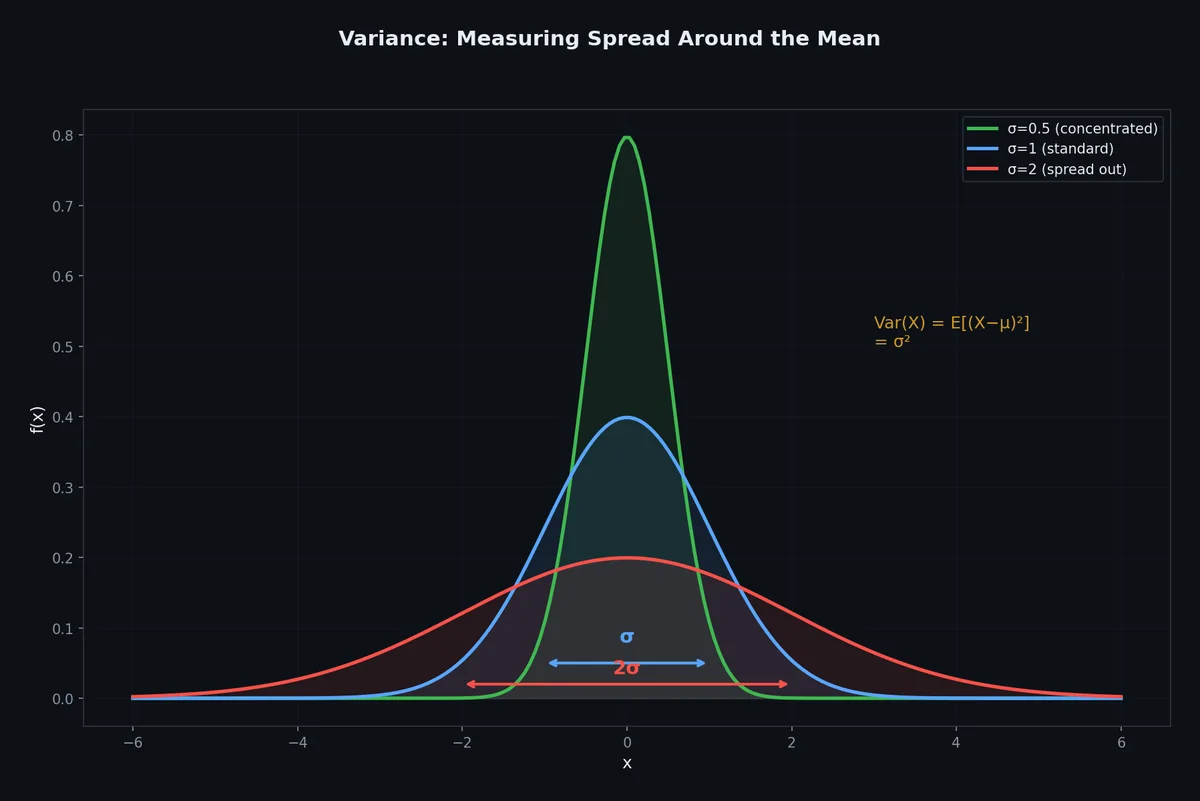
$$\text{Var}(X) = E\left[(X - E[X])^2\right].$$The standard deviation is $\text{SD}(X) = \sigma_X = \sqrt{\text{Var}(X)}$ , which has the same units as $X$ .
Computational Formula#
$$\text{Var}(X) = E\left[X^2 - 2XE[X] + (E[X])^2\right] = E[X^2] - 2E[X]E[X] + (E[X])^2$$ $$= E[X^2] - (E[X])^2.$$ $$\boxed{\text{Var}(X) = E[X^2] - (E[X])^2}$$Example. $X \sim \text{Uniform}(0,1)$ : $E[X] = 1/2$ , $E[X^2] = 1/3$ (computed above). So $\text{Var}(X) = 1/3 - 1/4 = 1/12$ . This matches the formula $(b-a)^2/12 = 1/12$ .
Scaling and Shifting#
$$\text{Var}(aX + b) = a^2 \text{Var}(X).$$ $$\text{Var}(aX + b) = E[(aX + b)^2] - (E[aX + b])^2$$ $$= E[a^2X^2 + 2abX + b^2] - (aE[X] + b)^2$$ $$= a^2E[X^2] + 2abE[X] + b^2 - a^2(E[X])^2 - 2abE[X] - b^2$$ $$= a^2(E[X^2] - (E[X])^2) = a^2\text{Var}(X). \quad \blacksquare$$Adding a constant shifts the distribution but doesn’t change its spread. Multiplying by $a$ scales the spread by $|a|$ (and the variance by $a^2$ ).
Variance of a Sum#
$$\text{Var}(X + Y) = \text{Var}(X) + \text{Var}(Y).$$ $$\text{Var}(X + Y) = \text{Var}(X) + \text{Var}(Y) + 2\text{Cov}(X, Y)$$which brings us to our next topic.
Covariance#

Definition#
$$\text{Cov}(X, Y) = E[(X - E[X])(Y - E[Y])] = E[XY] - E[X]E[Y].$$ $$\text{Cov}(X,Y) = E[XY - XE[Y] - YE[X] + E[X]E[Y]]$$ $$= E[XY] - E[X]E[Y] - E[Y]E[X] + E[X]E[Y] = E[XY] - E[X]E[Y]. \quad \blacksquare$$Properties#
- $\text{Cov}(X, X) = \text{Var}(X)$
- $\text{Cov}(X, Y) = \text{Cov}(Y, X)$ (symmetry)
- $\text{Cov}(aX + b, Y) = a \, \text{Cov}(X, Y)$ (linearity in each argument)
- $\text{Cov}(X + Y, Z) = \text{Cov}(X, Z) + \text{Cov}(Y, Z)$ (bilinearity)
- If $X$ and $Y$ are independent, $\text{Cov}(X, Y) = 0$ .
Warning: The converse of Property 5 is false. $\text{Cov}(X, Y) = 0$ does not imply independence.
$$E[XY] = E[X^3] = \int_{-1}^{1} x^3 \cdot \frac{1}{2} dx = 0$$because $x^3$ is an odd function on a symmetric interval. So $\text{Cov}(X, Y) = E[XY] - E[X]E[Y] = 0 - 0 \cdot E[Y] = 0$ .
Covariance detects linear relationships. It misses nonlinear ones.
Correlation#
$$\rho(X, Y) = \frac{\text{Cov}(X, Y)}{\sigma_X \sigma_Y} = \frac{\text{Cov}(X, Y)}{\sqrt{\text{Var}(X)\text{Var}(Y)}}.$$Properties#
- $-1 \leq \rho \leq 1$ (proved via Cauchy-Schwarz inequality)
- $\rho = 1$ if and only if $Y = aX + b$ with $a > 0$ (perfect positive linear relationship)
- $\rho = -1$ if and only if $Y = aX + b$ with $a < 0$ (perfect negative linear relationship)
- $\rho = 0$ means “uncorrelated” but not necessarily independent
What Correlation Does and Doesn’t Mean#
Correlation measures the strength and direction of the linear relationship between two variables. It does not capture:
- Nonlinear relationships ($X$ and $X^2$ can have $\rho = 0$ )
- Causation (a third variable may drive both)
- The slope of the relationship (that’s the regression coefficient, not $\rho$ )
Higher Moments#
The $k$ -th moment of $X$ about the origin is $E[X^k]$ . The $k$ -th central moment is $E[(X - \mu)^k]$ .

- 1st moment: $E[X] = \mu$ (location)
- 2nd central moment: $\text{Var}(X) = \sigma^2$ (spread)
- 3rd central moment (normalized): Skewness $\gamma_1 = \frac{E[(X - \mu)^3]}{\sigma^3}$ Skewness measures asymmetry. $\gamma_1 > 0$ : right tail is longer (right-skewed). $\gamma_1 < 0$ : left tail is longer (left-skewed). $\gamma_1 = 0$ : symmetric (like the Normal).
Example. The Exponential($\lambda$ ) distribution has $\gamma_1 = 2$ — always positively skewed. Income distributions typically have $\gamma_1 > 0$ (long right tail of high earners). Returns on financial assets often have $\gamma_1 < 0$ (the “crash” tail is heavier than the “boom” tail).
- 4th central moment (normalized): Kurtosis $\gamma_2 = \frac{E[(X - \mu)^4]}{\sigma^4}$ The Normal distribution has $\gamma_2 = 3$ . Excess kurtosis is $\gamma_2 - 3$ , measuring how much heavier the tails are compared to a Normal. Positive excess kurtosis means heavier tails (more extreme events than a Gaussian predicts).
Example. The Student’s t-distribution with $\nu$ degrees of freedom has excess kurtosis $6/(\nu - 4)$ (for $\nu > 4$ ). As $\nu \to \infty$ , it approaches 0 (Normal). For small $\nu$ , the excess kurtosis is large, reflecting heavy tails. This is why the t-distribution appears in robust statistics.
Example. The Uniform distribution has $\gamma_2 = 1.8$ , so its excess kurtosis is $-1.2$ (lighter tails than Normal). It’s as “platykurtic” as a continuous distribution gets on a bounded interval.
Moment-Generating Functions#
Definition#
$$M_X(t) = E[e^{tX}]$$defined for all $t$ in some open interval containing 0.
$$M_X(t) = 1 + tE[X] + \frac{t^2}{2!}E[X^2] + \frac{t^3}{3!}E[X^3] + \cdots$$ $$E[X^k] = M_X^{(k)}(0) = \frac{d^k}{dt^k} M_X(t) \bigg|_{t=0}.$$Uniqueness Theorem#
Theorem. If $M_X(t) = M_Y(t)$ for all $t$ in an open interval containing 0, then $X$ and $Y$ have the same distribution.
This is why MGFs are powerful: they are fingerprints of distributions. Identify the MGF, and you’ve identified the distribution.
MGF of the Poisson Distribution#
$$M_X(t) = E[e^{tX}] = \sum_{k=0}^{\infty} e^{tk} \frac{\lambda^k e^{-\lambda}}{k!} = e^{-\lambda} \sum_{k=0}^{\infty} \frac{(\lambda e^t)^k}{k!} = e^{-\lambda} \cdot e^{\lambda e^t} = e^{\lambda(e^t - 1)}.$$Verification: $M_X'(t) = \lambda e^t \cdot e^{\lambda(e^t - 1)}$ , so $M_X'(0) = \lambda \cdot 1 = \lambda = E[X]$ . $\checkmark$
$M_X''(t) = (\lambda e^t)^2 e^{\lambda(e^t-1)} + \lambda e^t e^{\lambda(e^t-1)}$ , so $M_X''(0) = \lambda^2 + \lambda = E[X^2]$ . Then $\text{Var}(X) = \lambda^2 + \lambda - \lambda^2 = \lambda$ . $\checkmark$
MGF of the Normal Distribution#
$$M_Z(t) = E[e^{tZ}] = \int_{-\infty}^{\infty} e^{tz} \frac{1}{\sqrt{2\pi}} e^{-z^2/2} dz = \frac{1}{\sqrt{2\pi}} \int_{-\infty}^{\infty} e^{-(z^2 - 2tz)/2} dz.$$ $$M_Z(t) = e^{t^2/2} \frac{1}{\sqrt{2\pi}} \int_{-\infty}^{\infty} e^{-(z-t)^2/2} dz = e^{t^2/2} \cdot 1 = e^{t^2/2}.$$ $$M_X(t) = E[e^{t(\mu + \sigma Z)}] = e^{\mu t} M_Z(\sigma t) = e^{\mu t + \sigma^2 t^2/2}.$$MGF of the Exponential Distribution#
$$M_X(t) = \int_0^{\infty} e^{tx} \lambda e^{-\lambda x} dx = \lambda \int_0^{\infty} e^{-(\lambda - t)x} dx = \frac{\lambda}{\lambda - t} \quad \text{for } t < \lambda.$$Using MGFs to Prove Distribution Results#
Claim: The sum of independent Poissons is Poisson. If $X \sim \text{Poisson}(\lambda)$ and $Y \sim \text{Poisson}(\mu)$ are independent, then $X + Y \sim \text{Poisson}(\lambda + \mu)$ .
Proof. $M_{X+Y}(t) = M_X(t) M_Y(t) = e^{\lambda(e^t - 1)} e^{\mu(e^t - 1)} = e^{(\lambda + \mu)(e^t - 1)}$ , which is the MGF of $\text{Poisson}(\lambda + \mu)$ . By uniqueness, $X + Y \sim \text{Poisson}(\lambda + \mu)$ . $\blacksquare$
Markov’s Inequality#
$$P(X \geq a) \leq \frac{E[X]}{a}.$$ $$a \cdot P(X \geq a) \leq E[X].$$Divide by $a$ . $\blacksquare$
Markov’s inequality is often loose, but it requires almost nothing — just $X \geq 0$ and finite mean.
Chebyshev’s Inequality#
Theorem (Chebyshev). For any random variable $X$ with finite mean $\mu$ and variance $\sigma^2$ , and for any $k > 0$ :
$$P(|X - \mu| \geq k\sigma) \leq \frac{1}{k^2}.$$ $$P((X - \mu)^2 \geq k^2 \sigma^2) \leq \frac{E[(X - \mu)^2]}{k^2 \sigma^2} = \frac{\sigma^2}{k^2 \sigma^2} = \frac{1}{k^2}. \quad \blacksquare$$| $k$ | Chebyshev bound $P(\mid X - \mu\mid \geq k\sigma) \leq$ | Normal exact $P(\mid Z\mid \geq k)$ |
|---|---|---|
| 1 | 1.000 | 0.317 |
| 2 | 0.250 | 0.046 |
| 3 | 0.111 | 0.003 |
| 4 | 0.063 | 0.00006 |
Chebyshev is distribution-free — it holds for any distribution with finite variance. The price for this generality is that the bound is loose (compare the columns above). But “loose but always valid” is often more useful than “tight but only for Gaussians.”
Python: Visualizing Moments and Chebyshev’s Bound#

| |
The right panel shows the gap between Chebyshev’s bound and the actual Normal tail probability on a log scale. For the Normal distribution, the true probability drops exponentially in $k^2$ , while Chebyshev only guarantees $1/k^2$ decay. The bound is conservative, but it applies to every distribution — including ones with much heavier tails than the Gaussian.
Conditional Expectation#
Definition#
$$E[X | Y = y] = \sum_x x \, p_{X|Y}(x | y) \quad \text{(discrete)}$$ $$E[X | Y = y] = \int_{-\infty}^{\infty} x \, f_{X|Y}(x | y) \, dx \quad \text{(continuous)}$$The conditional expectation $E[X|Y]$ (viewed as a function of $Y$ ) is itself a random variable.
The Tower Property (Law of Iterated Expectation)#
Theorem. $E[E[X | Y]] = E[X]$ .
$$E[E[X|Y]] = \sum_y E[X|Y=y] \cdot p_Y(y) = \sum_y \left(\sum_x x \, p_{X|Y}(x|y)\right) p_Y(y)$$ $$= \sum_y \sum_x x \, p_{X,Y}(x,y) = \sum_x x \sum_y p_{X,Y}(x,y) = \sum_x x \, p_X(x) = E[X]. \quad \blacksquare$$This is extremely useful. To compute $E[X]$ , condition on something that simplifies the problem, compute $E[X|Y]$ for each value of $Y$ , then average.
Example. Roll a die. If the result is $Y$ , flip $Y$ coins. Let $X$ be the number of heads. Find $E[X]$ .
$$E[X] = E[E[X|Y]] = E[Y/2] = E[Y]/2 = 3.5/2 = 1.75.$$Conditional Variance#
$$\text{Var}(X | Y) = E[X^2 | Y] - (E[X|Y])^2.$$ $$\text{Var}(X) = E[\text{Var}(X|Y)] + \text{Var}(E[X|Y]).$$The total variance decomposes into:
- Within-group variance: $E[\text{Var}(X|Y)]$ — average variability within each level of $Y$ .
- Between-group variance: $\text{Var}(E[X|Y])$ — variability of group means.
The last two terms are $\text{Var}(E[X|Y])$ . $\blacksquare$
Jensen’s Inequality#
$$g(E[X]) \leq E[g(X)].$$If $g$ is concave, the inequality reverses: $g(E[X]) \geq E[g(X)]$ .
Proof sketch. A convex function lies above its tangent lines. For any tangent at $E[X]$ : $g(x) \geq g(E[X]) + g'(E[X])(x - E[X])$ . Taking expectations of both sides and noting $E[x - E[X]] = 0$ gives the result. $\blacksquare$
Applications:
Variance is non-negative: Apply Jensen with $g(x) = x^2$ (convex): $E[X^2] \geq (E[X])^2$ , so $\text{Var}(X) \geq 0$ .
AM-GM inequality: $E[\ln X] \leq \ln E[X]$ for $X > 0$ (since $\ln$ is concave), which implies the arithmetic mean of positive numbers is at least the geometric mean.
KL divergence is non-negative: Jensen’s inequality applied to the $\ln$ function proves that the Kullback-Leibler divergence $D_{\text{KL}}(P \| Q) \geq 0$ — a foundational result in information theory and machine learning.
Characteristic Functions (Brief)#
$$\varphi_X(t) = E[e^{itX}] = E[\cos(tX)] + i \, E[\sin(tX)]$$where $i = \sqrt{-1}$ . The characteristic function exists for every distribution (since $|e^{itX}| = 1$ , the expectation always converges). It uniquely determines the distribution and shares the MGF’s property that $\varphi_{X+Y}(t) = \varphi_X(t) \varphi_Y(t)$ for independent $X$ and $Y$ .
The characteristic function is how the CLT is proved in full generality — you show $\varphi_{\bar{X}_n}(t) \to e^{-t^2/2}$ , which is the characteristic function of $\mathcal{N}(0,1)$ , and apply Levy’s continuity theorem.
Inequalities Beyond Chebyshev#
Chernoff Bound#
$$P(X \geq a) = P(e^{tX} \geq e^{ta}) \leq \frac{E[e^{tX}]}{e^{ta}} = \frac{M_X(t)}{e^{ta}}$$by Markov’s inequality applied to $e^{tX}$ . Optimizing over $t$ gives the tightest bound. This is the Chernoff bound, and it provides exponentially decaying tail probabilities for distributions with well-behaved MGFs.
Example. Standard Normal tail: $P(Z \geq a) \leq e^{-a^2/2}$ , derived by choosing $t = a$ in the Chernoff bound with $M_Z(t) = e^{t^2/2}$ .
One-Sided Chebyshev (Cantelli’s Inequality)#
$$P(X - \mu \geq t) \leq \frac{\sigma^2}{\sigma^2 + t^2}.$$This is tighter than Chebyshev for one-sided deviations and requires no symmetry assumption.
Summary#
| Quantity | Formula | Notes |
|---|---|---|
| $E[X]$ | $\sum x \, p(x)$ or $\int x \, f(x) \, dx$ | Center of distribution |
| $E[g(X)]$ | $\sum g(x) \, p(x)$ or $\int g(x) \, f(x) \, dx$ | LOTUS |
| $\text{Var}(X)$ | $E[X^2] - (E[X])^2$ | Spread of distribution |
| $\text{Var}(aX + b)$ | $a^2 \text{Var}(X)$ | Shift doesn’t affect spread |
| $\text{Cov}(X,Y)$ | $E[XY] - E[X]E[Y]$ | Linear co-variation |
| $\rho(X,Y)$ | $\text{Cov}(X,Y)/(\sigma_X \sigma_Y)$ | Normalized, $\in [-1, 1]$ |
| $M_X(t)$ | $E[e^{tX}]$ | Generates all moments |
| Tower property | $E[E[X\mid Y]] = E[X]$ | Iterated expectation |
| Total variance | $\text{Var}(X) = E[\text{Var}(X\mid Y)] + \text{Var}(E[X\mid Y])$ | Within + between |
| Jensen | $g(E[X]) \leq E[g(X)]$ for convex $g$ | Fundamental inequality |
| Markov | $P(X \geq a) \leq E[X]/a$ | Requires $X \geq 0$ |
| Chebyshev | $P(\mid X-\mu\mid \geq k\sigma) \leq 1/k^2$ | Distribution-free |
What’s Next#
So far we’ve worked with one random variable at a time. But real data is multivariate: height and weight are correlated, features in a dataset interact, errors propagate through functions. The next article tackles joint distributions — the mathematics of multiple random variables living together — including marginals, conditionals, transformations, and the bivariate normal.
Probability and Statistics 8 parts
- 01 Probability and Statistics (1): Probability Spaces — Why We Need Axioms (But Won't Overdo It)
- 02 Probability and Statistics (2): Random Variables and the Distributions That Matter
- 03 Probability and Statistics (3): Expectation, Variance, and the Moment-Generating Trick you are here
- 04 Probability and Statistics (4): Joint Distributions, Marginalization, and Independence
- 05 Probability and Statistics (5): Law of Large Numbers and the Central Limit Theorem
- 06 Probability and Statistics (6): Estimation — MLE, MAP, and the Bias-Variance Story
- 07 Probability and Statistics (7): Hypothesis Testing — p-Values, Confidence Intervals, and All Their Pitfalls
- 08 Probability and Statistics (8): Bayesian Statistics — Priors, Posteriors, and Why Frequentists Argue