Probability and Statistics (7): Hypothesis Testing — p-Values, Confidence Intervals, and All Their Pitfalls
A rigorous treatment of hypothesis testing, p-values, Type I/II errors, confidence intervals, and multiple testing corrections — including the misinterpretations that trip up even experienced practitioners, with Python implementations.
You’ve estimated a parameter. You’ve quantified the bias-variance tradeoff. Now comes the question that drives most applied statistics: “Is this effect real, or just noise?”
Hypothesis testing is the formal framework for answering this question. It’s also the most widely misunderstood part of statistics. Entire papers have been written about how researchers misinterpret p-values, how significance thresholds are arbitrary, and how the multiple testing problem inflates false discoveries. Understanding both the theory and the pitfalls is essential for anyone who works with data.
The Framework#

Setting Up the Hypotheses#
A hypothesis test begins with two competing claims:
- Null hypothesis $H_0$ : The “default” or “nothing special is happening” claim. Usually the status quo.
- Alternative hypothesis $H_1$ (or $H_a$ ): What we’d like to show is true.
Examples:
- Drug trial: $H_0: \mu_{\text{drug}} = \mu_{\text{placebo}}$ vs $H_1: \mu_{\text{drug}} > \mu_{\text{placebo}}$
- A/B test: $H_0: p_A = p_B$ vs $H_1: p_A \neq p_B$
- Quality control: $H_0: \mu = 10.0$ vs $H_1: \mu \neq 10.0$
The alternative can be one-sided ($H_1: \theta > \theta_0$ ) or two-sided ($H_1: \theta \neq \theta_0$ ).
Test Statistics and Rejection Regions#
A test statistic $T = T(X_1, \ldots, X_n)$ summarizes the data into a single number that measures evidence against $H_0$ .

The rejection region $R$ is a set of values of $T$ for which we reject $H_0$ :
- If $T \in R$ : reject $H_0$
- If $T \notin R$ : fail to reject $H_0$ (this is not the same as accepting $H_0$ )
Significance Level#
$$\alpha = P(\text{reject } H_0 \mid H_0 \text{ is true}) = P(T \in R \mid H_0).$$Common choices: $\alpha = 0.05, 0.01, 0.001$ . The rejection region is chosen to satisfy this constraint.
Errors in Hypothesis Testing#
| $H_0$ is true | $H_0$ is false | |
|---|---|---|
| Reject $H_0$ | Type I error (false positive) | Correct (true positive) |
| Fail to reject $H_0$ | Correct (true negative) | Type II error (false negative) |

- Type I error rate = $\alpha$ = P(reject $H_0$ | $H_0$ true)
- Type II error rate = $\beta$ = P(fail to reject $H_0$ | $H_0$ false)
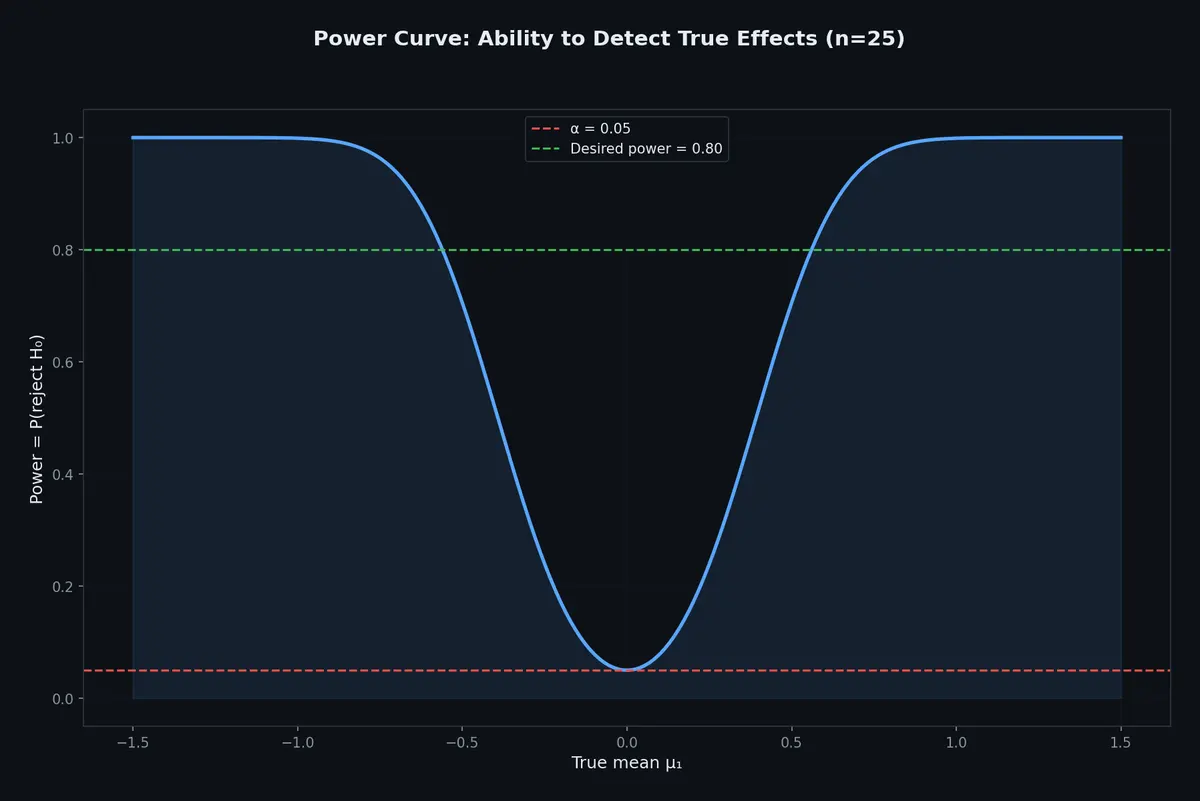
- Power = $1 - \beta$ = P(reject $H_0$ | $H_0$ false)
We control Type I error directly (by choosing $\alpha$ ). Power depends on:
- The true effect size (larger effects are easier to detect)
- The sample size $n$ (more data = more power)
- The significance level $\alpha$ (more lenient threshold = more power, but also more false positives)
- The variance $\sigma^2$ (less noise = more power)
The Tradeoff#
Decreasing $\alpha$ reduces false positives but increases false negatives ($\beta$ goes up, power goes down). You can’t minimize both simultaneously with a fixed sample size. The only free lunch is more data.
The p-Value#

Definition#
$$p\text{-value} = P(T \geq t_{\text{obs}} \mid H_0) \quad \text{(one-sided)}$$ $$p\text{-value} = P(|T| \geq |t_{\text{obs}}| \mid H_0) \quad \text{(two-sided)}$$Decision rule: Reject $H_0$ if $p\text{-value} \leq \alpha$ .
The p-value is a random variable (it depends on the data). Under $H_0$ , the p-value has a $\text{Uniform}(0, 1)$ distribution — this is why $P(p\text{-value} \leq 0.05 \mid H_0) = 0.05$ .
What the p-Value IS#
The p-value is: the probability of seeing data this extreme or more extreme, assuming $H_0$ is true.
What the p-Value IS NOT#
These are common and dangerous misinterpretations:
- NOT the probability that $H_0$ is true. ($P(H_0 | \text{data})$ requires Bayes’ theorem and a prior.)
- NOT the probability that the result is due to chance. (The p-value is computed assuming the result is due to chance.)
- NOT the probability of making an error. (The error rate is $\alpha$ , not the p-value.)
- NOT a measure of effect size. (A tiny, meaningless effect can have $p < 0.001$ with enough data.)
- NOT a measure of replicability. (A $p = 0.04$ result does not have a 96% chance of replicating.)
Common Tests#
The Z-Test#
$$Z = \frac{\bar{X} - \mu_0}{\sigma / \sqrt{n}} \sim \mathcal{N}(0, 1) \quad \text{under } H_0: \mu = \mu_0.$$ $$Z = \frac{10.2 - 10.0}{0.5/\sqrt{25}} = \frac{0.2}{0.1} = 2.0.$$$p\text{-value} = 2 \cdot P(Z > 2.0) = 2 \times 0.0228 = 0.0456 < 0.05$ .
Reject $H_0$ . There is statistically significant evidence that the mean length differs from 10.0 mm.
The t-Test#
$$T = \frac{\bar{X} - \mu_0}{S / \sqrt{n}} \sim t_{n-1} \quad \text{under } H_0$$where $t_{n-1}$ is the Student’s t-distribution with $n-1$ degrees of freedom.
The t-distribution has heavier tails than the Normal, reflecting the additional uncertainty from estimating $\sigma$ . As $n \to \infty$ , $t_{n-1} \to \mathcal{N}(0, 1)$ .
Two-Sample t-Test#
$$T = \frac{\bar{X} - \bar{Y}}{S_p \sqrt{1/n_1 + 1/n_2}}, \quad S_p^2 = \frac{(n_1-1)S_1^2 + (n_2-1)S_2^2}{n_1 + n_2 - 2}$$where $S_p$ is the pooled standard deviation. Under $H_0: \mu_1 = \mu_2$ , $T \sim t_{n_1 + n_2 - 2}$ .
Welch’s t-test handles unequal variances by adjusting the degrees of freedom — use this as the default in practice.
Paired t-Test#
$$T = \frac{\bar{D}}{S_D / \sqrt{n}} \sim t_{n-1}.$$Chi-Squared Test for Independence#
For categorical data in a contingency table, test whether two variables are independent.
$$\chi^2 = \sum_{\text{cells}} \frac{(O_{ij} - E_{ij})^2}{E_{ij}}$$where $O_{ij}$ is the observed count and $E_{ij} = \frac{(\text{row } i \text{ total})(\text{col } j \text{ total})}{n}$ is the expected count under independence.
Under $H_0$ , $\chi^2 \sim \chi^2_{(r-1)(c-1)}$ where $r$ and $c$ are the number of rows and columns.
Confidence Intervals#
Construction#
$$P(\theta \in [L, U]) = 1 - \alpha.$$ $$\bar{X} \pm z_{\alpha/2} \frac{\sigma}{\sqrt{n}}$$where $z_{\alpha/2}$ is the $1 - \alpha/2$ quantile of $\mathcal{N}(0, 1)$ . For 95% CI: $z_{0.025} = 1.96$ .
$$\bar{X} \pm t_{\alpha/2, n-1} \frac{S}{\sqrt{n}}.$$Interpretation (Frequentist)#
“If we repeated the experiment many times and computed a 95% CI each time, approximately 95% of those intervals would contain the true parameter $\theta$ .”
Common misinterpretation: “There is a 95% probability that $\theta$ is in this interval.” This is wrong in the frequentist framework — $\theta$ is a fixed (unknown) constant, not a random variable. It either is or isn’t in the interval; we just don’t know which.
Relationship Between CI and Hypothesis Test#
$$\text{Reject } H_0: \theta = \theta_0 \text{ at level } \alpha \iff \theta_0 \notin \text{CI at level } 1-\alpha.$$A 95% confidence interval contains exactly those values of $\theta_0$ that would not be rejected at $\alpha = 0.05$ .
Proof. The CI is $\{\theta_0 : |T(\theta_0)| \leq z_{\alpha/2}\}$ and the test rejects when $|T(\theta_0)| > z_{\alpha/2}$ . These are complements. $\blacksquare$
The Multiple Testing Problem#
The Problem#
$$P(\text{at least one Type I error}) = 1 - (1 - 0.05)^{20} = 1 - 0.95^{20} \approx 0.64.$$A 64% chance of a false discovery. With 100 tests: $1 - 0.95^{100} \approx 0.994$ .
This is the multiple testing problem or look-elsewhere effect. It explains many of the “replication crises” across scientific fields.
Bonferroni Correction#
The simplest fix: use significance level $\alpha/m$ for each of $m$ tests.
Theorem (Bonferroni). If each of $m$ tests uses level $\alpha/m$ , then the family-wise error rate (FWER) — the probability of any false rejection — is at most $\alpha$ .
$$P(\text{any false rejection}) = P\left(\bigcup_{i=1}^{m_0} \{p_i \leq \alpha/m\}\right) \leq \sum_{i=1}^{m_0} P(p_i \leq \alpha/m) = m_0 \cdot \frac{\alpha}{m} \leq \alpha$$where $m_0 \leq m$ is the number of true nulls. $\blacksquare$
Bonferroni is conservative — it controls FWER but can have very low power when $m$ is large.
False Discovery Rate (FDR): Benjamini-Hochberg#
The false discovery rate is $\text{FDR} = E\left[\frac{\text{false positives}}{\text{total rejections}}\right]$ .
Benjamini-Hochberg procedure:
- Sort the $m$ p-values: $p_{(1)} \leq p_{(2)} \leq \cdots \leq p_{(m)}$ .
- Find the largest $k$ such that $p_{(k)} \leq \frac{k}{m} \alpha$ .
- Reject hypotheses corresponding to $p_{(1)}, \ldots, p_{(k)}$ .
This controls $\text{FDR} \leq \alpha$ and is much more powerful than Bonferroni when many tests are conducted.
A/B Testing#
The Setup#
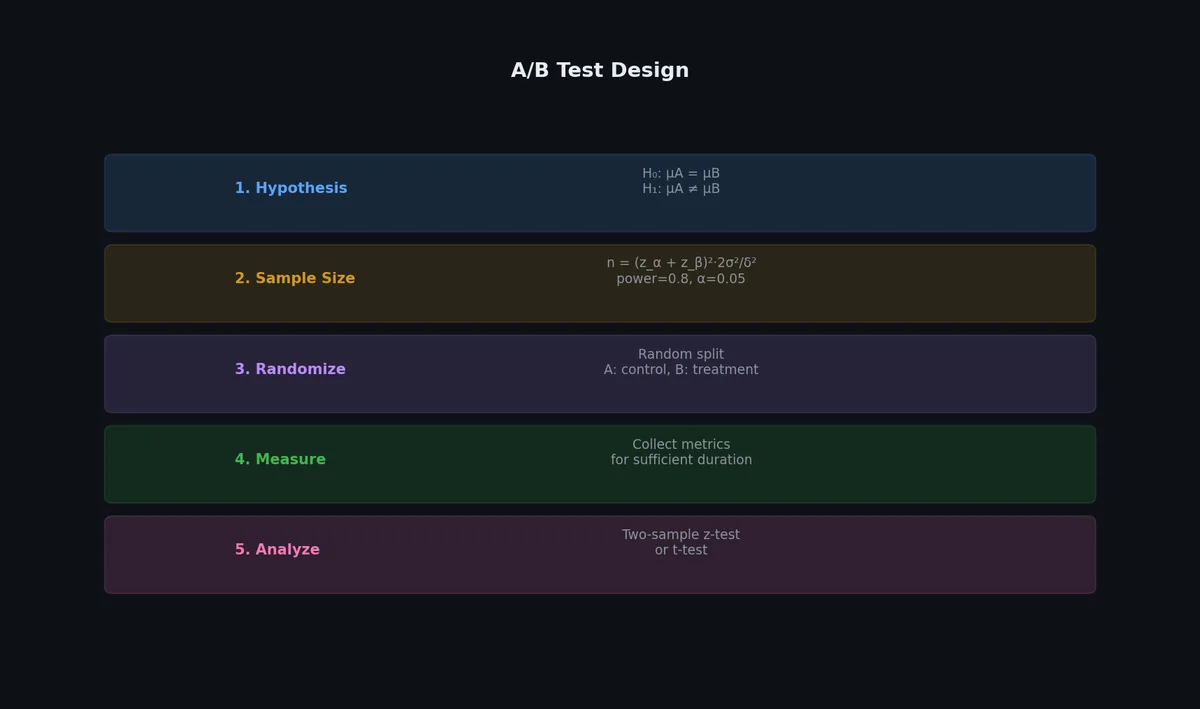
Compare two versions (A = control, B = treatment) of a web page, ad, or product feature. Observe conversion rates $\hat{p}_A = k_A/n_A$ and $\hat{p}_B = k_B/n_B$ .
Test Statistic#
$$Z = \frac{\hat{p}_B - \hat{p}_A}{\sqrt{\hat{p}(1-\hat{p})(1/n_A + 1/n_B)}}$$where $\hat{p} = (k_A + k_B)/(n_A + n_B)$ is the pooled proportion.
Sample Size Calculation#
$$n \geq \left(\frac{z_{\alpha/2} + z_\beta}{\delta}\right)^2 \cdot 2\bar{p}(1-\bar{p})$$where $\bar{p} = (p_A + p_B)/2$ is the average proportion.
$$n \geq \left(\frac{1.96 + 0.84}{0.02}\right)^2 \cdot 2 \times 0.11 \times 0.89 \approx \frac{19600}{1} \times 0.1958 \approx 3838$$per group. You need about 3,838 users per group — roughly 7,700 total.
Practical vs Statistical Significance#
A result can be statistically significant (small p-value) but practically meaningless. If an A/B test with 1 million users shows $p_B - p_A = 0.0001$ with $p < 0.001$ , the effect is real but tiny — probably not worth the engineering effort to ship.
Always report effect size and confidence interval, not just p-values.
Python: Hypothesis Tests in Practice#
| |
| |
The output typically shows: without correction, about 5-6 false positives sneak in among the 90 nulls. Bonferroni eliminates all false positives but may miss some true effects. Benjamini-Hochberg finds most true effects while keeping false discoveries under control. This illustrates the power advantage of FDR control over FWER control.
Effect Size: What p-Values Don’t Tell You#

A p-value tells you whether an effect is statistically distinguishable from zero. It does not tell you how large the effect is or whether it matters.
Cohen’s d#
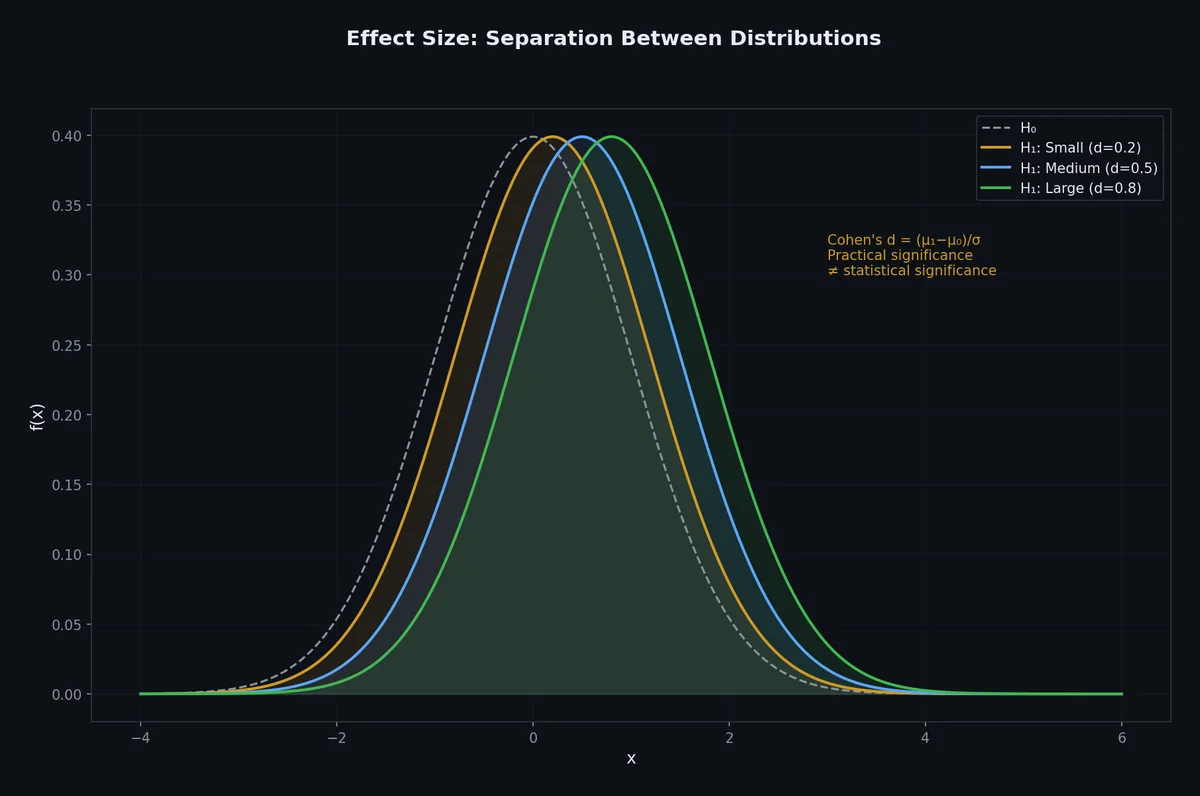
$$d = \frac{\bar{X}_1 - \bar{X}_2}{S_p}$$where $S_p$ is the pooled standard deviation. This is a standardized effect size — it measures the difference in units of standard deviations.
| $d$ | Interpretation |
|---|---|
| 0.2 | Small effect |
| 0.5 | Medium effect |
| 0.8 | Large effect |
Why Effect Size Matters#
With $n = 1{,}000{,}000$ per group, you can detect $d = 0.01$ at $p < 0.001$ . The effect is “highly significant” but completely meaningless in practice — a 0.01 standard deviation difference is invisible to any individual.
The antidote: always report confidence intervals for effect sizes, not just p-values. A confidence interval for the difference in means tells you both whether the effect is significant (does the CI exclude zero?) and how large it could plausibly be.
The Neyman-Pearson Lemma#
$$\Lambda(\mathbf{x}) = \frac{L(\theta_1; \mathbf{x})}{L(\theta_0; \mathbf{x})} > c$$where $c$ is chosen so that $P(\Lambda > c | H_0) = \alpha$ .
The likelihood ratio $\Lambda$ is the optimal test statistic: no other test at the same significance level can have higher power. This theoretical result justifies the widespread use of likelihood ratio tests in parametric statistics.
Generalized Likelihood Ratio Test#
$$\Lambda = \frac{\max_{\theta \in \Theta_0} L(\theta)}{\max_{\theta \in \Theta} L(\theta)} = \frac{L(\hat{\theta}_0)}{L(\hat{\theta}_{\text{MLE}})}.$$ $$-2 \ln \Lambda \xrightarrow{d} \chi^2_r$$where $r = \dim(\Theta) - \dim(\Theta_0)$ is the difference in the number of free parameters.
This is Wilks’ theorem, and it’s the foundation for comparing nested models — from testing whether a regression coefficient is zero to comparing hierarchical Bayesian models.
Permutation Tests: Distribution-Free Inference#
When distributional assumptions (normality, equal variances) are questionable, permutation tests offer an exact alternative.
Idea: Under $H_0$ (no difference between groups), the group labels are arbitrary. Permute the labels many times, recompute the test statistic each time, and see where the observed statistic falls in this permutation distribution.
| |
Permutation tests are exact (not approximate) for any test statistic, require no distributional assumptions, and are easy to implement. Their main limitation: they only test exchangeability (are the groups interchangeable under $H_0$ ?), which may not capture all null hypotheses of interest.
The Replication Crisis and What to Do About It#
Starting around 2010, systematic replication efforts revealed that many published findings — perhaps 50% or more in psychology and biomedicine — fail to replicate. Common contributing factors:
- p-hacking: Trying multiple analyses until $p < 0.05$ , then reporting only the “significant” one.
- HARKing: Hypothesizing After Results are Known — presenting post-hoc findings as if they were pre-specified.
- Publication bias: Journals preferentially publish “significant” results, creating a literature biased toward false positives.
- Underpowered studies: With low power, a significant result is more likely to overestimate the true effect.
Recommended practices:
- Pre-register hypotheses and analysis plans
- Report effect sizes and confidence intervals, not just p-values
- Use appropriate multiple testing corrections
- Consider Bayesian approaches for accumulating evidence
- Focus on replication rather than single studies
Quick Reference#
| Situation | Test | Statistic | Distribution under $H_0$ |
|---|---|---|---|
| One mean, $\sigma$ known | Z-test | $(\bar{X}-\mu_0)/(\sigma/\sqrt{n})$ | $\mathcal{N}(0,1)$ |
| One mean, $\sigma$ unknown | t-test | $(\bar{X}-\mu_0)/(S/\sqrt{n})$ | $t_{n-1}$ |
| Two means, independent | Two-sample t | $(\bar{X}-\bar{Y})/(S_p\sqrt{1/n_1+1/n_2})$ | $t_{n_1+n_2-2}$ |
| Two means, paired | Paired t | $\bar{D}/(S_D/\sqrt{n})$ | $t_{n-1}$ |
| Categorical independence | Chi-squared | $\sum (O-E)^2/E$ | $\chi^2_{(r-1)(c-1)}$ |
| Two proportions | Z-test | $(p_B-p_A)/\text{SE}$ | $\mathcal{N}(0,1)$ |
| Model comparison | Likelihood ratio | $-2\ln\Lambda$ | $\chi^2_r$ (Wilks) |
| Non-parametric | Permutation test | Any statistic | Permutation distribution |
What’s Next#
Hypothesis testing answers “is the effect real?” by controlling false positive rates. But it treats the parameter as a fixed unknown and the data as random. Bayesian statistics flips this: the data are fixed (you observed them), and the parameter is random (described by a distribution). The next article develops Bayesian thinking — priors, posteriors, conjugate families, and the philosophical debate that has shaped statistics for a century.
Probability and Statistics 8 parts
- 01 Probability and Statistics (1): Probability Spaces — Why We Need Axioms (But Won't Overdo It)
- 02 Probability and Statistics (2): Random Variables and the Distributions That Matter
- 03 Probability and Statistics (3): Expectation, Variance, and the Moment-Generating Trick
- 04 Probability and Statistics (4): Joint Distributions, Marginalization, and Independence
- 05 Probability and Statistics (5): Law of Large Numbers and the Central Limit Theorem
- 06 Probability and Statistics (6): Estimation — MLE, MAP, and the Bias-Variance Story
- 07 Probability and Statistics (7): Hypothesis Testing — p-Values, Confidence Intervals, and All Their Pitfalls you are here
- 08 Probability and Statistics (8): Bayesian Statistics — Priors, Posteriors, and Why Frequentists Argue