Series · Python Engineering · Chapter 3

Python Engineering (3): Testing — pytest, Fixtures, and the Confidence Loop

Build confidence in your code with pytest fixtures, parametrize, mocking, and coverage. Learn debugging techniques that save hours.

You change one line and three unrelated features break. You refactor a function and spend two hours manually clicking through the app to check if everything still works. You deploy on Friday and get paged at midnight. All of these are symptoms of the same disease: no tests.

Tests are not bureaucracy. They are the fastest way to know that your code does what you think it does. A good test suite runs in seconds and catches the bugs that would take hours to find manually.


Why Test#

Writing tests costs time up front. Not writing tests costs more time later. Here is the math:

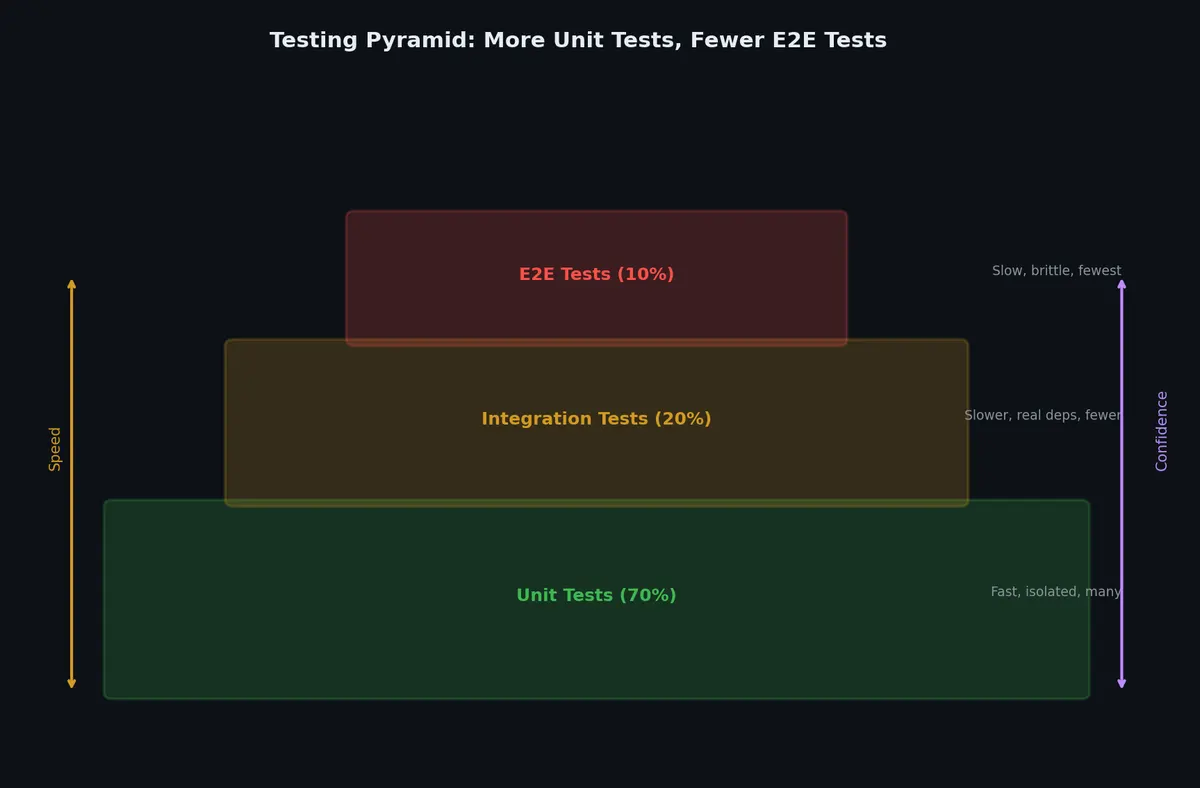
Testing pyramid

ActivityWithout TestsWith Tests
Initial developmentFaster (no tests to write)Slower (tests add 20-40% time)
RefactoringTerrifying (did I break something?)Confident (tests catch regressions)
DebuggingRead the whole codebaseRun tests, see exactly what broke
Onboarding new developer“Ask Sarah, she knows how it works”Tests document expected behavior
Deploying to productionManual QA, hope for the bestAutomated gate, deploy with confidence
Bug reported by customerReproduce manually, fix, manually verifyWrite test that reproduces bug, fix, test verifies

The real payoff comes on the second change to any piece of code. The first time, you know the code works because you just wrote it. Every subsequent change, you do not know unless you test.

pytest Basics#

pytest is the de facto testing framework for Python. It uses plain assert statements and automatic test discovery.

Installation#

1
(.venv) $ pip install pytest

Your First Test#

 1
 2
 3
 4
 5
 6
 7
 8
 9
10
11
12
13
14
15
# tests/test_math.py

def test_addition():
    assert 1 + 1 == 2


def test_string_upper():
    assert "hello".upper() == "HELLO"


def test_list_append():
    items = [1, 2, 3]
    items.append(4)
    assert items == [1, 2, 3, 4]
    assert len(items) == 4

Run it:

1
2
3
4
5
6
7
8
9
(.venv) $ pytest
========================= test session starts ==========================
platform linux -- Python 3.11.7, pytest-7.4.4
rootdir: /home/user/project
collected 3 items

tests/test_math.py ...                                            [100%]

========================= 3 passed in 0.02s ============================

Test Discovery Rules#

pytest finds tests automatically by looking for:

  • Files named test_*.py or *_test.py
  • Functions named test_* inside those files
  • Classes named Test* with methods named test_*

Useful Command-Line Flags#

 1
 2
 3
 4
 5
 6
 7
 8
 9
10
11
12
13
14
15
16
17
18
19
20
21
22
23
24
25
26
# Verbose output (show each test name)
(.venv) $ pytest -v

# Stop on first failure
(.venv) $ pytest -x

# Run tests matching a keyword expression
(.venv) $ pytest -k "download"

# Run tests in a specific file
(.venv) $ pytest tests/test_core.py

# Run a specific test function
(.venv) $ pytest tests/test_core.py::test_download_file

# Show print statements (not captured)
(.venv) $ pytest -s

# Show local variables in tracebacks
(.venv) $ pytest -l

# Re-run only failed tests from last run
(.venv) $ pytest --lf

# Run failed tests first, then the rest
(.venv) $ pytest --ff

Testing Exceptions#

Use pytest.raises to verify that code raises expected exceptions:

 1
 2
 3
 4
 5
 6
 7
 8
 9
10
11
12
13
import pytest

from my_tool.utils import validate_url


def test_invalid_url_raises():
    with pytest.raises(ValueError, match="Invalid URL"):
        validate_url("not-a-url")


def test_empty_url_raises():
    with pytest.raises(ValueError):
        validate_url("")

The match parameter checks the exception message with a regex.

Testing Approximate Values#

1
2
3
4
def test_float_division():
    # Float comparison with tolerance
    assert 0.1 + 0.2 == pytest.approx(0.3)
    assert 3.14 == pytest.approx(3.14159, abs=0.01)

Fixtures: Reusable Test Setup#

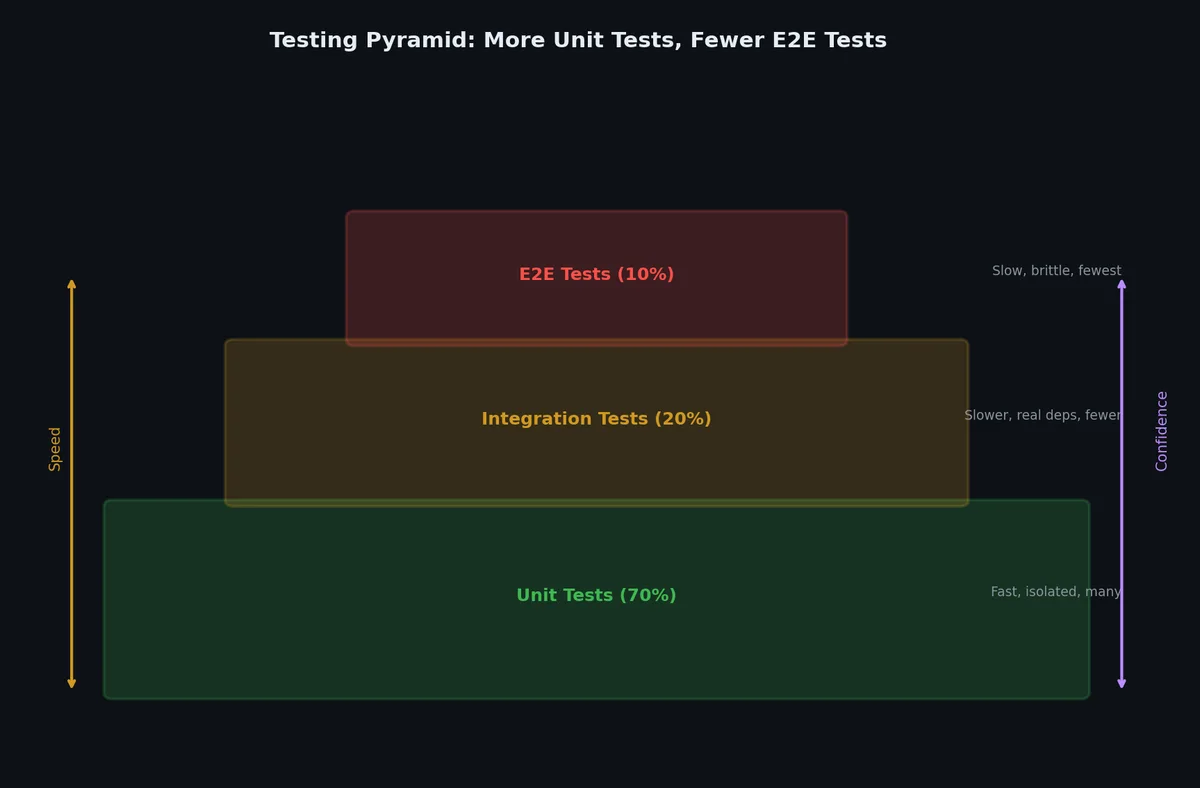
Testing pyramid ancient egyptian pyramid with unit integrati

Fixtures replace the setUp/tearDown pattern from unittest. They provide test dependencies through function arguments.

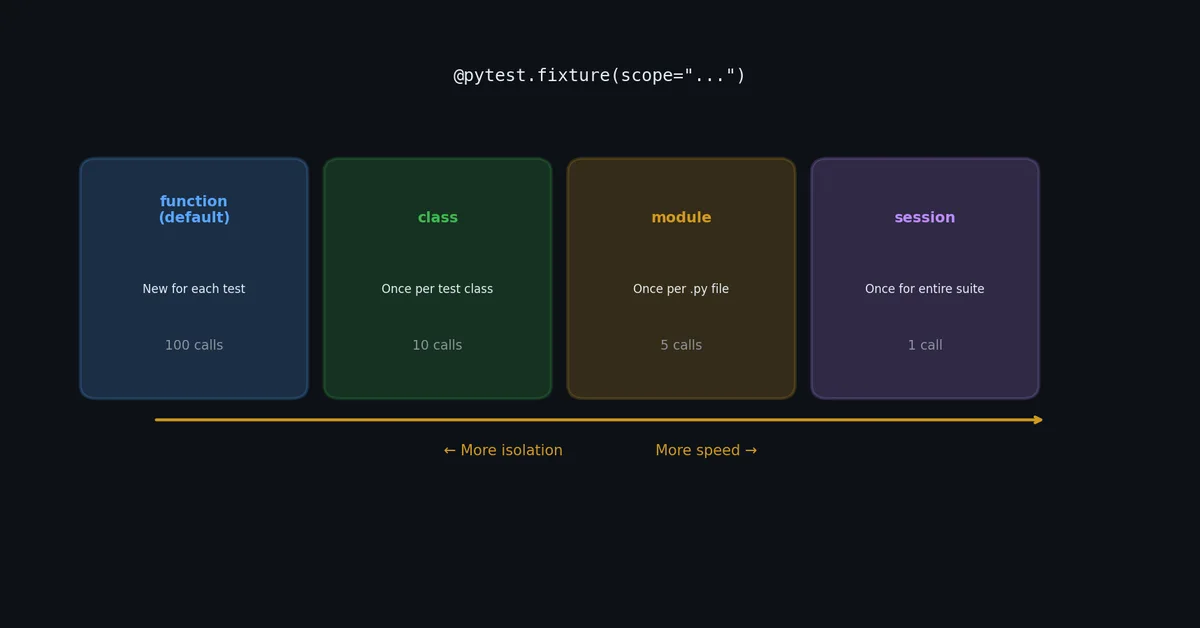
Fixture scopes

Basic Fixture#

 1
 2
 3
 4
 5
 6
 7
 8
 9
10
11
12
13
14
15
16
17
import pytest

from my_tool.core import FileDownloader


@pytest.fixture
def downloader():
    """Create a configured downloader instance."""
    return FileDownloader(timeout=5, retries=1)


def test_download_sets_timeout(downloader):
    assert downloader.timeout == 5


def test_download_sets_retries(downloader):
    assert downloader.retries == 1

pytest sees downloader in the test function’s parameter list, finds the fixture with that name, calls it, and passes the result. Each test gets a fresh instance.

Fixture with Teardown#

Use yield to run cleanup code after the test:

 1
 2
 3
 4
 5
 6
 7
 8
 9
10
11
12
13
14
15
16
17
18
19
20
import tempfile
from pathlib import Path

import pytest


@pytest.fixture
def temp_dir():
    """Create a temporary directory, clean up after test."""
    path = Path(tempfile.mkdtemp())
    yield path
    # Cleanup runs after the test, even if the test fails
    import shutil
    shutil.rmtree(path, ignore_errors=True)


def test_file_creation(temp_dir):
    test_file = temp_dir / "test.txt"
    test_file.write_text("hello")
    assert test_file.read_text() == "hello"

Fixture Scope#

By default, fixtures run once per test function. Change the scope for expensive setup:

 1
 2
 3
 4
 5
 6
 7
 8
 9
10
11
12
13
14
15
16
17
18
19
20
21
22
23
24
@pytest.fixture(scope="session")
def database_connection():
    """Create a database connection, shared across all tests."""
    conn = create_connection("test.db")
    yield conn
    conn.close()


@pytest.fixture(scope="module")
def sample_data():
    """Load sample data, shared within one test file."""
    return load_test_data("fixtures/sample.json")


@pytest.fixture(scope="class")
def api_client():
    """Create API client, shared within one test class."""
    return APIClient(base_url="http://localhost:8000")


@pytest.fixture  # scope="function" is the default
def clean_state():
    """Fresh state for each test."""
    return {}
ScopeCreatedDestroyedUse When
functionBefore each testAfter each testDefault, for most fixtures
classBefore first test in classAfter last test in classShared state within a test class
moduleBefore first test in fileAfter last test in fileExpensive file-level setup
sessionBefore first test overallAfter last test overallDatabase connections, server startup

conftest.py: Shared Fixtures#

Fixtures in conftest.py are available to all tests in the same directory and subdirectories without importing:

1
2
3
4
5
6
7
tests/
  conftest.py          # fixtures available to all tests
  test_core.py
  test_cli.py
  integration/
    conftest.py        # additional fixtures for integration tests
    test_api.py
 1
 2
 3
 4
 5
 6
 7
 8
 9
10
11
12
13
# tests/conftest.py

import pytest


@pytest.fixture
def sample_url():
    return "https://httpbin.org/get"


@pytest.fixture
def sample_headers():
    return {"User-Agent": "test-agent/1.0"}

Any test file in tests/ can use sample_url and sample_headers without importing them.

Built-in Fixtures#

pytest provides several useful built-in fixtures:

 1
 2
 3
 4
 5
 6
 7
 8
 9
10
11
12
13
14
15
16
17
18
19
def test_capture_output(capsys):
    """capsys captures stdout and stderr."""
    print("hello world")
    captured = capsys.readouterr()
    assert captured.out == "hello world\n"


def test_temp_path(tmp_path):
    """tmp_path provides a unique temporary directory."""
    file = tmp_path / "data.txt"
    file.write_text("content")
    assert file.read_text() == "content"


def test_monkeypatch_env(monkeypatch):
    """monkeypatch modifies environment for the test."""
    monkeypatch.setenv("API_KEY", "test-key-123")
    import os
    assert os.environ["API_KEY"] == "test-key-123"

Parametrize: Testing Multiple Cases#

Pytest fixture mechanism factory producing test data assembl

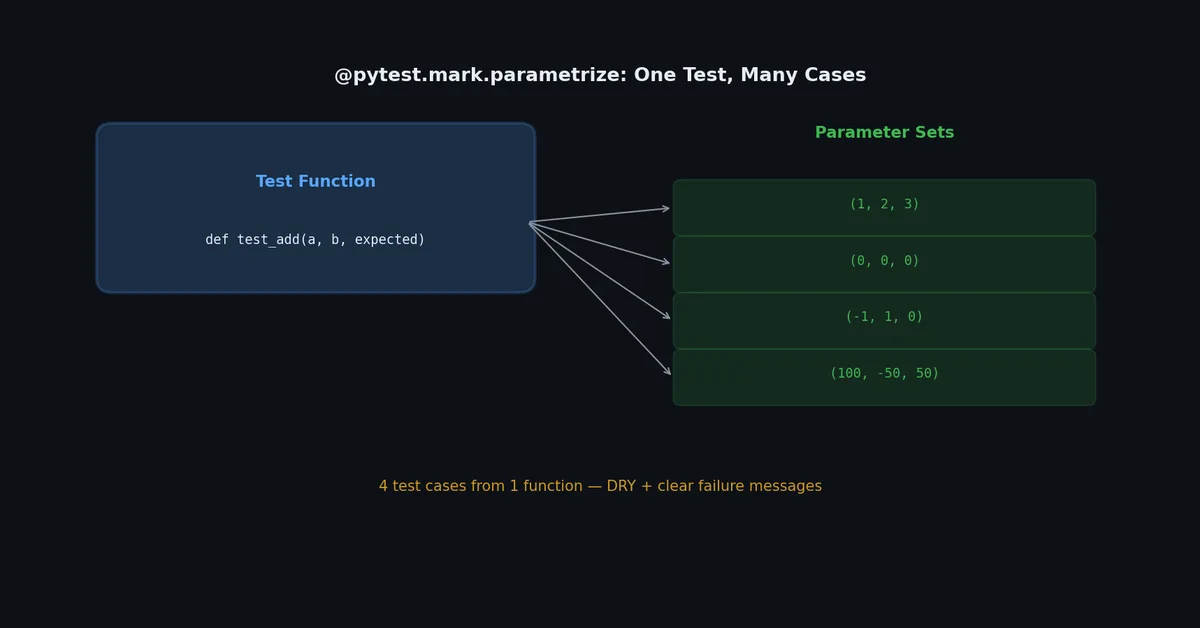
Instead of writing separate test functions for each case, use @pytest.mark.parametrize:

Parametrized tests

 1
 2
 3
 4
 5
 6
 7
 8
 9
10
11
12
13
14
15
16
import pytest

from my_tool.utils import format_size


@pytest.mark.parametrize("size_bytes,expected", [
    (0, "0.0 B"),
    (1023, "1023.0 B"),
    (1024, "1.0 KB"),
    (1536, "1.5 KB"),
    (1048576, "1.0 MB"),
    (1073741824, "1.0 GB"),
    (5368709120, "5.0 GB"),
])
def test_format_size(size_bytes, expected):
    assert format_size(size_bytes) == expected

Output:

1
2
3
4
5
6
7
8
(.venv) $ pytest -v tests/test_utils.py::test_format_size
tests/test_utils.py::test_format_size[0-0.0 B] PASSED
tests/test_utils.py::test_format_size[1023-1023.0 B] PASSED
tests/test_utils.py::test_format_size[1024-1.0 KB] PASSED
tests/test_utils.py::test_format_size[1536-1.5 KB] PASSED
tests/test_utils.py::test_format_size[1048576-1.0 MB] PASSED
tests/test_utils.py::test_format_size[1073741824-1.0 GB] PASSED
tests/test_utils.py::test_format_size[5368709120-5.0 GB] PASSED

Seven test cases, one function. Each case appears as a separate test in the output with its own pass/fail status.

Parametrize with IDs#

Make output clearer with explicit IDs:

1
2
3
4
5
6
7
8
@pytest.mark.parametrize("url,expected_filename", [
    ("https://example.com/data.csv", "data.csv"),
    ("https://example.com/path/to/file.txt", "file.txt"),
    ("https://example.com/", "download"),
    ("https://example.com", "download"),
], ids=["simple", "nested-path", "trailing-slash", "no-path"])
def test_filename_from_url(url, expected_filename):
    assert filename_from_url(url) == expected_filename

Mocking: Isolating Your Code#

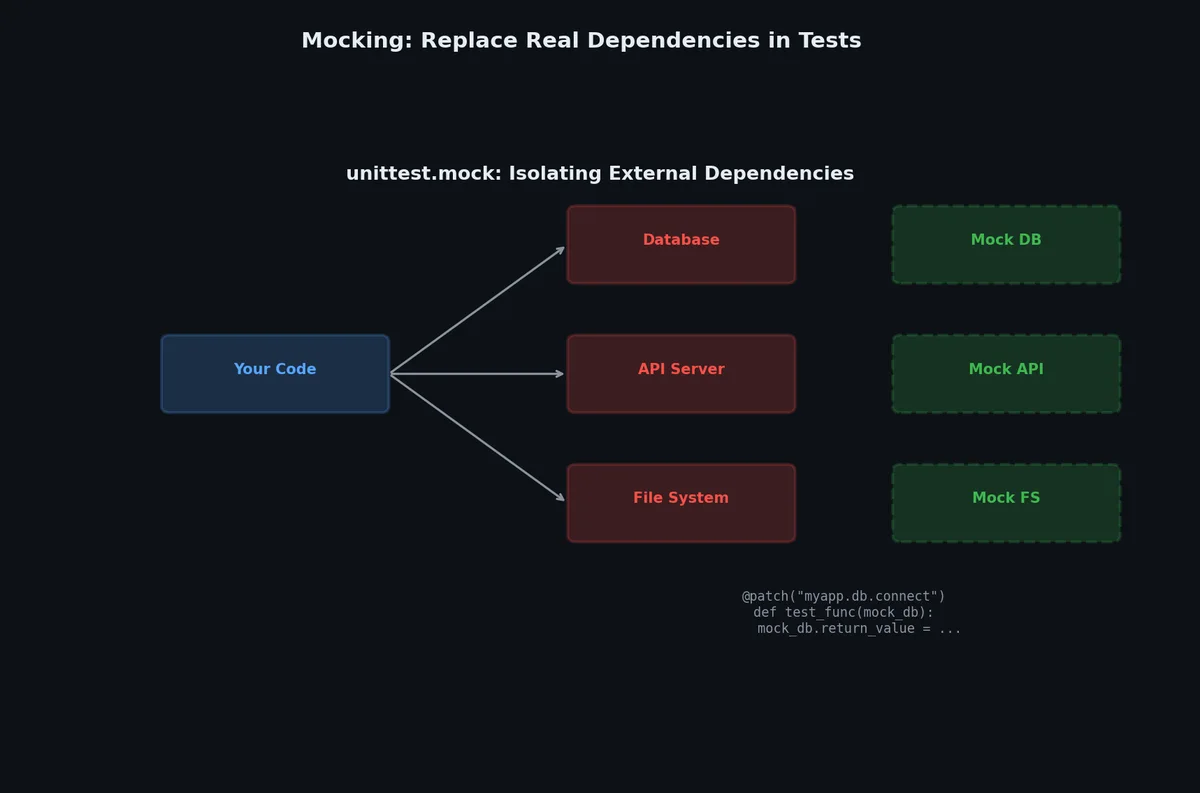
When testing a function that calls an external service, you do not want your tests to make real HTTP requests. Mocking replaces parts of your code with controlled fakes.

Mock architecture

unittest.mock.patch#

 1
 2
 3
 4
 5
 6
 7
 8
 9
10
11
12
13
14
15
16
17
18
19
20
21
22
23
24
25
26
27
28
29
30
31
from unittest.mock import patch, MagicMock

from my_tool.core import download_file


@patch("my_tool.core.requests.get")
def test_download_file_success(mock_get, tmp_path):
    # Configure the mock response
    mock_response = MagicMock()
    mock_response.status_code = 200
    mock_response.headers = {"content-length": "11"}
    mock_response.iter_content.return_value = [b"hello world"]
    mock_response.raise_for_status.return_value = None
    mock_get.return_value = mock_response

    output = tmp_path / "test.txt"
    result = download_file("https://example.com/test.txt", str(output), quiet=True)

    assert result == output
    assert output.read_bytes() == b"hello world"
    mock_get.assert_called_once()


@patch("my_tool.core.requests.get")
def test_download_file_http_error(mock_get):
    mock_response = MagicMock()
    mock_response.raise_for_status.side_effect = Exception("404 Not Found")
    mock_get.return_value = mock_response

    with pytest.raises(Exception, match="404"):
        download_file("https://example.com/missing.txt", quiet=True)

When to Mock#

MockDo Not Mock
HTTP requestsPure functions
Database queriesData transformations
File system (sometimes)String manipulation
Time-dependent codeMath
External service APIsYour own internal logic

Over-mocking is a common mistake. If you mock everything, your tests verify the mocks, not your code. Mock at the boundary (network, disk, clock) and test real logic with real code.

Monkeypatch as a Simpler Alternative#

For simple cases, monkeypatch is cleaner than patch:

1
2
3
4
def test_download_with_env_config(monkeypatch):
    monkeypatch.setenv("DOWNLOAD_TIMEOUT", "60")
    monkeypatch.setattr("my_tool.config.DEFAULT_TIMEOUT", 60)
    # test code that reads from config

Coverage: Measuring What Is Tested#

Install pytest-cov:

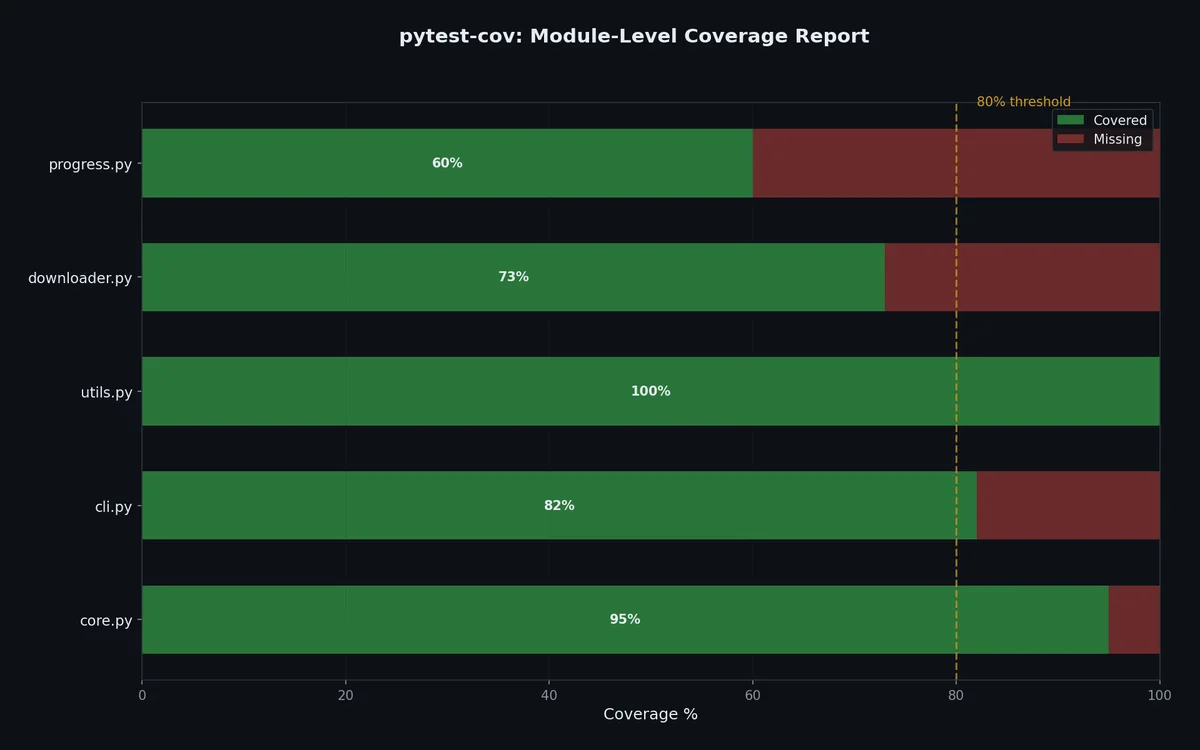
Coverage report

1
(.venv) $ pip install pytest-cov

Run with coverage:

 1
 2
 3
 4
 5
 6
 7
 8
 9
10
11
12
13
14
15
16
(.venv) $ pytest --cov=my_tool --cov-report=term-missing
========================= test session starts ==========================
...

---------- coverage: platform linux, python 3.11.7 ----------
Name                        Stmts   Miss  Cover   Missing
---------------------------------------------------------
src/my_tool/__init__.py         3      0   100%
src/my_tool/cli.py             28      5    82%   41-45
src/my_tool/config.py           4      0   100%
src/my_tool/core.py            31      3    90%   52-54
src/my_tool/utils.py           15      0   100%
---------------------------------------------------------
TOTAL                          81      8    90%

========================= 12 passed in 0.45s ===========================

The Missing column tells you exactly which lines lack coverage. 41-45 means lines 41 through 45 are not exercised by any test.

Coverage Configuration#

 1
 2
 3
 4
 5
 6
 7
 8
 9
10
11
12
13
14
# pyproject.toml

[tool.coverage.run]
source = ["my_tool"]
branch = true

[tool.coverage.report]
show_missing = true
fail_under = 80
exclude_lines = [
    "pragma: no cover",
    "if __name__ == .__main__.",
    "if TYPE_CHECKING:",
]

branch = true enables branch coverage, which checks that both sides of if/else are tested.

Coverage Targets#

Coverage LevelWhat It MeansAppropriate For
< 50%Barely testedLegacy code you are starting to test
50-70%Basic coverageInternal tools, scripts
70-85%Good coverageMost applications
85-95%Strong coverageLibraries, critical services
95-100%Near-completePayment processing, security code

Do not chase 100% coverage. Some code (error handlers for impossible states, __repr__ methods) is not worth testing. Focus on business logic and edge cases.

Test Organization#

Unit Tests#

Test individual functions in isolation. Fast, focused, many of them.

1
2
3
4
5
6
7
# tests/test_utils.py

def test_format_size_zero():
    assert format_size(0) == "0.0 B"

def test_format_size_kilobytes():
    assert format_size(1024) == "1.0 KB"

Integration Tests#

Test how components work together. Slower, fewer of them.

 1
 2
 3
 4
 5
 6
 7
 8
 9
10
# tests/integration/test_download.py

def test_download_real_file(tmp_path):
    """Integration test: actually downloads from httpbin."""
    result = download_file(
        "https://httpbin.org/bytes/1024",
        str(tmp_path / "data.bin"),
        quiet=True,
    )
    assert result.stat().st_size == 1024

Mark integration tests so you can skip them in fast runs:

1
2
3
4
5
6
import pytest

pytestmark = pytest.mark.integration

def test_download_real_file(tmp_path):
    ...
1
2
3
4
5
# Run only unit tests (skip integration)
(.venv) $ pytest -m "not integration"

# Run only integration tests
(.venv) $ pytest -m integration

Register custom marks in pyproject.toml:

1
2
3
4
5
[tool.pytest.ini_options]
markers = [
    "integration: marks tests as integration tests (deselect with '-m \"not integration\"')",
    "slow: marks tests as slow (deselect with '-m \"not slow\"')",
]

End-to-End Tests#

Test the full application from the user’s perspective:

 1
 2
 3
 4
 5
 6
 7
 8
 9
10
11
12
13
14
15
16
17
18
19
# tests/e2e/test_cli.py

from click.testing import CliRunner
from my_tool.cli import main


def test_cli_download(tmp_path, monkeypatch):
    monkeypatch.chdir(tmp_path)
    runner = CliRunner()
    result = runner.invoke(main, ["https://httpbin.org/bytes/100", "-o", "test.bin", "-q"])
    assert result.exit_code == 0
    assert (tmp_path / "test.bin").exists()


def test_cli_help():
    runner = CliRunner()
    result = runner.invoke(main, ["--help"])
    assert result.exit_code == 0
    assert "Download files from URLs" in result.output

Debugging: When Tests Fail#

breakpoint() and pdb#

Python 3.7 added the breakpoint() built-in:

1
2
3
4
5
def download_file(url, output=None, quiet=False, timeout=30):
    response = requests.get(url, stream=True, timeout=timeout)
    breakpoint()  # Execution stops here, drops into debugger
    response.raise_for_status()
    ...

Run the test normally (without -s pytest will capture stdin, but breakpoint() forces it open):

1
2
3
4
(.venv) $ pytest -s tests/test_core.py::test_download_file_success
> /home/user/src/my_tool/core.py(15)download_file()
-> response.raise_for_status()
(Pdb)

Essential pdb Commands#

CommandShortWhat It Does
nextnExecute current line, step over function calls
stepsExecute current line, step into function calls
continuecContinue until next breakpoint
print exprp exprPrint the value of an expression
pp exprPretty-print the value
listlShow source code around current line
wherewShow the call stack
upuMove up one frame in the call stack
downdMove down one frame in the call stack
quitqExit the debugger
helphShow help

ipdb: A Better Debugger#

ipdb adds syntax highlighting and tab completion:

1
(.venv) $ pip install ipdb
1
import ipdb; ipdb.set_trace()  # or set PYTHONBREAKPOINT=ipdb.set_trace

Or set it globally:

1
2
$ export PYTHONBREAKPOINT=ipdb.set_trace
$ pytest -s tests/test_core.py  # breakpoint() now uses ipdb

Post-Mortem Debugging#

Debug a test that just failed, at the point of failure:

1
2
(.venv) $ pytest --pdb tests/test_core.py
# Drops into pdb at the point of failure

This is extremely powerful. You do not need to add breakpoint() anywhere. Just run with --pdb and pytest will open the debugger at the exact line where the assertion failed, with all local variables intact.

Property-Based Testing with Hypothesis#

Traditional tests check specific examples. Property-based testing checks invariants that should hold for any valid input. Hypothesis generates hundreds of random inputs to find edge cases you would never think to test manually.

Installation#

1
(.venv) $ pip install hypothesis

Basic Properties#

 1
 2
 3
 4
 5
 6
 7
 8
 9
10
11
12
13
14
15
16
17
18
19
from hypothesis import given, assume, settings
from hypothesis import strategies as st

@given(st.lists(st.integers()))
def test_sort_is_idempotent(xs):
    """Sorting twice gives the same result as sorting once."""
    assert sorted(sorted(xs)) == sorted(xs)

@given(st.lists(st.integers()))
def test_sort_preserves_length(xs):
    """Sorting does not add or remove elements."""
    assert len(sorted(xs)) == len(xs)

@given(st.lists(st.integers(), min_size=1))
def test_sort_result_is_ordered(xs):
    """Every element is <= the next."""
    result = sorted(xs)
    for a, b in zip(result, result[1:]):
        assert a <= b

Instead of testing sorted([3, 1, 2]) == [1, 2, 3], we test properties that any correct sort must satisfy. Hypothesis will try empty lists, single elements, duplicates, negative numbers, huge values, and more.

Custom Strategies#

 1
 2
 3
 4
 5
 6
 7
 8
 9
10
11
12
13
14
15
16
17
18
19
20
21
22
from dataclasses import dataclass

@dataclass
class User:
    name: str
    age: int
    email: str

# Build a strategy for generating Users
users = st.builds(
    User,
    name=st.text(min_size=1, max_size=50),
    age=st.integers(min_value=0, max_value=150),
    email=st.emails(),
)

@given(users)
def test_user_serialization_roundtrip(user):
    """Serialize → deserialize should return the original object."""
    data = serialize(user)
    restored = deserialize(data)
    assert restored == user

Stateful Testing#

For systems with state (databases, APIs), Hypothesis can generate sequences of operations:

 1
 2
 3
 4
 5
 6
 7
 8
 9
10
11
12
13
14
15
16
17
18
19
20
21
22
23
24
25
26
27
28
from hypothesis.stateful import RuleBasedStateMachine, rule, precondition

class SetMachine(RuleBasedStateMachine):
    """Test that our CustomSet behaves like Python's built-in set."""

    def __init__(self):
        super().__init__()
        self.model = set()         # reference
        self.actual = CustomSet()  # system under test

    @rule(value=st.integers())
    def add(self, value):
        self.model.add(value)
        self.actual.add(value)
        assert value in self.actual

    @rule(value=st.integers())
    def remove(self, value):
        if value in self.model:
            self.model.remove(value)
            self.actual.remove(value)
        assert value not in self.actual

    @rule()
    def check_length(self):
        assert len(self.actual) == len(self.model)

TestSet = SetMachine.TestCase

When Hypothesis Finds a Bug#

Hypothesis shrinks the failing input to the smallest example that still fails:

1
2
3
Falsifying example: test_parse_date(
    s='0000-00-00',  # Shrunk from '9812-23-71'
)

It then stores this example in .hypothesis/ so future runs re-test it. Commit .hypothesis/examples/ to your repo.

Settings and Profiles#

 1
 2
 3
 4
 5
 6
 7
 8
 9
10
11
12
13
14
15
16
17
18
from hypothesis import settings, Phase, Verbosity

# Slow but thorough (CI)
@settings(max_examples=1000, deadline=None)
@given(st.text())
def test_thorough(s):
    ...

# Fast iteration (dev)
@settings(max_examples=50)
@given(st.text())
def test_quick(s):
    ...

# Configure profiles globally in conftest.py
settings.register_profile("ci", max_examples=1000)
settings.register_profile("dev", max_examples=50)
settings.load_profile(os.environ.get("HYPOTHESIS_PROFILE", "dev"))

Snapshot Testing#

Snapshot testing captures the output of a function and compares it against a saved “golden” file. Useful for:

  • CLI output formatting
  • Serialization formats (JSON, YAML responses)
  • Template rendering
  • Code generation output

Using syrupy for snapshot testing#

1
(.venv) $ pip install syrupy
 1
 2
 3
 4
 5
 6
 7
 8
 9
10
11
12
13
def test_user_json_format(snapshot):
    user = User(name="Alice", age=30, email="alice@example.com")
    result = user.to_json(indent=2)
    assert result == snapshot

def test_error_message(snapshot):
    with pytest.raises(ValidationError) as exc_info:
        validate_config({"port": "not_a_number"})
    assert str(exc_info.value) == snapshot

def test_cli_help_output(snapshot):
    result = runner.invoke(app, ["--help"])
    assert result.output == snapshot

First run creates __snapshots__/ files. Subsequent runs compare against them.

1
2
# Update snapshots when output intentionally changes
(.venv) $ pytest --snapshot-update

When to Use Snapshots vs Assertions#

ApproachBest forDrawback
Explicit assertionsLogic, calculations, state transitionsVerbose for complex outputs
SnapshotsFormatting, rendering, serializationEasy to over-approve changes

Rule of thumb: use snapshots when you care about the exact shape of output and would need >5 assertions to verify it manually.

Detecting Slow Tests#

As test suites grow, individual slow tests accumulate and kill feedback loops. Catch them early.

Profiling test duration (–durations)#

1
2
3
4
5
6
7
8
# Show 10 slowest tests
(.venv) $ pytest --durations=10

============================= slowest 10 durations =============================
1.23s call     tests/test_api.py::test_database_migration
0.89s call     tests/test_export.py::test_large_csv_export
0.67s setup    tests/test_integration.py::test_full_pipeline
...

Enforcing Time Limits#

1
2
3
4
5
6
7
import pytest

@pytest.mark.timeout(5)
def test_api_response():
    """Must complete within 5 seconds."""
    response = client.get("/api/heavy-endpoint")
    assert response.status_code == 200

Or globally in pyproject.toml:

1
2
[tool.pytest.ini_options]
timeout = 30  # seconds — any single test exceeding this fails

Parallelizing Tests#

1
2
3
4
5
6
7
(.venv) $ pip install pytest-xdist

# Run tests across all CPU cores
(.venv) $ pytest -n auto

# Run tests across 4 workers
(.venv) $ pytest -n 4

Tests must be independent (no shared state, no fixed ports) to run in parallel. Use fixtures with unique temp directories and random ports.

CI Optimization Pattern#

1
2
3
4
5
6
7
8
# .github/workflows/test.yml
jobs:
  test:
    strategy:
      matrix:
        shard: [1, 2, 3, 4]
    steps:
      - run: pytest --splits 4 --group ${{ matrix.shard }}

Split tests across multiple CI runners for faster feedback on large suites.

Real Example: Testing a Data Processor#

Here is a function that processes log entries:

 1
 2
 3
 4
 5
 6
 7
 8
 9
10
11
12
13
14
15
16
17
18
19
20
21
22
23
24
25
26
27
28
29
30
31
32
33
34
35
# src/my_tool/processor.py

from datetime import datetime


def parse_log_entry(line: str) -> dict:
    """Parse a log line into structured data.

    Expected format: YYYY-MM-DD HH:MM:SS LEVEL message

    Args:
        line: Raw log line string.

    Returns:
        Dict with keys: timestamp, level, message.

    Raises:
        ValueError: If the line format is invalid.
    """
    parts = line.strip().split(" ", 3)
    if len(parts) < 4:
        raise ValueError(f"Invalid log format: {line!r}")

    date_str, time_str, level, message = parts
    timestamp = datetime.fromisoformat(f"{date_str} {time_str}")
    level = level.upper()

    if level not in ("DEBUG", "INFO", "WARNING", "ERROR", "CRITICAL"):
        raise ValueError(f"Unknown log level: {level!r}")

    return {
        "timestamp": timestamp,
        "level": level,
        "message": message,
    }

And thorough tests:

 1
 2
 3
 4
 5
 6
 7
 8
 9
10
11
12
13
14
15
16
17
18
19
20
21
22
23
24
25
26
27
28
29
30
31
32
33
34
35
36
37
38
39
40
41
42
43
44
45
46
47
48
49
50
51
52
53
54
55
56
57
58
59
60
61
62
# tests/test_processor.py

from datetime import datetime

import pytest

from my_tool.processor import parse_log_entry


class TestParseLogEntry:
    """Tests for parse_log_entry function."""

    def test_valid_info_line(self):
        result = parse_log_entry("2024-01-15 10:30:00 INFO Server started")
        assert result == {
            "timestamp": datetime(2024, 1, 15, 10, 30, 0),
            "level": "INFO",
            "message": "Server started",
        }

    def test_valid_error_line(self):
        result = parse_log_entry("2024-01-15 10:30:00 ERROR Connection refused")
        assert result["level"] == "ERROR"
        assert result["message"] == "Connection refused"

    def test_message_with_spaces(self):
        result = parse_log_entry(
            "2024-01-15 10:30:00 WARNING Disk usage at 90% on /dev/sda1"
        )
        assert result["message"] == "Disk usage at 90% on /dev/sda1"

    def test_level_case_insensitive(self):
        result = parse_log_entry("2024-01-15 10:30:00 info lowercase level")
        assert result["level"] == "INFO"

    @pytest.mark.parametrize("level", [
        "DEBUG", "INFO", "WARNING", "ERROR", "CRITICAL",
    ])
    def test_all_valid_levels(self, level):
        line = f"2024-01-15 10:30:00 {level} test message"
        result = parse_log_entry(line)
        assert result["level"] == level

    def test_empty_string_raises(self):
        with pytest.raises(ValueError, match="Invalid log format"):
            parse_log_entry("")

    def test_incomplete_line_raises(self):
        with pytest.raises(ValueError, match="Invalid log format"):
            parse_log_entry("2024-01-15 10:30:00")

    def test_invalid_level_raises(self):
        with pytest.raises(ValueError, match="Unknown log level"):
            parse_log_entry("2024-01-15 10:30:00 TRACE message")

    def test_invalid_timestamp_raises(self):
        with pytest.raises(ValueError):
            parse_log_entry("not-a-date 10:30:00 INFO message")

    def test_strips_whitespace(self):
        result = parse_log_entry("  2024-01-15 10:30:00 INFO padded  \n")
        assert result["level"] == "INFO"

Run with verbose output and coverage:

 1
 2
 3
 4
 5
 6
 7
 8
 9
10
11
12
13
14
15
16
(.venv) $ pytest -v --cov=my_tool tests/test_processor.py
tests/test_processor.py::TestParseLogEntry::test_valid_info_line PASSED
tests/test_processor.py::TestParseLogEntry::test_valid_error_line PASSED
tests/test_processor.py::TestParseLogEntry::test_message_with_spaces PASSED
tests/test_processor.py::TestParseLogEntry::test_level_case_insensitive PASSED
tests/test_processor.py::TestParseLogEntry::test_all_valid_levels[DEBUG] PASSED
tests/test_processor.py::TestParseLogEntry::test_all_valid_levels[INFO] PASSED
tests/test_processor.py::TestParseLogEntry::test_all_valid_levels[WARNING] PASSED
tests/test_processor.py::TestParseLogEntry::test_all_valid_levels[ERROR] PASSED
tests/test_processor.py::TestParseLogEntry::test_all_valid_levels[CRITICAL] PASSED
tests/test_processor.py::TestParseLogEntry::test_empty_string_raises PASSED
tests/test_processor.py::TestParseLogEntry::test_incomplete_line_raises PASSED
tests/test_processor.py::TestParseLogEntry::test_invalid_level_raises PASSED
tests/test_processor.py::TestParseLogEntry::test_invalid_timestamp_raises PASSED
tests/test_processor.py::TestParseLogEntry::test_strips_whitespace PASSED
14 passed

What’s Next#

Tests tell you that your code works. Type hints and linting tell you that your code is correct before you even run it. In the next article, we will add type annotations to our codebase, set up mypy for static type checking, and configure ruff and black so that style arguments become automated, not debated.
In this series

Python Engineering 8 parts

  1. 01 Python Engineering (1): Environment Setup — pyenv, venv, and Dependency Hell
  2. 02 Python Engineering (2): Project Structure — From Script to Package
  3. 03 Python Engineering (3): Testing — pytest, Fixtures, and the Confidence Loop you are here
  4. 04 Python Engineering (4): Type Hints, Linting, and Code Quality
  5. 05 Python Engineering (5): I/O, Serialization, and Data Formats
  6. 06 Python Engineering (6): Concurrency — Threads, Processes, and asyncio
  7. 07 Python Engineering (7): Packaging — From pip install to PyPI
  8. 08 Python Engineering (8): Performance — Profiling, Caching, and Knowing When to Stop

Liked this piece?

Follow on GitHub for the next one — usually one a week.

GitHub