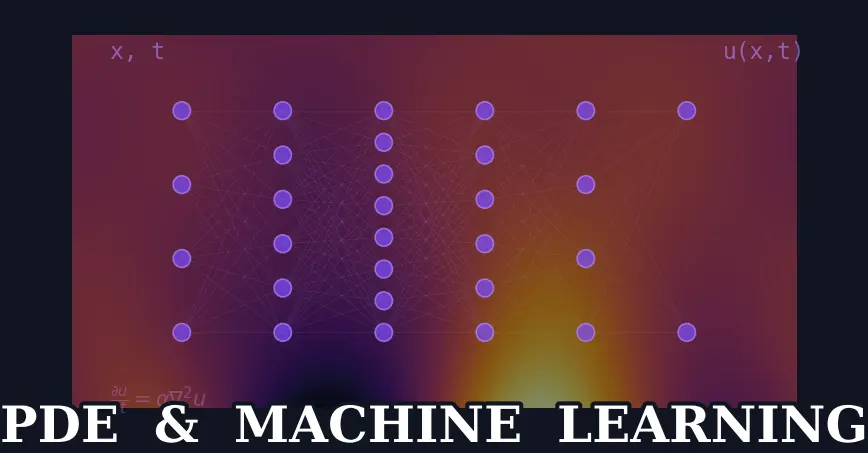
PDE and Machine Learning
PINNs, neural operators, and the math behind learned PDE solvers.
 01
01PDE and ML (1): Physics-Informed Neural Networks
From finite differences to PINNs: automatic differentiation, PDE residual losses, NTK-based training pathologies, …
 02
02PDE and ML (2): Neural Operator Theory
DeepONet vs FNO from a function-space view: resolution invariance, error bounds, failure modes.
 03
03PDE and ML (3): Variational Principles and Optimization
Calculus of variations to Wasserstein gradient flow and the mean-field limit of neural networks.
 04
04PDE and ML (4): Variational Inference and the Fokker-Planck Equation
Variational inference and Langevin MCMC are two faces of the same Fokker-Planck PDE. We derive the equivalence, build …
 05
05PDE and ML (5): Symplectic Geometry and Structure-Preserving Networks
Standard neural networks violate conservation laws. This article derives Hamiltonian mechanics, symplectic integrators, …
 06
06PDE and ML (6): Continuous Normalizing Flows and Neural ODE
How do you turn a Gaussian into a complex data distribution? This article derives Neural ODEs, the adjoint method, …
 07
07PDE and ML (7): Diffusion Models and Score Matching
Diffusion models are PDE solvers in disguise. We derive the heat equation, Fokker-Planck, score matching, DDPM, and DDIM …
 08
08PDE and ML (8): Reaction-Diffusion Systems and Graph Neural Networks
Deep GNNs collapse because they are diffusion equations on graphs. Turing's reaction-diffusion theory tells us how to …