Graph Contextualized Self-Attention Network (GC-SAN) for Session-based Recommendation
GC-SAN combines a session-graph GGNN (local transitions) with multi-layer self-attention (global dependencies) for session-based recommendation. Covers graph construction, message passing, attention fusion, and where the design wins or breaks.
In session-based recommendation you only see a short anonymous click sequence — no user profile, no long history, no demographics. Every signal you have lives inside that single window. GC-SAN (IJCAI 2019) takes the strongest two ideas of the time — SR-GNN’s session graph and the Transformer’s self-attention — and stacks them: a graph view captures local transition patterns and loops, a sequence view captures long-range intent, and a tiny weighted sum decides how much of each to trust. The result is a clean “best of both worlds” baseline that is genuinely hard to beat at its parameter budget.
What You Will Learn#
- Why session recommendation is structurally harder than classical CF
- How a click sequence becomes a directed weighted graph
- The GGNN cell: in/out aggregation plus GRU gates
- Self-attention as a global encoder on top of graph-contextualised embeddings
- The fusion weight $w$ between last-click and global intent
- When GC-SAN is the right baseline and when it is not
Prerequisites#
- Graph neural network basics (message passing, GRU-style updates)
- Self-attention (queries, keys, values, scaled dot product)
- Recommendation evaluation metrics (Recall@K, MRR@K)
Problem setup and why this is hard#
Let $V = \{v_1, v_2, \dots, v_{|V|}\}$ be the item universe and let a session be an ordered click sequence $s = (v_{s,1}, v_{s,2}, \dots, v_{s,n})$ . The task is to predict the next item $v_{s,n+1}$ , usually by ranking all candidates and reporting Recall@K and MRR@K.
What makes this harder than classical collaborative filtering:
- No long-term profile. You cannot lean on stable user embeddings or demographic features.
- Short, noisy behaviour. A session may contain exploratory clicks, mis-clicks, or back-and-forth navigation.
- Long-range dependencies. Early clicks often still matter — click “camera” first, click “memory card” twenty steps later.
- Repeated transitions. Users bounce between a few related items; a strict sequence model can underuse this structure.
These four pressures pull in different directions. Sequence-only models (RNN/Transformer) handle order well but treat each step as a new token. Graph-only models (SR-GNN) capture loops and repeats but need many hops to reach distant clicks. GC-SAN’s design aims to combine the two without incurring the costs of either.
Where GC-SAN sits among prior work#
Before GC-SAN the standard baselines were:
- Markov chains. Strong local signal, no global understanding.
- GRU4Rec. Sequential RNN; captures order but struggles past a few steps.
- NARM, STAMP. Attention-based sequential models; better long range, but ignore the explicit transition graph that emerges within a session.
- SR-GNN. Build a per-session directed graph and run a gated GNN; rich local structure, but multi-hop intent needs many propagation steps and can oversmooth.
GC-SAN’s contribution is architectural rather than algorithmic: keep SR-GNN’s gated-GNN as the local encoder, then stack a Transformer-style self-attention block on top so global dependencies do not need to be reached by graph hops. Figure 1 shows the full pipeline.

The pipeline is strictly serial: clicks $\to$ graph build $\to$ GGNN propagation $\to$ self-attention stack $\to$ fuse last-click and global $\to$ score every item.
Session graph construction#
For each session $s$ build a directed graph $G_s = (V_s, E_s)$ :
- Nodes are the unique items that appear in the session.
- For each adjacent pair $(v_{s,i}, v_{s,i+1})$ , add a directed edge $v_{s,i} \to v_{s,i+1}$ .
- If the same transition repeats, accumulate its weight (or treat as a multi-edge and normalise later).
This step is where you trade richness for compactness. The same item appearing twice in the session collapses into one node; only the transitions between them carry repetition. Loops — click A then B then A — show up as cycles in the graph, which a pure sequence model only sees as “two separate occurrences of A”.
$$ A^{out}_{ij} = \frac{w(v_i \to v_j)}{\sum_k w(v_i \to v_k)}, \quad A^{in}_{ij} = \frac{w(v_j \to v_i)}{\sum_k w(v_k \to v_i)}. $$Figure 2 walks through one example end-to-end.
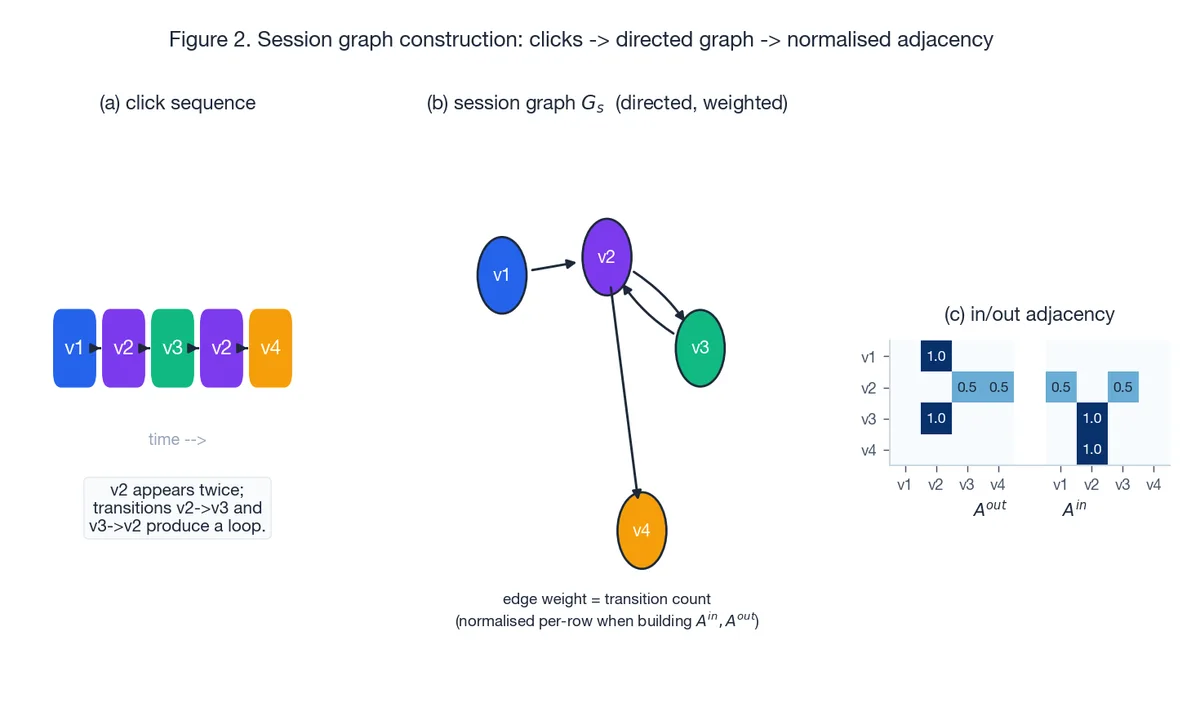
Note that the click sequence v1 v2 v3 v2 v4 produces a 4-node graph with a v2 <-> v3 loop and a fan-out from v2 to both v3 and v4. The pure sequence has length 5; the graph has 4 nodes and 4 distinct edges. That compactness is the whole point.
Local encoder: GGNN over the session graph#
GC-SAN reuses the SR-GNN gated graph neural network cell. Each node carries a $d$ -dim embedding $h_i$ . One propagation step has three parts.
$$a_i^{(t)} \;=\; A^{in}_{i,:} \, H^{(t-1)} W^{in} \;+\; A^{out}_{i,:} \, H^{(t-1)} W^{out} \;+\; b,$$where $H^{(t-1)} = [h_1^{(t-1)}, \dots, h_{|V_s|}^{(t-1)}]^\top$ stacks all node embeddings for the session and $W^{in}, W^{out} \in \mathbb{R}^{d \times d}$ are learnable. The two terms separate “evidence flowing into me” from “evidence flowing out of me”, which matters for directional transitions.
$$ \begin{aligned} z_i^{(t)} &= \sigma(W_z a_i^{(t)} + U_z h_i^{(t-1)}), \\ r_i^{(t)} &= \sigma(W_r a_i^{(t)} + U_r h_i^{(t-1)}), \\ \tilde h_i^{(t)} &= \tanh\!\bigl(W_h a_i^{(t)} + U_h (r_i^{(t)} \odot h_i^{(t-1)})\bigr), \\ h_i^{(t)} &= (1 - z_i^{(t)}) \odot h_i^{(t-1)} \;+\; z_i^{(t)} \odot \tilde h_i^{(t)}. \end{aligned} $$The update gate $z$ decides how much of the new graph signal to write in; the reset gate $r$ decides how much of the old state to forget when forming the candidate. Figure 3 shows this on a single node.

After $T$ propagation steps (the paper uses $T=1$ , sometimes 2), each node embedding has absorbed its local neighbourhood. Crucially, propagation is performed on the per-session graph — not a global item graph — so the embeddings are session-conditional.
Practical note. Because sessions can repeat items, the implementation maintains an alias mapping from each sequence position to its node index in the unique-item graph. After GGNN you “scatter” node states back to sequence positions before applying self-attention. This is what
seq_hidden = hidden[alias_inputs]does in any standard implementation.
Global encoder: self-attention over the session#
GGNN is strong locally, but reaching a distant click requires many hops, and stacking too many GGNN layers leads to oversmoothing — node embeddings collapse toward each other. Self-attention sidesteps this entirely: every position can attend to every other position in one step.
$$F = \mathrm{softmax}\!\left(\frac{(E W^Q)(E W^K)^\top}{\sqrt{d}}\right)(E W^V),$$ $$E^{(1)} = \mathrm{ReLU}(F W_1 + b_1) W_2 + b_2 + F.$$Stacking $k$ such blocks produces $E^{(k)}$ , the graph-contextualised sequence representation. Figure 4 shows what attention typically learns and why GGNN alone struggles to reach the same connections.

The heatmap is illustrative but the pattern is real: the first click (“camera”) attends strongly to thematically related items deep in the session (memory card, battery, bag) — a connection that would take a 4-hop GNN traversal to reach, by which point the signal has been smoothed.
Fusion: last-click vs global intent#
Session recommendation almost always benefits from explicitly mixing two signals:
- Current interest $h_t$ : the embedding of the last clicked item (often the strongest short-term predictor).
- Global intent $a_t$ : the last-position output of the self-attention stack, which has integrated the whole session.
The weight $w$ is a hyperparameter (typical sweet spot $w \in [0.4, 0.6]$ ). Set $w = 0$ and you get last-click only, set $w = 1$ and you discard the strong short-term signal. Figure 5(b) shows the typical sweep — forgiving in the middle, painful at the extremes.
Training and evaluation#
$$\mathcal{L} \;=\; -\sum_{i=1}^{|V|} y_i \log \hat y_i \;+\; \lambda \|\Theta\|^2,$$ $$\mathcal{L}_{\text{BPR}} \;=\; -\sum_{(u, i, j)} \log \sigma(\hat r_{ui} - \hat r_{uj}) + \lambda \|\Theta\|^2,$$with $i$ a positive (clicked) item and $j$ sampled negatives.
Standard benchmarks are Yoochoose1/64 and Diginetica, reported with Recall@20 and MRR@20. Figure 5 summarises the gap pattern reported in the paper.

Two things to read off the chart:
- The GC-SAN over SR-GNN gap is consistent but not enormous (roughly +1 to +2 points on Recall and MRR). The marginal value of self-attention on top of a graph encoder is real but bounded.
- The fusion-weight curve is flat in the middle and steep at the edges, which is exactly what you want from a hyperparameter: easy to tune, hard to break.
Implementation notes (what matters in practice)#
Alias mapping and batching. Sessions repeat items, so you map each sequence position to a node index in the unique-item graph. Batching multiple session graphs together is non-trivial: either build a block-diagonal adjacency or use a library that supports batched graph operations (PyG, RecBole-GNN).
Complexity.
- GGNN: $\mathcal{O}(T \cdot |E_s| \cdot d)$ per session, where $T$ is propagation steps and $|E_s|$ is the number of edges in the session graph.
- Self-attention: $\mathcal{O}(n^2 d + n d^2)$ per session, quadratic in session length $n$ . In session data $n$ is usually short (often $< 50$ ), so the quadratic cost is fine.
Hyperparameters that change behaviour.
- Propagation steps $T$ . Too small misses multi-hop transitions; too large oversmooths. $T = 1$ is the paper default.
- Self-attention layers/heads. More layers add capacity but overfit on small datasets like Diginetica.
- Fusion weight $w$ . Controls global-vs-local emphasis. Sweep on validation; expect a flat optimum near $0.5$ .
Padding and masking. Self-attention must mask padded positions, otherwise gradient mass leaks into nonsense tokens. This is a frequent source of silent regressions when porting code.
Reference implementation sketch#
A minimal RecBole-style implementation. The GGNN cell is reused from SR-GNN; the rest of the wiring is GC-SAN’s contribution.
| |
A few things worth noticing about this reference:
- The GGNN cell is imported, not reimplemented — GC-SAN is a wiring story.
gather_indexesextracts the embedding at positionitem_seq_len - 1, which is the actual last click (not the padded tail).- The fusion weight
self.weightis a fixed scalar from config. A natural extension is to make it input-dependent (a small gating MLP on $h_t \oplus a_t$ ), but the paper does not explore this. - Loss can be swapped between BPR and full-softmax cross-entropy depending on $|V|$ .
When GC-SAN is a good choice (and when it is not)#
Good fit:
- Sessions have meaningful transition structure (loops, repeats, related-item bouncing).
- Sessions are short to moderate length, so the $\mathcal{O}(n^2)$ attention cost is fine.
- You want a strong baseline that combines graph and sequence signals without exotic infrastructure.
Limitations and risks:
- Attention cost grows quadratically with session length. For very long sessions, switch to a linear attention variant or chunk the session.
- Graph construction choices (edge weighting, normalisation) can quietly change results. Validate on a small held-out slice when changing them.
- If item metadata is critical (text, image, category hierarchy), pure-ID GC-SAN underuses your features. Consider concatenating side-information embeddings before the GGNN, or move to a content-aware variant.
- The improvement over SR-GNN is real but modest. If you cannot afford a self-attention stack, SR-GNN alone is a respectable baseline.
Practical takeaway#
GC-SAN reads as a sober “do both” recipe rather than a clever new mechanism:
- GGNN captures local transition patterns and repeats efficiently — but cannot reach far without oversmoothing.
- Self-attention captures long-range dependencies in one step — but treats the input as a flat sequence and ignores graph structure.
- A single scalar fusion weight $w$ between last-click and global intent ties them together, with a forgiving sweet spot.
For session-based recommendation in 2024, GC-SAN remains a clean baseline to beat: it tells you whether your fancy new model actually exploits session structure better than a graph encoder plus a Transformer block. If it does not, you have learned something useful before spending more compute.
References#
- Xu et al., “Graph Contextualized Self-Attention Network for Session-based Recommendation,” IJCAI 2019. Paper PDF
- Wu et al., “Session-based Recommendation with Graph Neural Networks (SR-GNN),” AAAI 2019.
- Hidasi et al., “Session-based Recommendations with Recurrent Neural Networks (GRU4Rec),” ICLR 2016.
- Li et al., “Neural Attentive Session-based Recommendation (NARM),” CIKM 2017.
- Liu et al., “STAMP: Short-Term Attention/Memory Priority Model for Session-based Recommendation,” KDD 2018.