System Design (6): Microservices vs Monoliths — The Honest Tradeoff
An honest assessment of monoliths vs microservices — covering the distributed systems tax, service boundary design with DDD, inter-service communication patterns, circuit breakers, service mesh, API gateways, and a practical decision framework.
In 2020, the team behind Segment — a customer data platform processing billions of events per month — published a blog post titled “Goodbye Microservices.” They had decomposed their monolith into over 140 microservices, and the result was not the engineering utopia they expected. Instead, they spent most of their time fighting the complexity of the distributed system itself: service discovery failures, cascading timeouts, inconsistent deployment pipelines, and an explosion of inter-service communication bugs. They consolidated back to a monolith and reported dramatic improvements in developer productivity and system reliability.
This story is not unique. The microservices pattern has become the default architectural assumption in the industry, but the honest truth is that it is the wrong choice for most teams. Understanding when microservices help and when they hurt is one of the most important judgment calls in system design.
The Monolith#
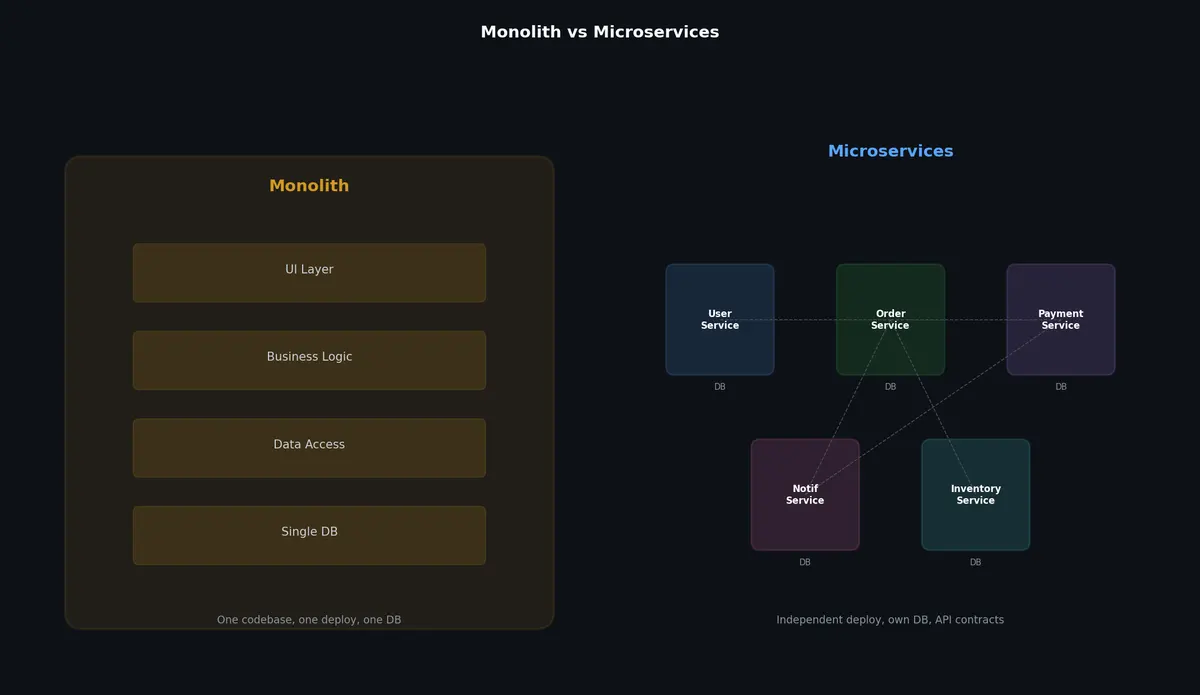
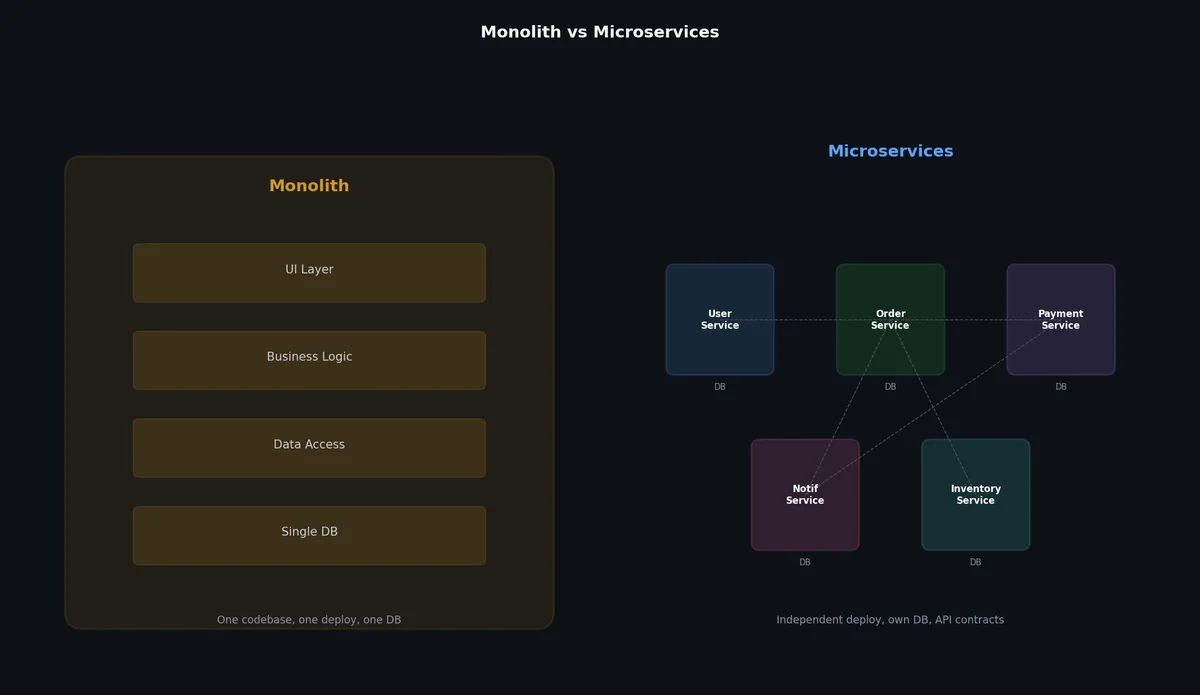
A monolith is a single deployable unit that contains all the application’s functionality. The entire codebase is compiled and deployed together. All modules share the same process, the same memory space, and the same database.
Why Monoliths Work#
Simplicity: One codebase, one deployment pipeline, one database, one set of logs. A new developer can clone the repo, run docker-compose up, and have the entire system running locally in minutes.
Performance: Function calls within a process take nanoseconds. There is no network serialization, no HTTP overhead, no service discovery. A monolith can handle remarkably high throughput with minimal infrastructure.
Transactional consistency: Because all modules share a database, you get ACID transactions across the entire domain. Deducting inventory and recording a sale happen in a single database transaction — no distributed coordination required.
Refactoring: Moving code between modules is a simple refactor. In a microservices world, moving functionality between services requires changing APIs, updating consumers, managing data migration, and coordinating deployments.
When Monoliths Struggle#
Team scaling: When 50+ engineers work on the same codebase, merge conflicts become constant, deploy queues get long, and one team’s bug breaks another team’s feature.
Scaling bottlenecks: If one module needs 10x more compute than the rest, you must scale the entire monolith 10x. You cannot independently scale the hot path.
Technology lock-in: The entire application uses the same language, framework, and database. If one module would benefit from a different technology, you cannot adopt it without affecting everything else.
Blast radius: A memory leak in one module crashes the entire process. A bad deploy affects all functionality simultaneously.
The Modular Monolith#
Before jumping to microservices, consider the modular monolith — a single deployable unit with strict internal module boundaries.
| |
Rules:
- Modules communicate only through their public APIs (no reaching into another module’s internals)
- Each module owns its own database tables (no cross-module table access)
- Cross-module data access goes through the module’s API
- Module boundaries can be enforced by linting rules or architecture tests
| |
The modular monolith gives you most of the organizational benefits of microservices (clear ownership, independent development) without the distributed systems tax.
The Microservices Architecture#
Microservices decompose the application into independently deployable services, each running in its own process and communicating over the network.
What You Gain#
Independent deployability: The orders team can deploy 10 times a day without coordinating with the payments team. Each service has its own CI/CD pipeline, its own release cycle, and its own rollback strategy.
Technology diversity: The orders service can use Python, the recommendation engine can use Go for performance, and the search service can use Elasticsearch. Each team picks the best tool for their domain.
Team autonomy: Each team owns a service end-to-end: code, tests, deployment, monitoring, and on-call. They make decisions independently. Conway’s Law works in your favor — the architecture mirrors the organization.
Independent scaling: The search service gets 100x more traffic during Black Friday. You scale it to 50 instances while keeping the orders service at 5 instances.
Fault isolation: A memory leak in the notification service does not crash the payment service. Failures are contained within service boundaries (if you implement proper isolation patterns).
The Distributed Systems Tax#
Every benefit comes with a cost. Microservices introduce distributed systems problems that do not exist in a monolith.
Network latency: A function call takes nanoseconds. A network call takes milliseconds. If a user request touches 5 services in sequence, you add 5-50ms of network latency even before processing.
Partial failures: In a monolith, either the process is up or it is down. In a distributed system, Service A might be up while Service B is down. Every service call needs timeout handling, retry logic, and fallback strategies.
Data consistency: Without a shared database, maintaining consistency across services requires distributed coordination (sagas, eventual consistency, compensating transactions). This is fundamentally harder than a database transaction.
Operational complexity: Instead of monitoring one application, you monitor 20+. Each has its own logs, metrics, alerts, deployment pipeline, and failure modes. You need centralized logging, distributed tracing, and service mesh infrastructure.
Testing complexity: Integration tests must spin up multiple services. End-to-end tests are slow and flaky. Contract testing becomes essential.
Debugging difficulty: A bug that would be a single stack trace in a monolith becomes a detective story across multiple services, logs, and network traces.
Service Boundaries: Domain-Driven Design#

The hardest part of microservices is deciding where to draw the boundaries. Get them wrong, and you end up with chatty services that need to call each other constantly, or services that are too granular to be useful.
Domain-Driven Design (DDD) provides a principled approach.
Bounded Contexts#
A bounded context is a boundary within which a particular domain model is defined and applicable. Within a bounded context, terms have precise, unambiguous meanings. Across bounded contexts, the same term may mean different things.
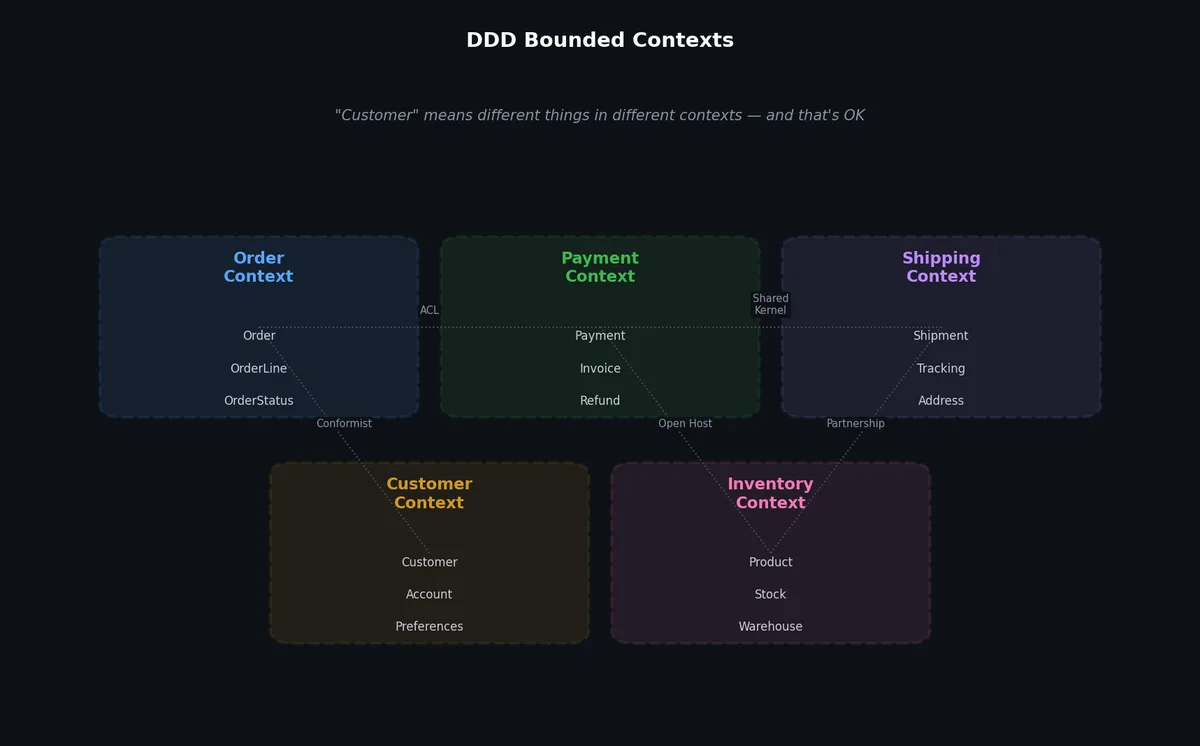
Example: In an e-commerce system, “Order” means different things in different contexts:
- Sales context: An Order is a customer’s intent to purchase items, with pricing, discounts, and payment terms
- Fulfillment context: An Order is a set of items that need to be picked, packed, and shipped from a warehouse
- Accounting context: An Order is a financial transaction with revenue recognition, tax calculations, and ledger entries
Each bounded context is a natural candidate for a service boundary. The key insight: services should be organized around business capabilities, not technical layers.
| |
Context Mapping#
Services need to communicate, and the boundaries between them need explicit contracts. DDD defines several relationship patterns:
Published Language: Services agree on a shared data format for events or API contracts (protobuf schemas, JSON Schema, OpenAPI specs).
Anti-Corruption Layer: When integrating with a legacy or external system, build a translation layer that converts the external model to your internal model. This prevents the external system’s design decisions from leaking into your codebase.
| |
Inter-Service Communication#

Synchronous: REST and gRPC#
Use synchronous communication when the caller needs an immediate response.
| |
Asynchronous: Events and Messages#
Use asynchronous communication when the caller does not need an immediate response, or when you need to fan out to multiple consumers.
The previous article on message queues covers this in detail. The key design choice: use events for facts (“OrderCreated”) and commands for instructions (“ProcessPayment”).
The Circuit Breaker Pattern#
When a downstream service is failing, continuing to send requests is wasteful and can cascade the failure. A circuit breaker stops the bleeding.


States#
The circuit breaker has three states:
Closed (normal): Requests pass through. Failures are counted. If failures exceed a threshold, the circuit opens.
Open (failing): Requests are immediately rejected without calling the downstream service. After a timeout, the circuit moves to half-open.
Half-Open (testing): A limited number of requests are sent to the downstream service. If they succeed, the circuit closes. If they fail, the circuit opens again.
| |
Distributed Tracing#
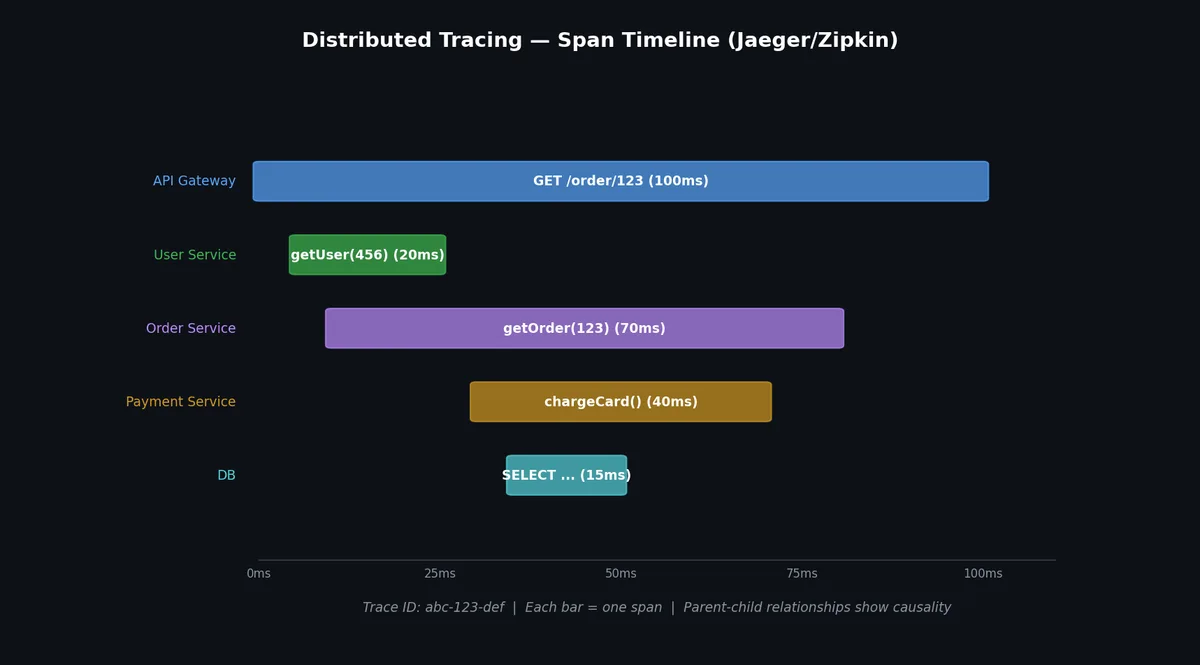
In a microservices architecture, a single user request may traverse 5-10 services. When something goes wrong, you need to trace the request across all of them.
OpenTelemetry#
OpenTelemetry is the industry standard for distributed tracing. It propagates a trace context (trace ID + span ID) through all service calls.
| |
The trace appears in Jaeger/Zipkin as a timeline showing each span, its duration, and which service executed it. When the payment service is slow, you see exactly which span took too long.
API Gateway#
An API gateway sits between external clients and internal services, providing a single entry point.
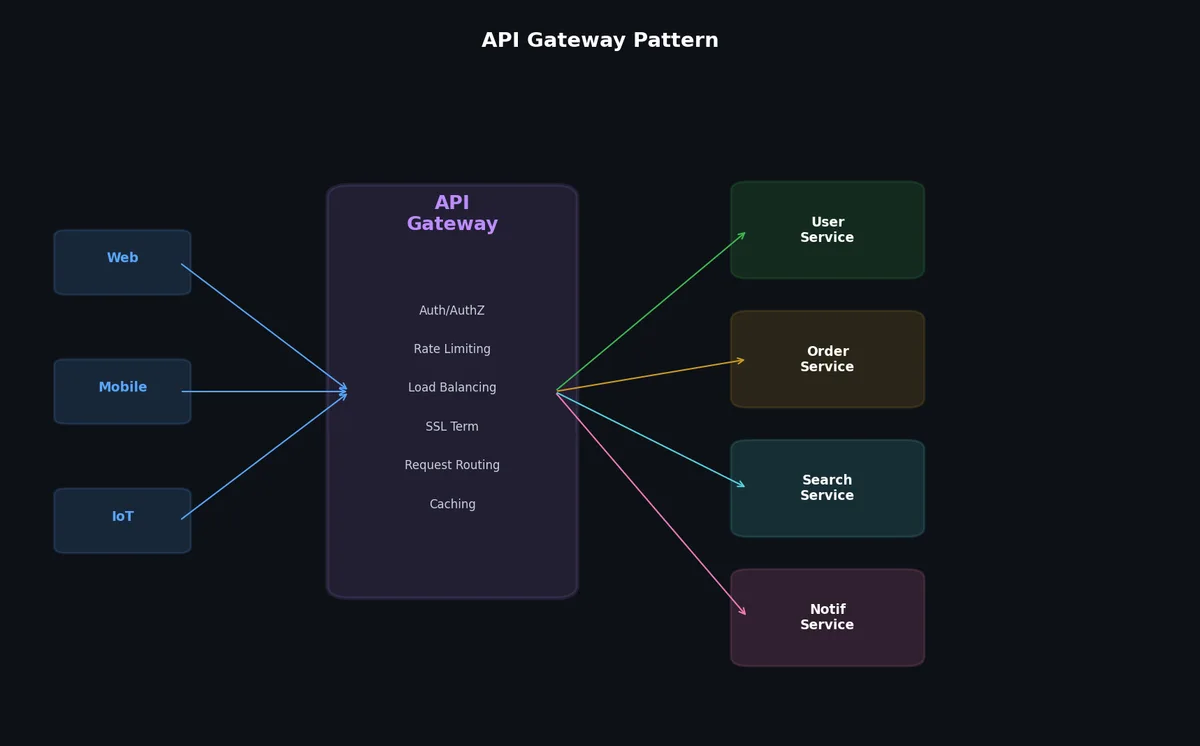
Gateway Responsibilities#
| |
Nginx as an API Gateway#
| |
Data Management in Microservices#
Database Per Service#
Each service owns its data exclusively. No other service can read from or write to its database directly.
| |
Consequence: You cannot JOIN across service boundaries. If the Orders Service needs user information, it must call the Users Service API. This adds latency and complexity but enforces loose coupling.
The Shared Database Anti-Pattern#
Multiple services sharing a single database is tempting but destructive:
- Any service can read/write any table, creating hidden dependencies
- Schema changes require coordinating all services that touch the affected tables
- One service’s heavy query can degrade another service’s performance
- You cannot deploy services independently if they share schema migration
Data Consistency: The Saga Pattern#
Without distributed transactions, maintaining consistency across services requires sagas — a sequence of local transactions coordinated by events or orchestration.
Choreography-based saga (event-driven):
| |
Each service publishes events and reacts to events. No central coordinator. Simple for short sagas but becomes hard to follow for complex workflows.
Orchestration-based saga (central coordinator):
| |
Decision Framework#
When to Stay Monolithic#
- Team size is under 20 engineers
- The application domain is well-understood and stable
- You need strong consistency (financial systems, inventory management)
- You are a startup and speed of iteration matters more than scalability
- You do not have operational maturity for distributed systems (monitoring, tracing, on-call)
When to Consider Microservices#
- Team size exceeds 30-50 engineers, with clear team ownership boundaries
- Different parts of the system have vastly different scaling requirements
- You need technology diversity (ML model serving vs. CRUD APIs)
- Multiple teams need to deploy independently without coordination
- You have the operational infrastructure to support distributed systems
The Extraction Pattern#
The safest approach is to start with a monolith and extract services when pain is clear:
- Build a well-structured monolith with clear module boundaries
- Identify the extraction candidate: the module that has the most independent scaling needs, the most frequent deployments, or the most distinct team ownership
- Define the API boundary: what does this module expose to the rest of the system?
- Extract: deploy the module as a separate service, replace internal function calls with API calls
- Verify: confirm the extraction solves the problem it was intended to solve
- Repeat: extract the next service when the next pain point emerges
This approach avoids premature decomposition. You only pay the microservices tax for parts of the system that genuinely need it.
What’s Next#
Whether your system is a monolith or microservices, data flows through it in patterns. The next article covers data pipelines — batch processing, stream processing, and the architectural patterns that connect raw data to actionable insights.
System Design 8 parts
- 01 System Design (1): Thinking in Systems — Load, Latency, and the Art of Estimation
- 02 System Design (2): DNS, CDN, and Load Balancing — The First Three Hops
- 03 System Design (3): API Design — REST, gRPC, GraphQL, and Choosing Wisely
- 04 System Design (4): Caching — Where to Cache, What to Evict, and When Caching Hurts
- 05 System Design (5): Message Queues and Event-Driven Architecture
- 06 System Design (6): Microservices vs Monoliths — The Honest Tradeoff you are here
- 07 System Design (7): Data Pipelines — Batch, Stream, and the Lambda Architecture
- 08 System Design (8): Case Studies — URL Shortener, Chat System, News Feed