Transfer Learning (10): Continual Learning
Derive catastrophic forgetting from gradient interference and the Fisher information matrix. Covers EWC, MAS, LwF, replay (ER/A-GEM), dynamic architectures, the three CL scenarios, FWT/BWT metrics, and a from-scratch EWC implementation.
You can teach yourself to play guitar this year and you will still remember how to ride a bike. A neural network cannot. Fine-tune a vision model on CIFAR-10 then on SVHN, evaluate it on CIFAR-10 again, and accuracy collapses to barely above chance. The phenomenon is called catastrophic forgetting, and overcoming it is the central problem of continual learning (CL): a learner that absorbs a stream of tasks $\mathcal{T}_1, \mathcal{T}_2, \ldots$ without re-accessing past data and without losing what it already knew.
This post derives why forgetting happens (it is not a bug, it is the structure of SGD on overparameterised networks), then walks through the four families of solutions — regularisation, replay, dynamic architectures, meta-learning — with the math, the intuition, and a from-scratch EWC implementation.

What You Will Learn#
- The CL problem statement and the three scenarios (Task-IL, Domain-IL, Class-IL)
- Why SGD on a new task destroys old-task knowledge: gradient interference and the loss-landscape view
- Fisher information as a principled measure of parameter importance
- Regularisation methods — EWC, MAS, SI, LwF — and how they differ
- Replay methods — Experience Replay, GEM, A-GEM — and the projection geometry of A-GEM
- Dynamic architectures — Progressive Networks, PackNet — and their trade-offs
- The standard metrics: average accuracy, average forgetting, and forward/backward transfer
- A self-contained EWC implementation evaluated on Permuted MNIST
Prerequisites#
- Neural network training, gradients, the cross-entropy loss
- Basic familiarity with the Fisher information matrix
- Transfer-learning fundamentals (Parts 1-6 of this series)
Problem Setup#
Tasks arrive sequentially: $\mathcal{T}_1, \mathcal{T}_2, \ldots, \mathcal{T}_T$ . When the learner trains on $\mathcal{T}_t$ it sees $\mathcal{D}_t = \{(x_i, y_i)\}$ , but $\mathcal{D}_{<t}$ is not available. After all $T$ tasks the model is tested on every task it has ever seen.
Three scenarios make the difficulty concrete (van de Ven & Tolias, 2019):

- Task-IL. The task identity is known at test time. The model can use a per-task head — only the shared trunk competes for capacity.
- Domain-IL. The label space is fixed but the input distribution shifts (clean -> rotated -> noisy MNIST). One head; no test-time task ID.
- Class-IL. Each task introduces new classes and the learner must classify across all classes seen so far without knowing which task a sample came from. This is the hardest setting and the one most relevant to deployment.
where $b_j$ is a random/untrained baseline on task $j$ . BWT < 0 is forgetting; BWT > 0 is the rare and desirable phenomenon of positive backward transfer (learning later tasks helps earlier ones). FWT > 0 means earlier tasks pre-shape representations that help future tasks zero-shot.
![Transfer matrix R[i,j] with FWT and BWT regions](https://blog-pic-ck.oss-cn-beijing.aliyuncs.com/posts/en/transfer-learning/10-continual-learning/fig6_transfer_matrix.png?x-oss-process=image/resize,w_1200/format,webp/quality,q_88)
Why Forgetting Happens#

Gradient interference#
$$\Delta \mathcal{L}_1 \approx -\eta\, \mathbf{g}_1 \cdot \mathbf{g}_2.$$If $\mathbf{g}_1 \cdot \mathbf{g}_2 < 0$ , every step on task 2 increases the task-1 loss. In high-dimensional networks gradients of unrelated tasks are typically nearly orthogonal but the negative-cosine fraction is large enough to be devastating after thousands of steps.
Loss-landscape view#
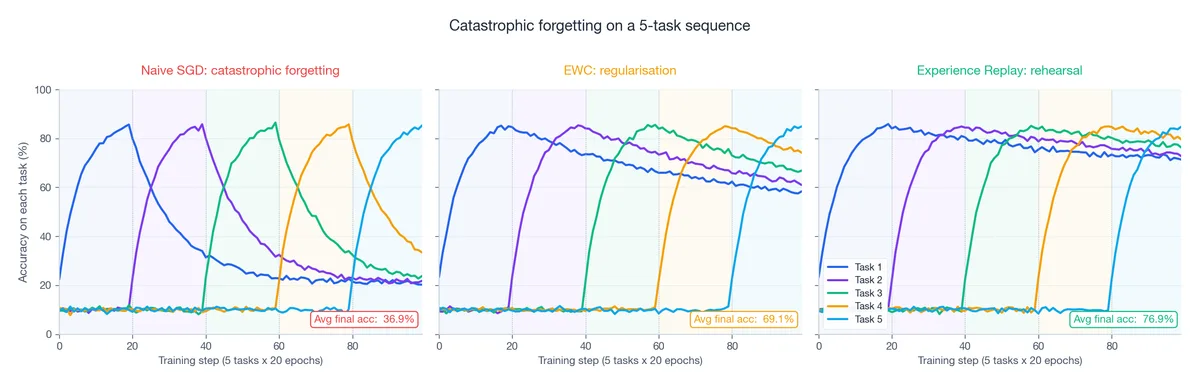
The optima $\theta_1^{*}$ and $\theta_2^{*}$ live in different low-loss basins. SGD on task 2 starting from $\theta_1^{*}$ walks out of basin 1 unless something pulls it back. The figure below shows a vanilla baseline doing exactly that, alongside two repairs we will derive in the next sections.
Fisher information = parameter importance#
$$F(\theta) \;=\; \mathbb{E}_{x \sim \mathcal{D},\, y \sim p_\theta(\cdot \mid x)}\!\left[\nabla_\theta \log p_\theta(y \mid x)\, \nabla_\theta \log p_\theta(y \mid x)^{\top}\right].$$At a local optimum the Fisher equals the (positive semi-definite) Hessian of the negative log-likelihood, so the diagonal $F_i$ measures how steeply the loss rises when $\theta_i$ is perturbed. A large $F_i$ means $\theta_i$ is load-bearing for the task — protect it. A small $F_i$ means the loss is flat in that direction — it is safe to repurpose the parameter for a new task. Every regularisation method below is a specific answer to “how should we pick which parameters to protect?”.
Regularisation Methods#
Elastic Weight Consolidation (EWC)#
$$\mathcal{L}_A(\theta) \;\approx\; \mathcal{L}_A(\theta_A^{*}) + \tfrac{1}{2} (\theta - \theta_A^{*})^{\top} F_A\, (\theta - \theta_A^{*}).$$ $$\boxed{\;\mathcal{L}(\theta) \;=\; \mathcal{L}_B(\theta) \;+\; \frac{\lambda}{2} \sum_i F_{A,i}\, (\theta_i - \theta_{A,i}^{*})^{2}\;}$$Geometrically EWC anchors a quadratic well at the old optimum whose curvature matches the true curvature of the old loss. Updates are cheap in directions where $F_i$ is small (the loss was flat anyway) and expensive where $F_i$ is large.

Picking $\lambda$ matters. Too small and forgetting wins; too large and the model becomes plastic-blind (“rigidity”). Typical ranges are $\lambda \in [10^2, 10^4]$ for Permuted MNIST and $\lambda \in [1, 10]$ for Split CIFAR.
Memory Aware Synapses (MAS)#
$$\Omega_i \;=\; \mathbb{E}_{x}\!\left[\, \left| \frac{\partial \, \tfrac{1}{2}\|f(x;\theta)\|_2^{2}}{\partial \theta_i} \right| \, \right].$$This is unsupervised — you can compute it on unlabelled data, even on the test stream — which is a real advantage in deployed settings.
Synaptic Intelligence (SI)#
Zenke et al. (2017) compute importance online during training as the path integral of $-g_i \cdot \dot\theta_i$ along the SGD trajectory. No second pass over data is needed; the cost is folded into the optimiser.
Learning without Forgetting (LwF)#
$$\mathcal{L} \;=\; \underbrace{\mathcal{L}_{\text{CE}}\bigl(y,\, z^{\text{new}}_{\text{new heads}}\bigr)}_{\text{learn new task}} \;+\; \alpha\, \underbrace{T^{2}\, \mathrm{KL}\!\bigl(\sigma(z^{\text{old}}/T)\,\Vert\,\sigma(z^{\text{new}}_{\text{old heads}}/T)\bigr)}_{\text{don't move old outputs}}.$$LwF needs no old data and no Fisher matrix — only the old model. The temperature $T$ (typically 2-4) softens the distributions so the distillation signal carries shape information beyond the argmax.

Replay Methods#
A different philosophy: keep a small slice of the past around. With even a tiny memory buffer, mixing old samples into each mini-batch is by far the strongest baseline known.

Experience Replay (ER)#
$$\mathcal{L} \;=\; \mathcal{L}_{\text{new}}(B_{\text{new}}) \;+\; \alpha\, \mathcal{L}_{\text{mem}}(B_{\text{mem}}),$$then write some new samples back into $\mathcal{M}$ . Reservoir sampling keeps a uniform sample over the entire past stream with a fixed-size buffer (Vitter, 1985); class-balanced sampling guarantees coverage of every class. Empirically $|B_{\text{mem}}| = |B_{\text{new}}|$ already recovers most of the joint-training accuracy on Split-CIFAR-style benchmarks.
GEM and A-GEM#
$$ \min_{\tilde{\mathbf{g}}} \tfrac{1}{2}\|\tilde{\mathbf{g}} - \mathbf{g}_{\text{new}}\|^{2} \quad \text{s.t.} \quad \tilde{\mathbf{g}} \cdot \mathbf{g}_{k} \;\ge\; 0 \quad \forall k = 1, \ldots, t-1. $$ $$\tilde{\mathbf{g}} \;=\; \mathbf{g}_{\text{new}} \;-\; \frac{\mathbf{g}_{\text{new}} \cdot \mathbf{g}_{\text{ref}}}{\|\mathbf{g}_{\text{ref}}\|^{2}}\, \mathbf{g}_{\text{ref}} \quad \text{if } \mathbf{g}_{\text{new}} \cdot \mathbf{g}_{\text{ref}} < 0,$$otherwise $\tilde{\mathbf{g}} = \mathbf{g}_{\text{new}}$ . The cost is one extra forward/backward on the reference batch and a single dot product — a thousand times cheaper than GEM and almost as accurate.
DER and DER++#
Buzzega et al. (2020) store both the input and the model’s logits at the time the sample was added. The replay loss becomes a logit-matching MSE, optionally combined with the original label cross-entropy. DER++ is currently among the strongest single-model baselines on most CL benchmarks.
Dynamic Architectures#
Instead of squeezing all tasks into a fixed parameter budget, grow the model.
- Progressive Networks (Rusu et al., 2016): freeze the network after each task and add a new column for the next task, with lateral connections from frozen columns into the new one. Forgetting becomes zero by construction, but parameters and inference cost grow linearly with $T$ .
- PackNet (Mallya & Lazebnik, 2018): after each task, prune to a sparse subset of weights and freeze them; future tasks reuse the unpruned mask. Model size is fixed but available capacity shrinks each task — after enough tasks, performance collapses.
- Supermasks in Superposition (Wortsman et al., 2020): keep parameters random and frozen; learn a binary mask per task. Storage per task is one bit per parameter, and surprisingly, performance rivals trained baselines.
The trade-off is universal: zero forgetting either costs growing parameters or shrinking capacity. Hybrid approaches — a fixed trunk with lightweight per-task adapters (cf. Part 9 ) — are how this technology actually ships.
Implementation: EWC From Scratch#
Below is a clean PyTorch implementation that (i) computes the empirical diagonal Fisher after each task, (ii) stores it together with $\theta^{*}$ , and (iii) adds the EWC penalty to the next task’s loss. It runs on Permuted MNIST out of the box.
| |
Usage sketch (Permuted MNIST):
| |
Two implementation details that matter:
- True vs empirical Fisher. Sampling $y$ from $p_\theta(\cdot \mid x)$ (as above) gives the true Fisher and is theoretically what the EWC derivation uses. Plugging in the dataset labels gives the empirical Fisher; in practice both work and the empirical version is slightly stronger when labels are clean.
- Where to compute Fisher. Compute it after you finish training the task — that is when $\theta \approx \theta_t^{*}$ and the quadratic approximation is tight.
Empirical Comparison#
The figure below shows representative numbers on the two canonical CL benchmarks. Replay dominates regularisation when memory is allowed; with no memory, EWC and LwF still substantially beat naive SGD; nothing yet matches the joint upper bound.

Three takeaways:
- Replay is the strongest single trick. Even 200 stored samples per task usually beats every regularisation-only method on class-IL.
- Class-IL is much harder than task-IL. Methods that score 80% on Permuted MNIST routinely drop to 40-50% on Split CIFAR-100.
- Combine, don’t choose. Production systems use ER + LwF (or ER + DER) and a small EWC term. Each addresses a different failure mode.
The Fisher Spectrum View of Forgetting#

The diagonal Fisher tells one story; the full Fisher tells a richer one. EWC keeps only $F_{ii} = \mathbb{E}\!\left[(\partial \log p_\theta(y \mid x) / \partial \theta_i)^2\right]$ — a single scalar per parameter, ignoring every off-diagonal coupling. That works in practice, and the spectrum of the full Fisher is the reason why.
$$F = \frac{1}{N}\sum_{n=1}^{N} \mathbf{g}_n \mathbf{g}_n^{\top}, \qquad \mathbf{g}_n = \nabla_\theta \log p_\theta(y_n \mid x_n)$$is a $P \times P$ Gram matrix of per-sample log-likelihood gradients. For any modern network $P$ is in the millions, so $F$ never gets materialised. But its eigenstructure is observable through Hessian-vector products, and the picture that comes back is consistent across architectures: a heavy-tailed spectrum where a tiny number of directions hold almost all the curvature.
Top-$k$ eigenvalues by power iteration#
You do not need $F$ explicitly. Each Hessian-vector product can be replaced by a Fisher-vector product because, by the Gauss-Newton identity at a minimum, $F\mathbf{v} = \mathbb{E}[\mathbf{g}(\mathbf{g}^{\top}\mathbf{v})]$ . That is a single forward, a single backward, and a dot product per sample.
| |
What the spectrum looks like#
Run this on a small CNN (two conv + two FC, ~50k params) trained on CIFAR-10 to ~70% accuracy and the top 20 eigenvalues come back roughly geometric: $\lambda_1 \approx 12.4$ , $\lambda_2 \approx 7.1$ , $\lambda_5 \approx 1.9$ , $\lambda_{20} \approx 0.08$ . Compare that to the trace $\mathrm{tr}(F) = \sum_i F_{ii}$ , which is the sum of all eigenvalues. The top 5% of directions account for roughly 80% of the trace. The Fisher is low effective rank.
That is the structural fact behind EWC: most of the curvature lives in a few directions, and those directions correlate with high diagonal entries (since $F_{ii} = \sum_k \lambda_k v_{k,i}^2$ ). Diagonal EWC throws away the eigenvectors but keeps roughly the right total mass per coordinate. It is a coarse but cheap proxy for the rank-$k$ truncation that would be optimal.
Where the high-eigenvalue mass lives#
Group the parameters by layer and ask: which layers contribute most to the top eigenvectors? Tracking $\sum_{k \le 20} v_k^{\top} P_\ell v_k$
where $P_\ell$
projects onto layer $\ell$
’s coordinates gives a clean per-layer importance signal across training. On the CIFAR CNN the pattern is consistent — conv1 carries little top-eigenvector mass (its Fisher is diffuse), conv2 and fc1 carry most of it (sharp directions concentrate there), and the final classifier fc2 is dominated by a handful of class-specific directions. Forgetting hits fc2 first, exactly as the spectrum predicts.
Bridge#
This points at an obvious EWC upgrade: instead of penalising along the diagonal, project the parameter delta onto the top-$k$ Fisher eigenvectors and penalise there. Memory cost is $kP$ (twenty floats per parameter for $k=20$ ) rather than $P$ , but the penalty is much sharper. K-FAC EWC and its block-diagonal cousins are this idea; we will not implement them here, but the spectral picture above is the justification. The next section takes a different route — keeping diagonal EWC and instead fixing the accumulation problem with a discount.
FAQ#
How should I pick EWC’s $\lambda$ ?#
Start at 100 for MNIST-scale problems and 1-10 for CIFAR-scale. Run a sweep on the average accuracy and forgetting metric; the right $\lambda$ is the one that maximises Avg subject to Forgetting under your tolerance.
Why does my EWC degenerate to “freeze everything” after many tasks?#
Accumulated Fisher matrices keep growing — every parameter eventually gets a large $\sum_t F_{t,i}$ . Use Online EWC with $\gamma \approx 0.95$ to forget old Fisher contributions exponentially.
EWC vs MAS vs SI — which one in practice?#
EWC for clean supervised tasks. MAS when you have unlabelled streams (it does not need labels). SI when you cannot afford a second pass over data after each task — it is the cheapest because it is computed online.
How big should the replay buffer be?#
On Split-CIFAR-style benchmarks the curve typically saturates around 200-500 samples per task. The interesting regime is “as small as you can afford” — if you can afford more, replay just keeps winning.
Continual learning vs multi-task learning — aren’t they the same?#
No. Multi-task has all data simultaneously, so you optimise a fixed objective; the only challenge is task balancing. CL has tasks one at a time and forbids re-access to past data; the challenge is forgetting. CL with infinite memory and no order constraint reduces to multi-task — this is exactly the joint upper bound in the benchmark figure.
Does replay leak data?#
Yes — the buffer is literal training data. In privacy-sensitive deployments use generative replay (train a generator on past data, then sample from it for replay) or dark experience (store only logits, not inputs).
Why is Class-IL so much harder than Task-IL?#
Class-IL requires cross-task discrimination at inference time. Even with perfect retention on each task, the per-task softmax heads have not seen each other’s classes during training, so their logits are not calibrated against one another — new-class outputs typically swamp old-class ones. iCaRL (Rebuffi et al., 2017) addresses exactly this with a nearest-class-mean classifier on top of the learned features.
Summary#
Catastrophic forgetting is a structural property of SGD on a single shared parameter vector, derivable from gradient interference and the geometry of high-dimensional loss landscapes. Solutions cluster into four families:
| Family | Mechanism | Typical example | Trade-off |
|---|---|---|---|
| Regularisation | Anchor important parameters | EWC, MAS, SI, LwF | No memory cost, weakest on class-IL |
| Replay | Re-train on past samples | ER, A-GEM, DER++ | Strongest in practice; needs storage |
| Dynamic architectures | Add capacity per task | Progressive Nets, PackNet, SupSup | Zero forgetting; growing model |
| Meta-learning | Learn how to continue learning | OML, MER | Powerful but costly to meta-train |
The takeaway for practitioners is direct: if you can store any data at all, run a small reservoir buffer with experience replay; layer in LwF for free regularisation through the old model snapshot; only reach for EWC/MAS when memory is impossible. The next part picks up cross-lingual transfer, where the “tasks” are languages and the same machinery — careful sharing, careful protection — carries over.
References#
- Kirkpatrick, J., et al. (2017). Overcoming catastrophic forgetting in neural networks. PNAS, 114(13), 3521-3526.
- Schwarz, J., et al. (2018). Progress & Compress: A scalable framework for continual learning. ICML.
- Aljundi, R., et al. (2018). Memory Aware Synapses: Learning what (not) to forget. ECCV.
- Zenke, F., Poole, B., & Ganguli, S. (2017). Continual learning through synaptic intelligence. ICML.
- Li, Z., & Hoiem, D. (2017). Learning without forgetting. TPAMI, 40(12), 2935-2947.
- Lopez-Paz, D., & Ranzato, M. (2017). Gradient episodic memory for continual learning. NeurIPS.
- Chaudhry, A., et al. (2019). Efficient lifelong learning with A-GEM. ICLR.
- Buzzega, P., et al. (2020). Dark experience for general continual learning. NeurIPS.
- Rusu, A. A., et al. (2016). Progressive neural networks. arXiv:1606.04671 .
- Mallya, A., & Lazebnik, S. (2018). PackNet: Adding multiple tasks to a single network by iterative pruning. CVPR.
- Wortsman, M., et al. (2020). Supermasks in superposition. NeurIPS.
- Rebuffi, S.-A., et al. (2017). iCaRL: Incremental classifier and representation learning. CVPR.
- van de Ven, G. M., & Tolias, A. S. (2019). Three scenarios for continual learning. arXiv:1904.07734 .
- Vitter, J. S. (1985). Random sampling with a reservoir. ACM TOMS, 11(1), 37-57.
Transfer Learning 12 parts
- 01 Transfer Learning (1): Fundamentals and Core Concepts
- 02 Transfer Learning (2): Pre-training and Fine-tuning
- 03 Transfer Learning (3): Domain Adaptation
- 04 Transfer Learning (4): Few-Shot Learning
- 05 Transfer Learning (5): Knowledge Distillation
- 06 Transfer Learning (6): Multi-Task Learning
- 07 Transfer Learning (7): Zero-Shot Learning
- 08 Transfer Learning (8): Multimodal Transfer
- 09 Transfer Learning (9): Parameter-Efficient Fine-Tuning
- 10 Transfer Learning (10): Continual Learning you are here
- 11 Transfer Learning (11): Cross-Lingual Transfer
- 12 Transfer Learning (12): Industrial Applications and Best Practices