概率与统计(八):贝叶斯统计——先验、后验,以及频率学派为何争论不休
从第一性原理出发的贝叶斯推断:后验分布、共轭先验、Beta-二项模型与正态-正态模型、可信区间、预测分布、MCMC 直观理解,以及与机器学习正则化的深层联系。
两位统计学家走进一家酒吧。一人说:“明天下雨的概率是 30%。”另一人反驳道:“概率指的是长期频率;而明天只发生一次,这种说法毫无意义。”第一个人回应:“它量化的是我对这一独特事件的不确定性。”两人就此争论了一整晚。
这大致就是贝叶斯学派与频率学派之争。争论的焦点并非谁对谁错——两种框架在数学上都是自洽的。关键在于“概率”究竟意味着什么,以及这种解释如何塑造你所使用的工具。在前六篇文章中,我们主要采用了频率学派的推理方式;现在,我们将转向贝叶斯视角:参数是随机变量,数据用于更新我们的信念,而不确定性通过概率分布(而非置信区间)来刻画。
贝叶斯 vs 频率学派:核心差异#

频率学派观点#
- 参数 是固定但未知的常数。
- 概率 指的是长期相对频率。
- 推断 基于估计量的抽样分布(即 $\hat{\theta}$ 在重复抽样下的变异性)。
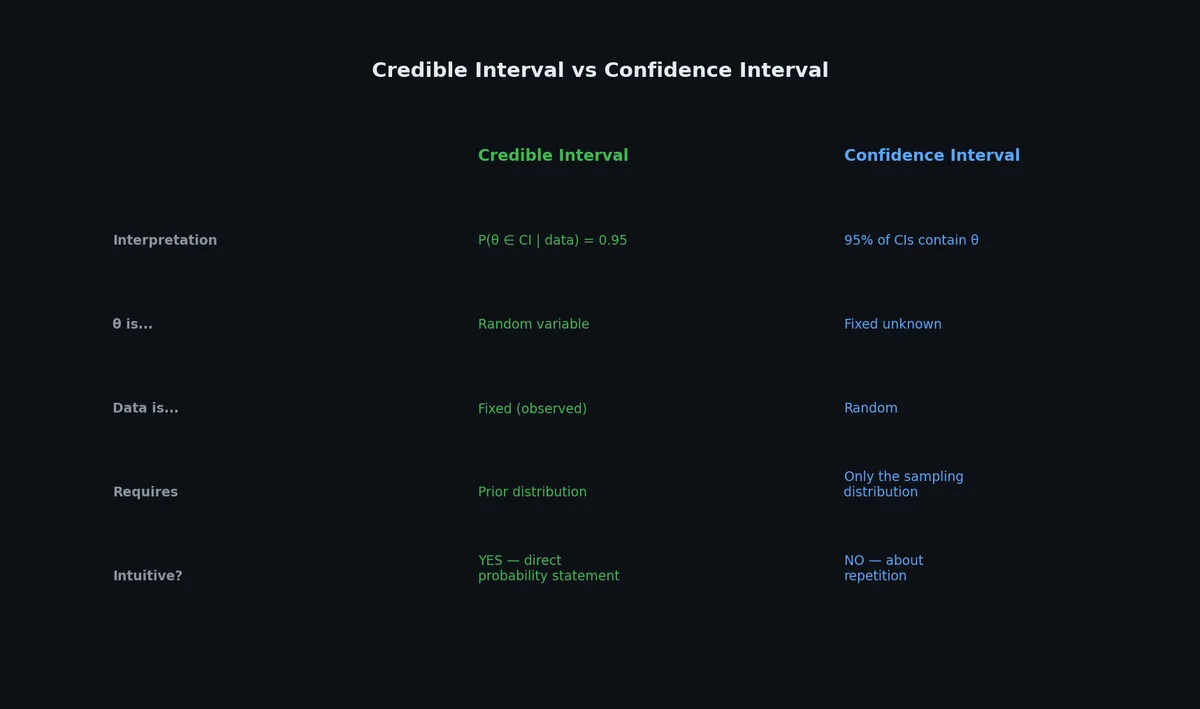
- 95% 置信区间的意思是:“如果我重复这个实验很多次,那么我计算出的区间中有 95% 会包含真实参数 $\theta$ 。”
贝叶斯观点#
- 参数 是具有概率分布的随机变量。
- 概率 用于量化主观不确定性(即信念的程度)。
- 推断 通过将先验分布与观测数据结合,得到后验分布。
- 95% 可信区间的意思是:“在给定数据的前提下,$\theta$ 落在该区间内的概率为 95%。”
对于具体问题,贝叶斯框架通常更直观:你从已有信念出发,观察数据,然后更新信念。而频率学派框架则更适合方法验证:它无需指定先验,就能保证在重复使用时控制错误率。
实践中,两者的结果常常一致——尤其是在大样本情况下,数据会压倒先验的影响。
分布形式的贝叶斯公式#
我们之前已经见过针对事件的贝叶斯定理。贝叶斯推断的核心正是将同样的逻辑应用到概率分布上。
后验正比于似然乘以先验。
这就是贝叶斯统计的基本方程,其余一切皆由此衍生。
各成分解读#
- 先验 $p(\theta)$ :你在看到数据之前对 $\theta$ 的信念。这里可以融入领域知识、以往实验结果,或者“合理的默认假设”。
- 似然 $p(\mathbf{x} | \theta)$ :在给定特定 $\theta$ 值的情况下,观测到当前数据的概率。这与极大似然估计(MLE)中使用的似然函数完全相同。
- 后验 $p(\theta | \mathbf{x})$ :你在看到数据之后更新的信念。这是一个完整的概率分布,而不是一个点估计。
共轭先验#
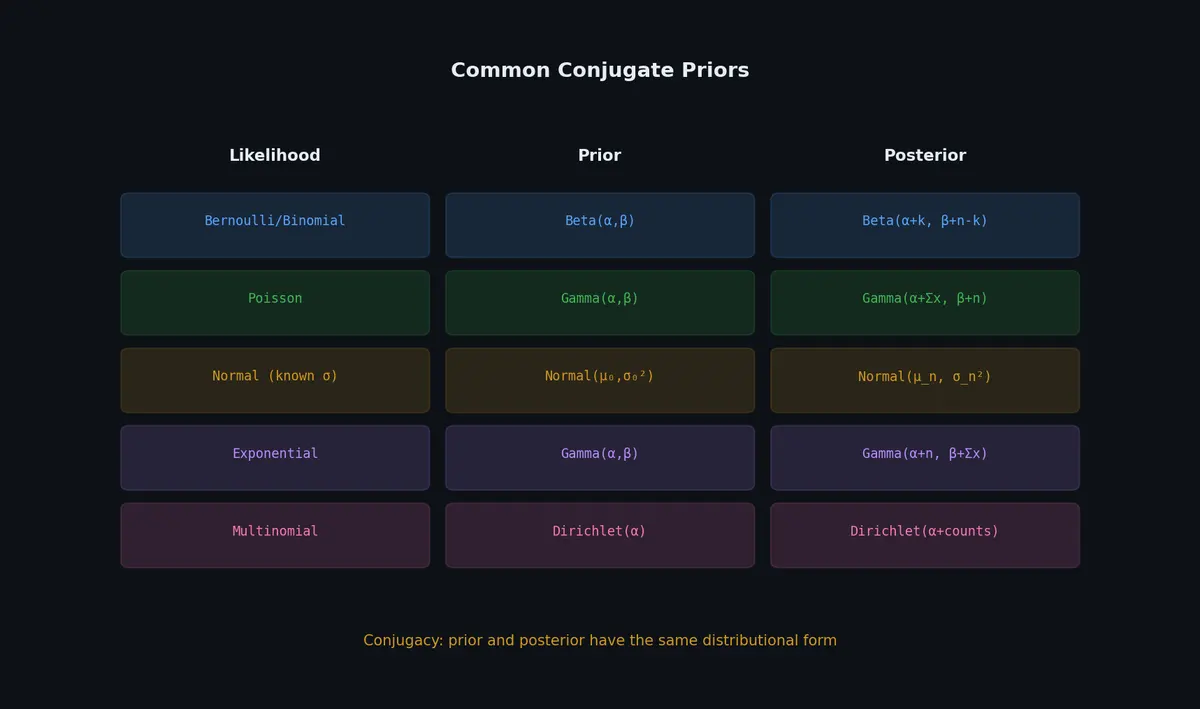
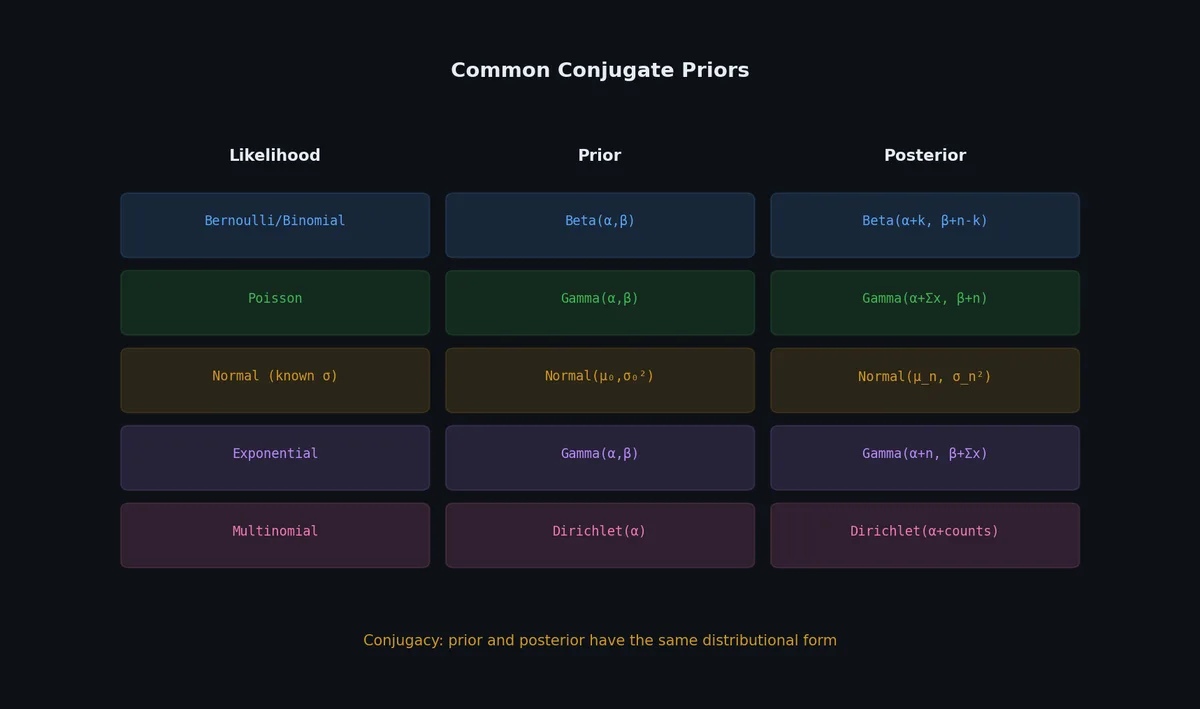
如果某个先验与似然结合后,所得的后验分布与先验属于同一分布族,那么这个先验就被称为该似然的 共轭先验。共轭性使得数学推导变得简单——后验拥有闭式解。
| 似然 | 共轭先验 | 后验 |
|---|---|---|
| 伯努利 / 二项 | Beta | Beta |
| 泊松 | Gamma | Gamma |
| 正态(已知 $\sigma^2$ ) | 正态 | 正态 |
| 正态(已知 $\mu$ ) | 逆伽马 | 逆伽马 |
| 多项 | Dirichlet | Dirichlet |
| 指数 | Gamma | Gamma |
如果没有共轭性,后验积分 $p(\mathbf{x}) = \int p(\mathbf{x}|\theta)p(\theta)d\theta$ 可能没有闭式解,这时就需要借助数值方法(如 MCMC、变分推断)。
Beta-二项模型#

这是贝叶斯推断的经典范例,我们将完整地推导一遍。
设定#

你正在抛一枚硬币,想估计正面朝上的概率 $\theta$ 。
- 似然: $X | \theta \sim \text{Binomial}(n, \theta)$ ,因此 $p(x | \theta) = \binom{n}{x} \theta^x (1-\theta)^{n-x}$ 。
- 先验: $\theta \sim \text{Beta}(\alpha, \beta)$ ,因此 $p(\theta) = \frac{\theta^{\alpha-1}(1-\theta)^{\beta-1}}{B(\alpha, \beta)}$ 。
推导后验#
$$p(\theta | x) \propto p(x | \theta) \cdot p(\theta) = \binom{n}{x} \theta^x (1-\theta)^{n-x} \cdot \frac{\theta^{\alpha-1}(1-\theta)^{\beta-1}}{B(\alpha, \beta)}$$ $$\propto \theta^{x + \alpha - 1} (1-\theta)^{n - x + \beta - 1}.$$ $$\boxed{\theta | x \sim \text{Beta}(\alpha + x, \beta + n - x)}$$解读#
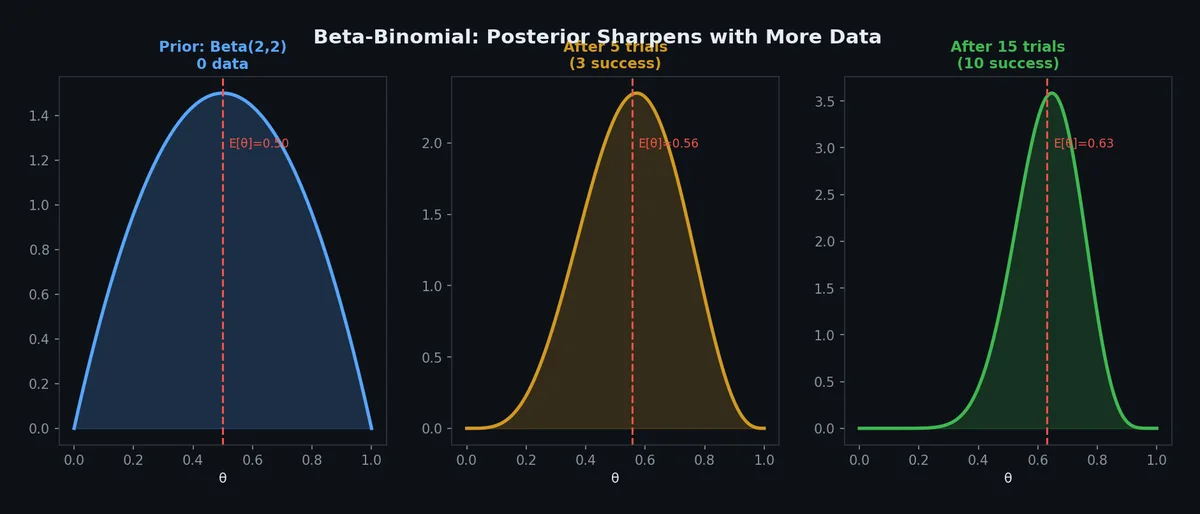
先验参数 $\alpha$ 和 $\beta$ 起到了“伪计数”的作用——仿佛你在实验前已经观察到了 $\alpha - 1$ 次正面和 $\beta - 1$ 次反面。而实际数据则增加了 $x$ 次正面和 $n - x$ 次反面。
$$E[\theta | x] = \frac{\alpha + x}{\alpha + \beta + n}.$$ $$E[\theta | x] = \frac{\alpha + \beta}{\alpha + \beta + n} \cdot \underbrace{\frac{\alpha}{\alpha + \beta}}_{\text{先验均值}} + \frac{n}{\alpha + \beta + n} \cdot \underbrace{\frac{x}{n}}_{\text{样本比例}}.$$当 $n \to \infty$ 时,先验的权重趋近于零,后验均值收敛到 MLE $x/n$ 。只要有足够多的数据,先验就变得无关紧要。
实例演算#
你怀疑一枚硬币可能有偏。你设定的先验是 $\theta \sim \text{Beta}(2, 2)$ (对称分布,略微倾向于公平)。你抛了 10 次,得到 7 次正面。
先验: $\text{Beta}(2, 2)$ ,均值 = 0.5。
后验: $\text{Beta}(2 + 7, 2 + 3) = \text{Beta}(9, 5)$ ,均值 = $9/14 \approx 0.643$ 。
MLE: $7/10 = 0.7$ 。
后验均值(0.643)相比 MLE(0.7)更靠近先验均值(0.5)。先验起到了正则化的作用,将估计值向中心拉近。随着数据量增加,这种收缩效应会逐渐减弱。
先验选择#
| 先验参数 | 解释 | 强度 |
|---|---|---|
| $\text{Beta}(1, 1)$ | 均匀分布——无任何偏好 | 弱(相当于 0 次伪观测) |
| $\text{Beta}(0.5, 0.5)$ | Jeffreys 先验——更关注极端值 | 无信息 |
| $\text{Beta}(2, 2)$ | 略微偏好公平性 | 弱 |
| $\text{Beta}(10, 10)$ | 强烈相信硬币是公平的 | 中等 |
| $\text{Beta}(100, 100)$ | 极其确信硬币是公平的 | 强 |
先验的强度由 $\alpha + \beta$ 控制。该值越大,代表“先验数据”越多,对新数据的更新就越不敏感。
正态-正态模型#
设定#
观测 $X_1, \ldots, X_n \sim \mathcal{N}(\mu, \sigma^2)$ ,其中 $\sigma^2$ 已知。先验为 $\mu \sim \mathcal{N}(\mu_0, \tau^2)$ 。
后验#
$$p(\mu | \mathbf{x}) \propto \exp\left(-\frac{1}{2\sigma^2}\sum(x_i - \mu)^2\right) \cdot \exp\left(-\frac{(\mu - \mu_0)^2}{2\tau^2}\right).$$ $$\mu | \mathbf{x} \sim \mathcal{N}\left(\mu_n, \sigma_n^2\right)$$ $$\mu_n = \frac{\frac{n}{\sigma^2}\bar{x} + \frac{1}{\tau^2}\mu_0}{\frac{n}{\sigma^2} + \frac{1}{\tau^2}}, \qquad \sigma_n^2 = \frac{1}{\frac{n}{\sigma^2} + \frac{1}{\tau^2}}.$$ $$-\frac{1}{2}\left[\frac{n(\mu - \bar{x})^2}{\sigma^2} + \frac{(\mu - \mu_0)^2}{\tau^2}\right]$$ $$= -\frac{1}{2}\left[\left(\frac{n}{\sigma^2} + \frac{1}{\tau^2}\right)\mu^2 - 2\left(\frac{n\bar{x}}{\sigma^2} + \frac{\mu_0}{\tau^2}\right)\mu + \text{const}\right].$$这是一个关于 $\mu$ 的二次函数,因此后验服从正态分布,其精度(方差的倒数)为 $\frac{n}{\sigma^2} + \frac{1}{\tau^2}$ ,均值即为上述的精度加权平均。$\blacksquare$
精度形式#
$$\text{后验精度} = n\lambda + \lambda_0 \qquad \text{(精度相加)}$$ $$\text{后验均值} = \frac{n\lambda \bar{x} + \lambda_0 \mu_0}{n\lambda + \lambda_0} \qquad \text{(精度加权平均)}$$由于精度具有可加性,它成为高斯分布下贝叶斯更新的自然参数化方式。
可信区间 vs 置信区间#
可信区间 是贝叶斯框架中对应于置信区间的概念。
$$P(\theta \in [a, b] | \mathbf{x}) = 1 - \alpha.$$最高后验密度(HPD)区间 是满足该条件的最短区间:它包含所有后验密度高于某一阈值的点。
关键差异#
| 置信区间 | 可信区间 | |
|---|---|---|
| 什么是随机的? | 区间(依赖于数据) | $\theta$ (参数是随机的) |
| 固定的是什么? | $\theta$ (未知常数) | 数据(已观测) |
| 解释 | 95% 的区间覆盖 $\theta$ | $\theta$ 落在区间内的后验概率为 95% |
| 所需前提 | 抽样分布 | 先验分布 |
对于先验弥散($\tau \to \infty$ )的正态-正态模型,95% 可信区间等于 95% 置信区间。但在先验信息较强或样本量较小时,两者会有所不同。
后验的点估计#
后验 $p(\theta | \mathbf{x})$ 是一个完整的分布。若需要一个单一数值,可以选择以下几种估计量:
| 估计量 | 定义 | 最优于 |
|---|---|---|
| 后验均值 | $E[\theta \mid\mathbf{x}]$ | 最小化 $E[(\hat\theta - \theta)^2 \mid\mathbf{x}]$ (平方误差) |
| 后验中位数 | $p(\theta \mid\mathbf{x})$ 的中位数 | 最小化 $E[\mid\hat\theta - \theta\mid\, \mid\mathbf{x}]$ (绝对误差) |
| MAP | $\arg\max_\theta p(\theta \mid\mathbf{x})$ | 后验众数(= 带惩罚的 MLE) |
对于对称且单峰的后验(如正态分布),这三种估计量重合。对于偏斜的后验,它们会有所不同,具体选择取决于你所采用的损失函数。
预测分布#
很多时候,我们并不关心参数 $\theta$ 本身,而是希望预测未来的观测值 $\tilde{X}$ 。
$$p(\tilde{x} | \mathbf{x}) = \int p(\tilde{x} | \theta) \, p(\theta | \mathbf{x}) \, d\theta.$$这考虑了 参数的不确定性:我们不是代入 $\theta$ 的某个点估计,而是对所有可能的 $\theta$ 值进行加权平均,权重即为后验概率。
Beta-二项预测#
$$P(\tilde{X} = 1 | x) = E[\theta | x] = \frac{\alpha + x}{\alpha + \beta + n}.$$ $$P(\text{下次成功}) = \frac{x + 1}{n + 2}.$$例如,如果你在 10 次抛掷中看到 7 次正面,那么下一次抛出正面的预测概率是 $8/12 = 2/3$ ,而不是 MLE 给出的 $7/10$ 。
正态预测#
$$\tilde{X} | \mathbf{x} \sim \mathcal{N}(\mu_n, \sigma^2 + \sigma_n^2).$$预测方差 $\sigma^2 + \sigma_n^2$ 大于 单纯的抽样方差 $\sigma^2$ ,因为它额外包含了对 $\mu$ 的不确定性。如果直接用点估计 $\hat\mu$ 代替真实 $\mu$ 进行预测(即“插值预测”),就会低估整体的不确定性。
MCMC:当共轭性不足时#
大多数现实中的模型并没有共轭先验。此时,后验 $p(\theta | \mathbf{x})$ 仅能以未归一化的形式给出:我们可以对任意 $\theta$ 计算 $p(\mathbf{x} | \theta) p(\theta)$ ,但计算归一化常数 $p(\mathbf{x}) = \int p(\mathbf{x}|\theta)p(\theta)d\theta$ 是不可行的。
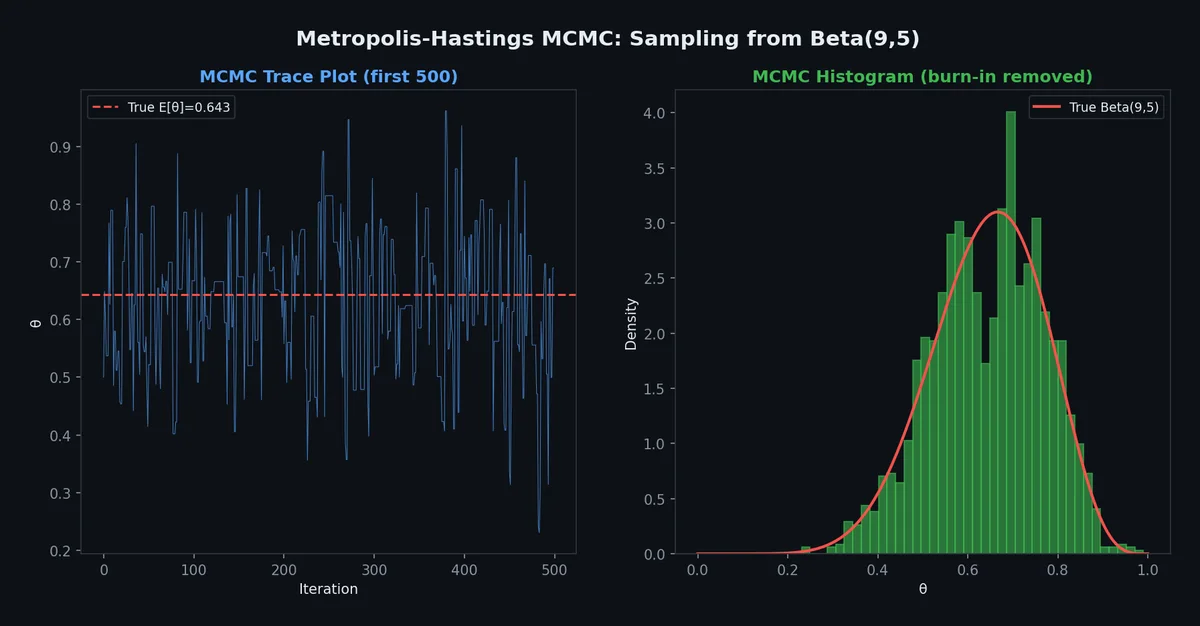
马尔可夫链蒙特卡洛(MCMC) 方法可以在不计算归一化常数的情况下,生成来自后验分布的样本 $\theta^{(1)}, \theta^{(2)}, \ldots$ 。
Metropolis-Hastings:核心思想#
从某个初始值 $\theta^{(0)}$ 开始。
提议:从提议分布 $q(\theta^* | \theta^{(t)})$ 中生成一个新值 $\theta^*$ 。
- $$\alpha = \min\left(1, \frac{p(\theta^* | \mathbf{x}) \, q(\theta^{(t)} | \theta^*)}{p(\theta^{(t)} | \mathbf{x}) \, q(\theta^* | \theta^{(t)})}\right) = \min\left(1, \frac{p(\mathbf{x} | \theta^*) p(\theta^*) \, q(\theta^{(t)} | \theta^*)}{p(\mathbf{x} | \theta^{(t)}) p(\theta^{(t)}) \, q(\theta^* | \theta^{(t)})}\right)$$
接受该提议。
如果接受,则 $\theta^{(t+1)} = \theta^*$ ;否则,$\theta^{(t+1)} = \theta^{(t)}$ 。
归一化常数 $p(\mathbf{x})$ 在比值中被约去。由此生成的马尔可夫链以 $p(\theta | \mathbf{x})$ 为平稳分布,因此经过预烧期(burn-in)后,样本就近似来自后验分布。
如果提议分布 对称(即 $q(\theta^*|\theta) = q(\theta|\theta^*)$ ),那么接受概率简化为 $p(\theta^* | \mathbf{x}) / p(\theta^{(t)} | \mathbf{x})$ —— 算法会倾向于向后验密度更高的区域移动,同时偶尔接受“下坡”移动以充分探索整个参数空间。
贝叶斯与机器学习的联系#

正则化即先验#
我们在第 6 篇文章中提到,带高斯先验的 MAP 估计等价于 L2 正则化。现在我们来明确这一点。
$$\hat{w}_{\text{MAP}} = \arg\max_w \left[\sum_{i=1}^n \ln p(y_i | x_i, w) - \frac{\|w\|^2}{2\tau^2}\right]$$ $$= \arg\min_w \left[-\sum_{i=1}^n \ln p(y_i | x_i, w) + \frac{1}{2\tau^2}\|w\|^2\right].$$这正是带有 L2 正则化(权重衰减)的损失函数,其中正则化系数 $\lambda = 1/\tau^2$ 。
模糊先验($\tau \to \infty$ )对应无正则化(即 MLE)。强先验($\tau$ 较小)则对应强正则化,将权重拉向零。
Dropout 作为近似贝叶斯推断#
Gal 和 Ghahramani(2016)证明,使用 dropout 进行训练等价于在深度高斯过程中进行近似贝叶斯推断。在测试时,通过多次启用 dropout 的前向传播所得到的预测分布,近似于后验预测分布。
贝叶斯神经网络#
$$p(y^* | x^*, \mathbf{x}, \mathbf{y}) = \int p(y^* | x^*, w) \, p(w | \mathbf{x}, \mathbf{y}) \, dw.$$这是不确定性量化的黄金标准,但对于大型网络来说,该积分难以计算。实际应用中通常采用变分推断或 MCMC 近似。
贝叶斯与频率学派何时一致?#
在大样本且模型设定正确的情况下:
- 后验会集中在真实参数 $\theta$ 附近(Bernstein-von Mises 定理)。
- 后验均值趋近于 MLE。
- 可信区间与置信区间趋于一致。
- 先验的影响变得可以忽略。
两者的分歧主要出现在以下情况:
- 样本量较小,先验对结果有显著影响;
- 参数维度远高于数据量;
- 问题的关注点不同:贝叶斯回答的是“基于当前数据,我现在应该相信什么?”,而频率学派关注的是“这个推断程序在长期重复使用中表现如何?”
Python:贝叶斯更新可视化#
| |
| |
MCMC 生成的直方图与精确的 Beta 后验高度吻合,验证了采样器的有效性。迹线图展示了马尔可夫链在参数空间中的探索过程,而自相关图则揭示了连续样本之间何时趋于独立(自相关越短,采样效率越高)。
系列回顾#
历经八篇文章,我们从零开始构建了概率与统计的完整体系:
- 公理体系 为我们提供了严谨的不确定性度量基础。
- 随机变量 将抽象结果转化为可计算的数值。
- 期望与矩 将复杂的分布压缩为简洁的摘要统计量。
- 联合分布 处理多个变量及其相互依赖关系。
- 极限定理 解释了为何样本均值有效,以及高斯分布为何如此普遍。
- 估计理论 展示了如何从数据中最优地提取参数。
- 假设检验 提供了在不确定性下做出决策的工具。
- 贝叶斯推断 提供了一个用数据持续更新信念的连贯框架。
每一篇文章都建立在前文的基础之上,共同构成了现代数据科学与机器学习的数学主干。文中涵盖的分布、定理与技术绝非历史遗迹——它们是每一位构建数据驱动系统者的日常工具。
前方的道路通向诸多方向:多元分析、时间序列、因果推断、信息论、统计学习理论。但本系列所奠定的基础,足以让你自信地深入研读上述任何一个领域。
总结#
| 概念 | 公式 | 作用 |
|---|---|---|
| 贝叶斯公式 | $p(\theta\mid\mathbf{x}) \propto p(\mathbf{x}\mid\theta)p(\theta)$ | 基本更新规则 |
| 共轭先验 | 先验与后验同属一族 | 后验具闭式解 |
| Beta-二项 | $\text{Beta}(\alpha+x, \beta+n-x)$ | 比例估计 |
| 正态-正态 | 精度加权平均 | 均值估计 |
| 后验均值 | $E[\theta\mid\mathbf{x}]$ | 平方损失下最优 |
| MAP | $\arg\max p(\theta\mid\mathbf{x})$ | = MLE + 正则化 |
| 可信区间 | $P(\theta \in [a,b]\mid\mathbf{x}) = 0.95$ | 直接概率陈述 |
| 预测分布 | $p(\tilde{x}\mid\mathbf{x}) = \int p(\tilde{x}\mid\theta)p(\theta\mid\mathbf{x})d\theta$ | 带不确定性的预测 |
| MCMC | 从后验采样 | 无闭式解时的替代方案 |


